
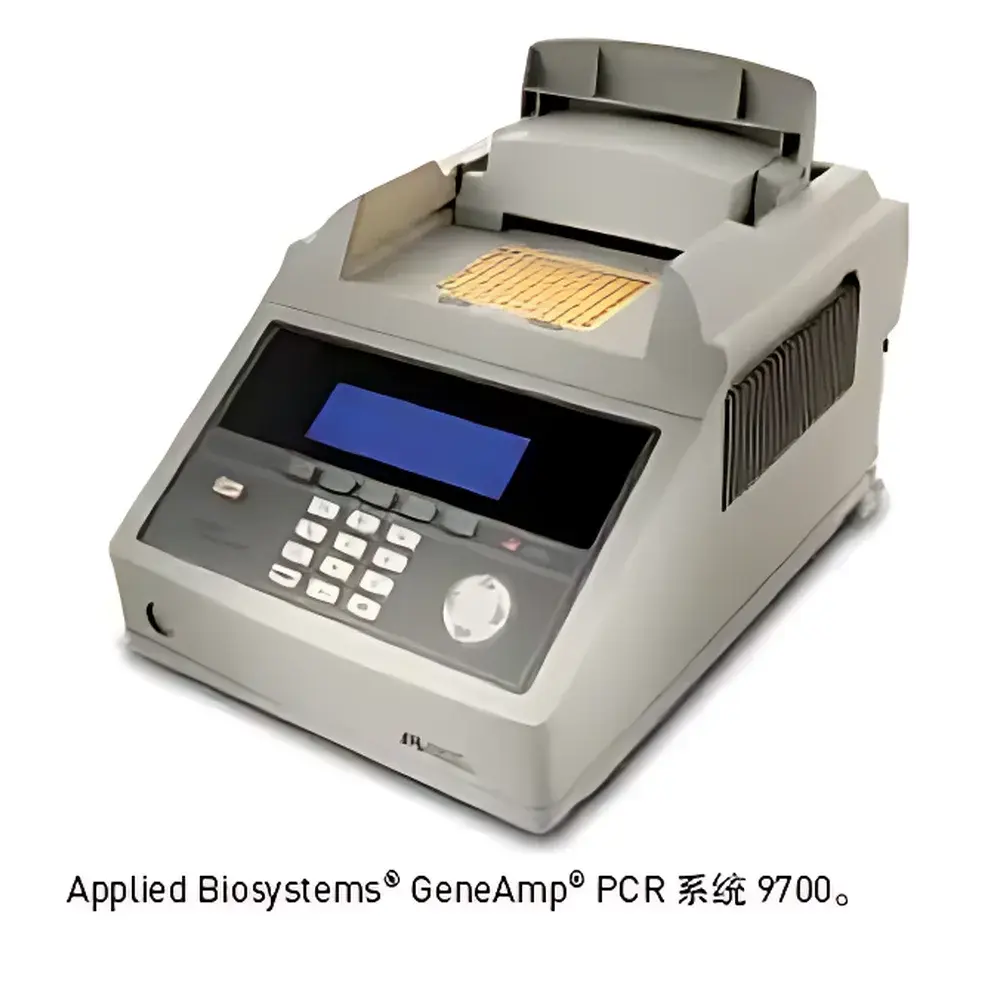
Applied Biosystems GeneAmp 9700 Series Thermal Cycler
| Brand | Thermo Fisher Scientific |
|---|---|
| Origin | Singapore |
| Model | 9700 Series |
| Instrument Type | Standard Thermal Cycler |
| Sample Capacity | 96-well, 60-well, Dual 96-well, Dual 384-well |
| Ramp Rate | 5 °C/s |
| Temperature Accuracy | ±0.25 °C |
| Well-to-Well Uniformity | ±0.5 °C (30 sec after reaching 95 °C) |
Overview
The Applied Biosystems GeneAmp® 9700 Series Thermal Cycler is a benchtop PCR instrument engineered for precision thermal cycling across diverse molecular biology workflows. Based on Peltier-based solid-state thermoelectric heating and cooling, the system delivers rapid, reproducible temperature transitions essential for robust DNA amplification, genotyping, cloning, and sequencing library preparation. Its modular architecture separates the base unit from interchangeable sample blocks—enabling seamless adaptation to varying throughput requirements without compromising thermal fidelity. Designed during the transition era from manual gradient optimization to standardized high-fidelity cycling, the 9700 series remains widely deployed in academic core facilities, clinical research labs, and quality-controlled diagnostic environments where protocol stability, long-term reliability, and regulatory traceability are foundational.
Key Features
- Modular block design supporting interchangeable sample formats: 60-well (0.5 mL), standard 96-well (0.2 mL), dual 96-well, and dual 384-well aluminum or gold-plated silver blocks
- Thermal ramp rate of 5 °C/s—optimized for fast cycling protocols while maintaining nucleic acid integrity
- Temperature accuracy of ±0.25 °C across the full operating range (4–99.9 °C), verified per internal calibration routines
- Well-to-well uniformity of ±0.5 °C at 95 °C (measured 30 seconds post-equilibration), ensuring consistent denaturation efficiency across all wells
- Intuitive graphical user interface with real-time temperature profile visualization and step-by-step protocol editing
- Automated heated lid system (optional for dual 384-well configuration) featuring motorized lift mechanism and pressure-sensing closure detection
- Robust mechanical architecture with vibration-damped base and precision-machined block interfaces to minimize thermal drift during extended runs
Sample Compatibility & Compliance
The GeneAmp 9700 Series accommodates industry-standard consumables including 0.2 mL thin-wall PCR tubes, 96-well polypropylene plates (full-skirted, semi-skirted, and unskirted), and 384-well low-profile plates. All heating modules comply with ISO 13485 manufacturing controls (as implemented by Thermo Fisher’s Singapore facility) and support GLP/GMP-aligned documentation practices. While the instrument itself does not include built-in audit trail functionality, its firmware versioning, user-accessible calibration logs, and parameter-lock features enable integration into FDA 21 CFR Part 11–compliant environments when paired with validated LIMS or electronic lab notebook (ELN) systems. The system meets IEC 61010-1 safety standards for laboratory electrical equipment and carries CE marking for use in European Union member states.
Software & Data Management
Controlled via the native GeneAmp 9700 software (Windows-compatible, legacy version 3.x), the instrument supports protocol creation, storage, and recall with up to 100 user-defined methods. Each method includes cycle count, temperature steps, hold times, ramp rates, and lid temperature settings—all editable with password-protected access levels. Data export is available in CSV format for downstream analysis; raw thermal profiles can be archived with timestamps and operator ID fields. Though lacking cloud connectivity or API endpoints, the system’s RS-232 and USB ports allow secure local transfer to networked workstations. For laboratories requiring electronic record retention, the software supports manual annotation of run notes and integration with third-party validation packages compliant with ASTM E2500 and USP analytical instrument qualification guidelines.
Applications
- Routine endpoint PCR for gene expression screening, pathogen detection, and transgenic verification
- High-throughput genotyping assays using TaqMan® probes or allele-specific primers
- Pre-sequencing amplification for Sanger and NGS library construction (including multiplex PCR)
- cDNA synthesis and RT-PCR workflows requiring precise annealing control
- Validation studies requiring thermal consistency across multi-site or longitudinal experiments
- Educational training platforms where mechanical simplicity and visual feedback enhance user comprehension of thermal cycling dynamics
FAQ
Is the GeneAmp 9700 Series compatible with modern qPCR reagents and master mixes?
Yes—the thermal performance specifications meet or exceed manufacturer requirements for most conventional DNA polymerases and probe-based chemistries. However, it lacks optical detection capability and must be used in conjunction with post-PCR analysis platforms (e.g., gel electrophoresis, capillary electrophoresis, or real-time instruments).
Can the dual 384-well configuration be operated with only one block installed?
Yes—each 384-well module operates independently; users may install a single block for lower-throughput applications without hardware modification.
What maintenance is required to sustain temperature accuracy over time?
Annual recalibration using NIST-traceable reference sensors is recommended. Routine cleaning of block surfaces with ethanol and inspection of lid gasket integrity are part of standard operational checks defined in the instrument’s IQ/OQ documentation package.
Does the system support gradient PCR functionality?
No—the 9700 Series does not incorporate thermal gradient capability. For gradient applications, users should consider the Applied Biosystems ProFlex™ or Veriti™ series instruments.




