
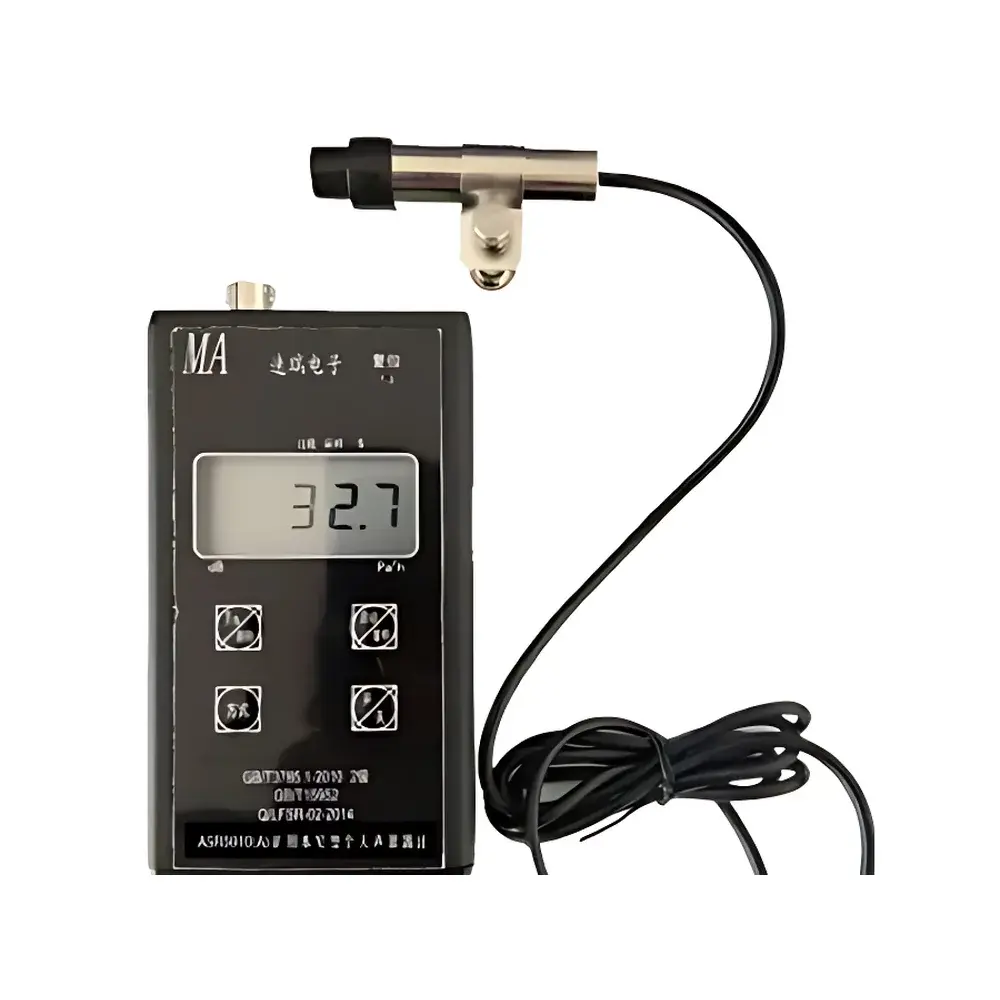
ASR5910(A) Intrinsically Safe Mine-Use Sound Exposure Meter
| Frequency Range | 20 Hz–8 kHz |
|---|---|
| Measurement Range | 30 dB–130 dB(A) |
| Exposure Range | 0–19.99 Pa²·h |
| Time Weighting | Fast (F), Slow (S) |
| Frequency Weighting | A-weighting |
| Measurement Durations | 10 s, 1 min, 5 min, 10 min, 15 min, 30 min, 1 h, 4 h, 8 h, 24 h |
| Microphone | Φ12.7 mm electret condenser sensor |
| Operating Voltage | 2.2–3.3 V DC |
| Battery | 2 × AAA, >24 h operation |
| Operating Temperature | −10 °C to +50 °C |
| Relative Humidity | 20–90 % RH |
| IP Rating | IP54 |
| Intrinsic Safety Certification | Exib I Mb |
| Dimensions | 116 × 61 × 25 mm |
| Weight | 160 g |
Overview
The ASR5910(A) Intrinsically Safe Mine-Use Sound Exposure Meter is a certified Class I, Division 1 (Exib I Mb) instrument engineered for occupational noise monitoring in hazardous underground coal mine environments where flammable methane-air mixtures may be present. It operates on the principle of precision acoustic pressure transduction using a calibrated Φ12.7 mm electret condenser microphone, coupled with real-time digital signal processing compliant with IEC 61672-1:2013 Class 2 requirements for sound level meters. The device measures time-integrated sound exposure levels (SEL), equivalent continuous sound pressure levels (Leq), maximum sound pressure levels (Lmax), and instantaneous sound pressure (Lp) — all referenced to 20 µPa and weighted per ANSI S1.4 and IEC 61672 A-frequency weighting. Its 20 Hz–8 kHz frequency response ensures accurate assessment of low-frequency noise components prevalent in mining machinery (e.g., conveyors, ventilation fans, roof bolters), while its 30 dB–130 dB(A) dynamic range covers typical occupational exposure scenarios from ambient drift noise to high-intensity impact events.
Key Features
- Intrinsically safe design certified to Exib I Mb per GB 3836.4–2021 and EN 60079-11:2012, enabling deployment in Zone 0/1 methane-prone areas without risk of ignition.
- IP54-rated enclosure provides protection against dust ingress and water splashing, ensuring reliable operation in high-humidity, particulate-laden mine tunnels.
- Dual time-weighting modes (Fast and Slow) support both transient event capture and steady-state noise evaluation in accordance with ISO 9612:2009 workplace measurement protocols.
- Configurable measurement durations—from 10 seconds to 24 hours—enable compliance with national occupational exposure limits (e.g., China’s GBZ 2.2–2014, EU Directive 2003/10/EC) requiring 8-hour TWA or full-shift integration.
- Four-digit LCD display simultaneously presents Lp, Leq, Lmax, LAE (sound exposure level), E (sound exposure in Pa²·h), and Tm (measurement duration), eliminating need for external logging during field surveys.
- Low-power architecture: ≤25 mA operating current; >24 h continuous runtime on two AAA alkaline cells; automatic “lobat” warning at end-of-life battery voltage (≤2.2 V).
Sample Compatibility & Compliance
The ASR5910(A) is validated for use with human operators wearing standard PPE (including hard hats and hearing protection), and requires no external calibration adapters or couplers during routine deployment. It complies with mandatory Chinese regulatory frameworks for coal mine safety instrumentation, including the Coal Mine Safety Regulations (2022 Edition), AQ 1013–2005 (Technical Requirements for Mine Noise Monitoring Instruments), and the National Safety Mark (MA) certification system administered by the National Mine Safety Administration (NMSA). All units ship with traceable factory calibration certificates aligned to JJG 188–2017 (Verification Regulation for Sound Level Meters) and include documentation supporting GLP-aligned recordkeeping for internal audit and regulatory inspection.
Software & Data Management
While the ASR5910(A) is a standalone, non-data-logging instrument, its real-time parameter output supports manual transcription into enterprise-wide occupational health databases (e.g., SAP EHS, Intelex, or custom Excel-based exposure tracking systems). Each unit includes a unique serial number and MA-certified calibration history, enabling full traceability across shifts and maintenance cycles. For facilities requiring automated reporting, the meter’s stable analog output interface (3 Vp-p max) permits integration with third-party data acquisition modules compliant with IEC 61000-4-5 surge immunity and intrinsic safety barriers (e.g., Pepperl+Fuchs KFD2-STC4-EX1). All firmware revisions adhere to IEC 62443-3-3 cybersecurity principles for industrial devices, though no network connectivity is embedded.
Applications
- Compliance-driven 8-hour time-weighted average (TWA) noise assessments for miners operating continuous miners, longwall shearers, and belt conveyors.
- Short-duration exposure profiling near high-noise sources such as rock drills, hydraulic pumps, and diesel locomotives.
- Baseline noise mapping during mine development phases to inform engineering controls (e.g., acoustic enclosures, muffler retrofits).
- Verification of hearing conservation program effectiveness through periodic re-measurement at fixed monitoring points.
- Supporting incident investigations where noise-induced stress or communication interference may contribute to safety events.
FAQ
What does “Exib I Mb” signify for underground use?
Exib I Mb denotes intrinsic safety protection level “ib” for Mining Equipment Category “Mb”, certifying that the device cannot ignite methane-air mixtures under normal operation and single-fault conditions — meeting the highest safety tier for mobile equipment in gassy coal mines per GB 3836.4–2021.
Is periodic recalibration required?
Yes. Per JJG 188–2017, annual verification against an accredited acoustic calibrator (e.g., 1 kHz, 94 dB or 114 dB reference tone) is mandatory. Field checks using the built-in acoustic coupler or portable pistonphone are recommended before each shift.
Can the ASR5910(A) measure C-weighted or Z-weighted spectra?
No. It implements only A-frequency weighting, as mandated by occupational noise standards for hearing damage risk assessment in mining contexts.
What is the stabilization time after environmental change?
Per specification, ≥12 hours is required to reach thermal and electrical equilibrium in reference conditions (23 °C, 50 % RH); ≥19 hours under extreme operational conditions (−10 °C or 50 °C), due to piezoelectric element settling and amplifier drift compensation.
Does it meet international mining standards beyond China?
While certified to Chinese MA and GB standards, its Exib I Mb rating aligns technically with IEC 60079-0 and IEC 60079-11, facilitating acceptance in ASEAN and African coal operations adopting harmonized IEC-based explosion protection frameworks.
Related Products







