
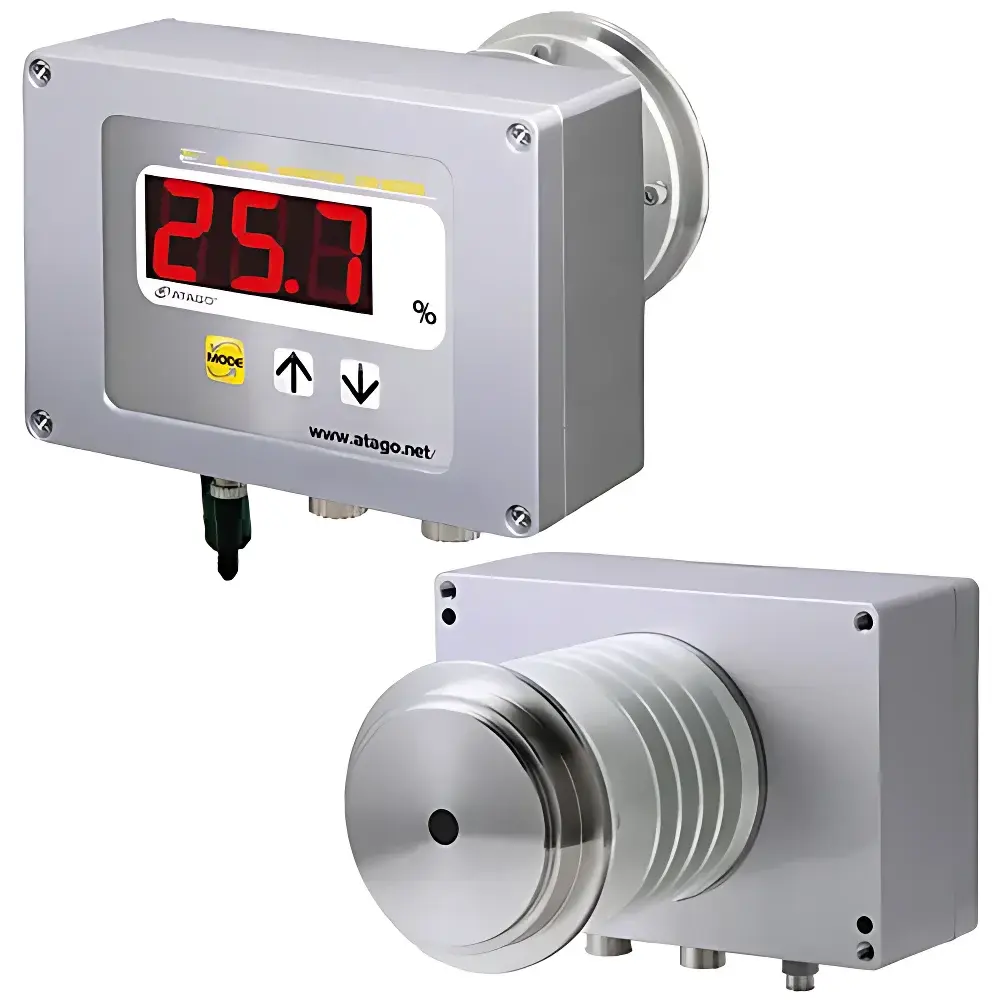
ATAGO CM-800α-Plato Online Refractometer for Wort Concentration Monitoring
| Brand | ATAGO |
|---|---|
| Origin | Japan |
| Model | CM-800α-Plato |
| Product Type | Online Refractometer |
| Temperature Control | Yes |
| Digital Display | Yes |
| Measurement Range | 0.0–30.0 °P |
| Measurement Accuracy | ±0.2 °P |
Overview
The ATAGO CM-800α-Plato is a high-precision, industrial-grade online refractometer engineered for continuous, real-time monitoring of wort concentration (expressed in degrees Plato, °P) during beer brewing and malt-based beverage production. Based on the principle of critical-angle refractometry using a stable LED light source approximating the sodium D-line (589.3 nm), the instrument measures the refractive index of flowing wort and converts it to °P via built-in calibration curves compliant with ISO 21527-1 and ASBC Methods of Analysis. Its robust optical architecture—featuring an artificial sapphire prism and SUS316L sample chamber—ensures long-term stability in harsh, wet-process environments typical of brewhouses and CIP/SIP systems. Designed for direct in-line installation in stainless-steel process lines (e.g., post-mash tun, pre-boil kettle, or fermentation feed lines), the CM-800α-Plato delivers measurement updates every ~1 second (configurable up to 5 intervals), enabling closed-loop control of sugar extraction efficiency, dilution ratios, and batch consistency.
Key Features
- Real-time, non-invasive wort concentration monitoring with 0.1 °P resolution and ±0.2 °P accuracy at 20 °C
- Integrated automatic temperature compensation (ATC) across 10–75 °C, eliminating manual correction and ensuring traceable measurements per ASTM D1218 and ISO 21527-2
- IP67-rated housing with sapphire prism and 316L stainless steel flow cell—resistant to caustic cleaning agents (NaOH), sanitizers (peracetic acid), and thermal cycling
- Dual-output capability: isolated 4–20 mA analog signal for PLC/DCS integration + RS-232C digital interface supporting ASCII protocol for refractive index (nD) or °P data export
- Configurable measurement interval (1, 2, 5, 10, or 30 seconds) and output synchronization via front-panel keypad or PC software
- Wide operating temperature range: -15 to 160 °C for process fluid; ambient environment: 5–40 °C
- Compact footprint (160 × 167 × 110 mm) and low mass (2.4 kg) facilitate retrofitting into existing piping layouts without structural reinforcement
Sample Compatibility & Compliance
The CM-800α-Plato is validated for use with turbid, particulate-laden wort streams containing suspended proteins, hop residues, and fine grain husk fragments—common in lautering and whirlpool stages. Its sapphire prism surface resists scratching and biofilm adhesion, maintaining optical integrity over extended runtimes (>12 months between recalibration). The device complies with IEC 61000-6-2 (EMC immunity) and IEC 61000-6-4 (EMC emissions), and meets food-contact material requirements under FDA 21 CFR §177.2420 and EU Regulation (EC) No. 1935/2004. While not intrinsically safe, it is suitable for Zone 2/Class I, Division 2 hazardous locations when installed with appropriate barrier systems. Calibration traceability aligns with NIST-traceable sucrose standards (SRM 84d), supporting GLP/GMP documentation workflows.
Software & Data Management
Data acquisition and configuration are managed via ATAGO’s proprietary PC utility (Windows-compatible), enabling firmware updates, zero-point verification, span calibration logging, and alarm threshold setup (e.g., deviation >±0.5 °P triggers relay output). All calibration events, measurement timestamps, and environmental parameters (process temp, ambient temp) are stored with audit-trail capability—fully compatible with 21 CFR Part 11-compliant electronic record systems when deployed with validated timestamping servers. Output data formats include CSV export for LIMS integration and Modbus RTU mapping (via optional converter) for SCADA interoperability.
Applications
- Monitoring extract yield during lautering and wort separation to optimize mash efficiency
- Controlling water addition/dilution pre-boil to achieve target original gravity (OG)
- Verifying consistency of wort transfer to fermenters—critical for ABV prediction and yeast pitching calculations
- Supporting HACCP Critical Control Point (CCP) documentation for wort gravity as a process parameter
- Enabling predictive maintenance by trending refractive index drift correlated with fouling or prism degradation
- Validating cleaning-in-place (CIP) endpoint via refractometric detection of residual sugars
FAQ
What does °P (degrees Plato) represent in brewing science?
Degrees Plato expresses the mass percentage of dissolved extract (primarily maltose, glucose, dextrins) in wort—equivalent to g solute per 100 g solution. It is directly convertible to specific gravity (SG) and original gravity (OG) using the Balling formula or ASBC Table 1.
Is the CM-800α-Plato suitable for high-gravity worts above 20 °P?
Yes—the 0.0–30.0 °P range covers standard lager (10–12 °P), strong ales (16–22 °P), and experimental high-gravity brews, with maintained linearity and repeatability per ISO 5725-2.
How often does the instrument require calibration verification?
ATAGO recommends daily zero-point check with deionized water and weekly span verification using certified sucrose standard (e.g., 10.00 ±0.02 °P), documented per internal SOP or brewery QA protocols.
Can the device be installed in vertical or horizontal pipe orientations?
It supports both orientations; however, horizontal mounting with upward-facing prism is preferred to minimize air bubble entrapment and ensure laminar flow across the sensing surface.
Does the unit support integration with Siemens S7 or Rockwell Allen-Bradley PLCs?
Yes—via 4–20 mA loop or RS-232C (with protocol translation gateway); ATAGO provides wiring schematics and register maps for seamless DCS/PLC communication setup.





