
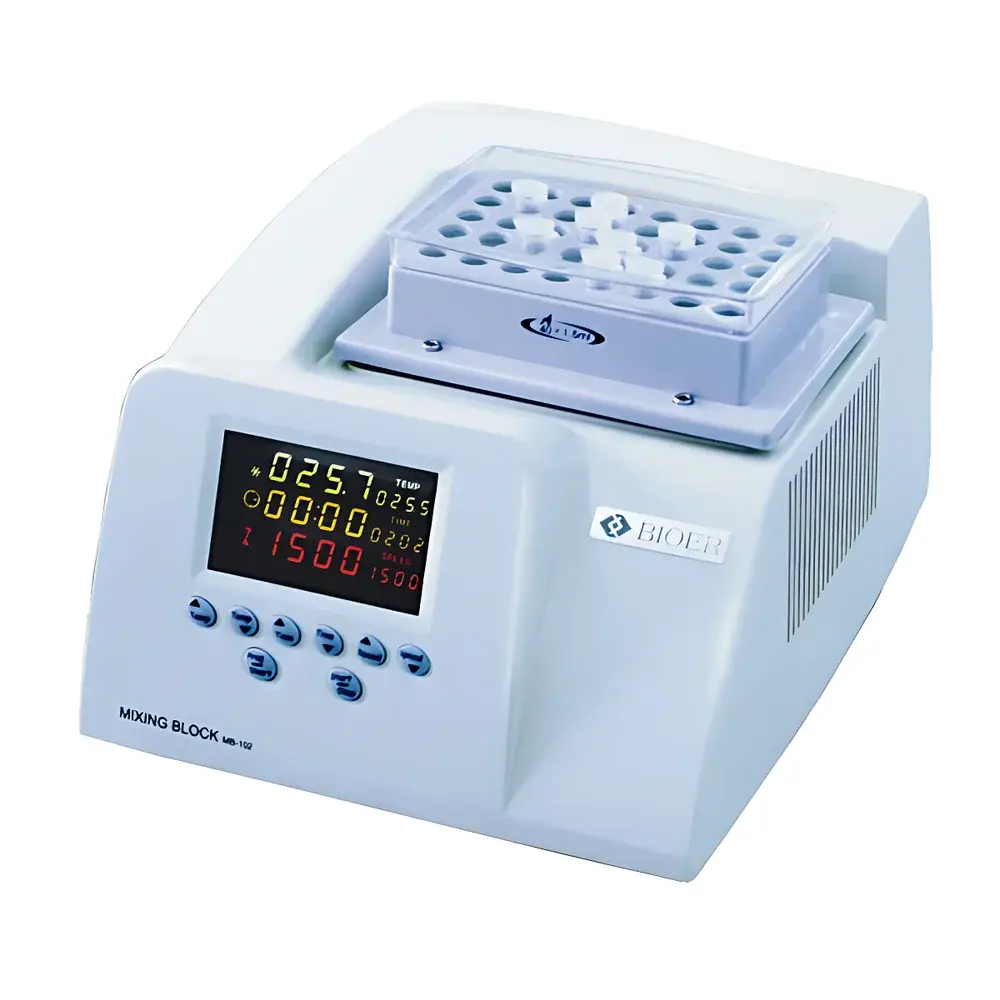
BIOER MB-102 ThermoCell Mixing Block Oscillating Metal Bath
| Brand | BIOER |
|---|---|
| Model | MB-102 |
| Temperature Range | 0°C to 100°C (with cooling down to 14°C below ambient, min. setpoint 0°C) |
| Temperature Accuracy | ≤ ±0.5°C |
| Heating Time | ≤12 min (20°C → 100°C) |
| Oscillation Speed | 300–1500 rpm |
| Oscillation Amplitude | 3 mm |
| Timer Range | 1 s – 99 h 59 min |
| Dimensions (L×W×H) | 328 × 166 × 249 mm |
| Net Weight | 8.5 kg |
| Power Supply | AC 220 ± 22 V, 50 ± 1 Hz, 150 W |
| Standard Blocks | A (40 × 1.5 mL), B (54 × 0.5 mL), C (96 × 0.2 mL), D (24 × φ15 mm), H (40 × 2.0 mL), G (26 × 0.5 mL + 24 × 1.5 mL), J (96-well microplate) |
| Display | Full-color VFD screen |
| Control System | 32-bit microcontroller with PID temperature regulation |
| Cooling Method | Thermoelectric (Peltier) |
| Motor Type | Brushless DC motor |
| Calibration Function | Built-in temperature calibration |
| Momentary Oscillation Mode | Yes |
Overview
The BIOER MB-102 ThermoCell Mixing Block Oscillating Metal Bath is an integrated thermal and mechanical incubation platform engineered for precise temperature control and reproducible orbital mixing in molecular biology, biochemistry, and clinical laboratory workflows. Unlike conventional water baths or dry-block heaters, the MB-102 employs a thermoelectric (Peltier) cooling/heating system combined with a brushless DC motor-driven oscillation mechanism—enabling simultaneous temperature stabilization and uniform sample agitation across a wide operational range (0°C to 100°C). Its ability to cool up to 14°C below ambient—without requiring external chillers or refrigerants—makes it uniquely suited for low-temperature enzymatic reactions, cold-sensitive protein handling, and time-critical pre-PCR setup steps. The instrument’s 32-bit microcontroller architecture implements adaptive PID algorithms for dynamic thermal load compensation, ensuring ≤ ±0.5°C temperature accuracy across all operating conditions. Designed for benchtop integration in ISO 17025-accredited labs and GLP-compliant environments, the MB-102 supports traceable temperature validation and meets fundamental requirements for thermal uniformity per ASTM E2251-21 (Standard Practice for Calibration of Thermal Chambers).
Key Features
- Thermoelectric (Peltier) temperature control enabling both heating and active cooling—no compressors, no condensation, no maintenance-intensive refrigerants.
- Brushless DC motor delivering stable, low-vibration oscillation from 300 to 1500 rpm with fixed 3 mm amplitude—optimized for consistent suspension of viscous or particulate-laden samples without splashing or cross-contamination.
- Full-color VFD display with intuitive menu navigation; supports simultaneous real-time monitoring of setpoint temperature, actual block temperature, speed, remaining time, and status indicators.
- Seven standardized interchangeable blocks—including configurations for 0.2 mL PCR tubes, 96-well microplates, 15 mm test tubes, and hybrid formats—designed for rapid tool-free insertion and secure thermal coupling.
- Built-in temperature calibration function accessible via service mode, allowing users to perform on-site offset correction against NIST-traceable reference probes (e.g., Fluke 1523 or equivalent).
- Momentary oscillation (“pulse mix”) mode for quick manual homogenization without altering ongoing temperature or timer settings—ideal for brief vortexing prior to centrifugation or pipetting.
- Robust aluminum alloy heating block with high thermal conductivity and low thermal inertia—ensuring rapid response and minimal gradient deviation (< ±0.8°C across full block surface at 37°C).
Sample Compatibility & Compliance
The MB-102 accommodates standard laboratory consumables including polypropylene and glass tubes (0.2–2.0 mL), conical-bottom microcentrifuge tubes, skirted and unskirted 96-well PCR plates, and round-bottom assay plates. All standard blocks are CNC-machined to ISO 8573-1 tolerances and undergo surface passivation to prevent metal ion leaching—critical for sensitive applications such as qPCR master mix preparation or ligase-mediated cloning. The device complies with IEC 61010-1:2010 for electrical safety in laboratory equipment and meets EMC requirements per CISPR 11 Class B. While not inherently 21 CFR Part 11 compliant, its deterministic timer logic, non-volatile parameter storage, and absence of network connectivity make it suitable for use in FDA-regulated environments when deployed with documented SOPs and periodic verification per USP Analytical Instrument Qualification.
Software & Data Management
The MB-102 operates as a standalone instrument with no embedded software stack or firmware-upgradable interface. All operational parameters—including temperature setpoint, oscillation speed, duration, and block selection—are stored in non-volatile memory and retained after power cycling. No data logging, USB export, or remote control capability is provided, aligning with risk-based design principles for instruments used in controlled environments where audit trail integrity depends on procedural documentation rather than electronic records. Users may integrate the device into broader lab workflows using external timers, environmental monitoring systems, or LIMS via physical event triggers (e.g., relay output optional upon request). Temperature calibration logs and performance verification reports are maintained manually per institutional QA protocols.
Applications
- Enzyme reaction incubation (e.g., restriction digests, ligations, phosphorylations) requiring tight thermal control and gentle mixing to prevent enzyme denaturation.
- Cell culture sample equilibration and reagent thawing with agitation to minimize thermal stratification and ice crystal formation.
- Antibody-antigen binding assays where kinetic consistency depends on uniform suspension during incubation at 4°C or 37°C.
- Pre-analytical sample processing—including blood plasma separation, DNA/RNA extraction buffer equilibration, and bead-based cleanup steps.
- Quality control testing of diagnostic kits under defined thermal-mechanical stress profiles per CLSI EP23-A guidelines.
- Teaching laboratories performing standardized protocols in biochemistry and molecular genetics courses.
FAQ
Can the MB-102 cool below 0°C?
No—the minimum user-settable temperature is 0°C, and its thermoelectric cooling capacity is limited to approximately 14°C below ambient temperature. It cannot achieve sub-zero temperatures unless ambient conditions are already below +14°C.
Is the oscillation motion orbital or linear?
The MB-102 provides orbital shaking with a fixed 3 mm diameter path—optimized for homogeneous mixing of low-volume samples without foaming or tube cap loosening.
Does the instrument support external temperature probe input for chamber monitoring?
No—temperature feedback is derived exclusively from internal platinum RTD sensors embedded in the aluminum block. External probe inputs are not supported.
Are custom blocks available for non-standard tube formats?
Yes—BIOER offers OEM block design services for validated geometries, subject to minimum order quantities and dimensional feasibility review.
What is the expected service life of the Peltier module?
Under continuous operation at moderate thermal differentials (< 40°C ΔT), the thermoelectric module is rated for ≥ 20,000 hours MTBF, consistent with industrial-grade Peltier assemblies meeting Telcordia GR-468-CORE reliability standards.



