
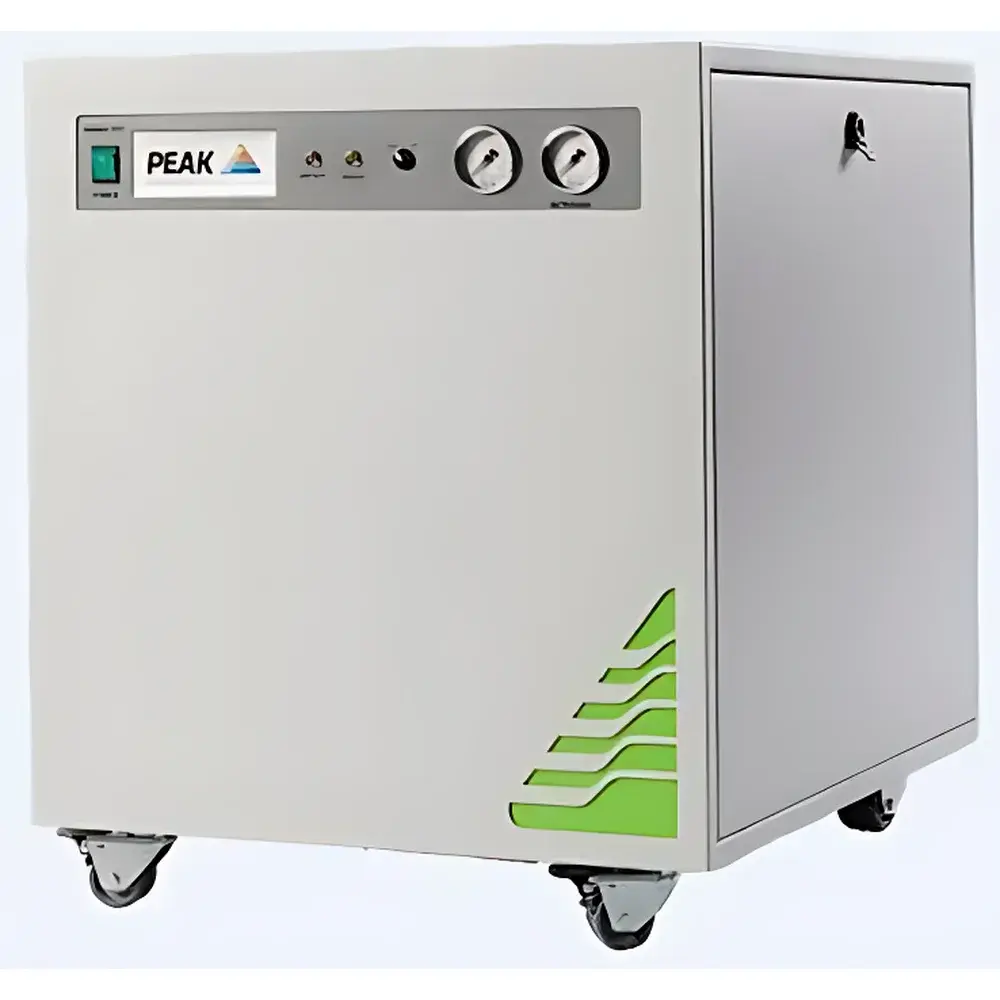
Peak Scientific Genius 1051 Nitrogen & Dry Air Generator
| Brand | PEAK |
|---|---|
| Origin | United Kingdom |
| Manufacturer Type | Original Equipment Manufacturer (OEM) |
| Product Category | Imported |
| Model | Genius 1051 |
| Nitrogen Generation Principle | Pressure Swing Adsorption (PSA) with Carbon Molecular Sieve (CMS) |
| Maximum Nitrogen Flow Rate | 25 L/min |
| Maximum Output Pressure | 100 psi (6.9 bar) |
| Nitrogen Purity | ≥95% (v/v) |
| Nitrogen Dew Point | −50 °C (at 100 psi) |
| Dry Air Flow Rate | up to 25 L/min |
| Dry Air Pressure | 100 psi |
| Input Power | 230 V AC ±10%, 50/60 Hz, 7 A |
| Dimensions (H×W×D) | 713 × 600 × 750 mm |
| Weight | 118.5 kg |
| Sound Pressure Level | 54 dBA |
| Warm-up Time | ≤30 minutes |
| Warranty | 12-month on-site comprehensive warranty |
Overview
The Peak Scientific Genius 1051 is an integrated, compressor-based nitrogen and dry air generator engineered for reliable, on-demand gas supply to high-performance analytical instrumentation—particularly liquid chromatography–mass spectrometry (LC-MS) systems such as the Shimadzu LCMS-8050. It employs a dual-bed pressure swing adsorption (PSA) process utilizing carbon molecular sieve (CMS) technology to separate nitrogen from compressed ambient air. This physical separation mechanism delivers consistent nitrogen purity of ≥95% (v/v) at flow rates up to 25 L/min and pressures up to 100 psi (6.9 bar), with a certified dew point of −50 °C—ensuring moisture content remains below 1 ppmv under operating conditions. Simultaneously, the unit produces instrument-grade dry air (also up to 25 L/min at 100 psi) via integrated refrigerated drying and coalescing filtration. Its self-contained architecture—featuring two oil-free, maintenance-optimized scroll compressors housed in acoustically isolated compartments—eliminates dependency on external compressed air infrastructure, reducing installation complexity and long-term operational risk.
Key Features
- Integrated dual-output design: independent, user-adjustable nitrogen and dry air streams—both regulated to 100 psi with precise flow control up to 25 L/min per stream.
- Oil-free, low-vibration scroll compressors mounted in vibration-dampened, sound-insulated enclosures—achieving a noise emission level of only 54 dBA at 1 m distance.
- Intelligent predictive maintenance system with real-time monitoring of CMS bed saturation, filter life, and compressor duty cycles—providing advance alerts for scheduled service intervals.
- Modular, wheeled chassis (casters with locking brakes) enables safe repositioning within laboratory environments without requiring disassembly or recalibration.
- Automatic start-stop sequencing synchronized with connected analytical instruments—minimizing idle runtime and extending component service life.
- Compliance-ready architecture: supports audit trails, user-access logging, and configurable event history—facilitating alignment with GLP, GMP, and ISO/IEC 17025 documentation requirements.
Sample Compatibility & Compliance
The Genius 1051 is validated for continuous operation with LC-MS platforms requiring stable, low-moisture nitrogen for desolvation, nebulization, and collision gas applications—and dry air for auxiliary pneumatic functions (e.g., curtain gas, source cooling). Its output meets ASTM D6673-22 specifications for instrument air quality and complies with ISO 8573-1:2010 Class 2:2:2 for particulate, water, and oil contamination. While not certified to FDA 21 CFR Part 11 out-of-the-box, its firmware architecture supports integration into validated workflows when deployed with third-party electronic lab notebook (ELN) or LIMS systems that enforce electronic signature and change-control protocols.
Software & Data Management
The generator operates via embedded microcontroller logic with no external PC dependency. All operational parameters—including real-time flow, pressure, dew point, CMS cycle status, and compressor runtime—are displayed on a backlit LCD interface with intuitive menu navigation. Event logs store the last 1,000 operational events (e.g., pressure deviations, filter saturation warnings, power interruptions) with timestamps accurate to ±1 second. USB-C port enables secure firmware updates and log export in CSV format. Remote diagnostics are supported via optional Ethernet module (sold separately), enabling SNMP-based monitoring and integration into centralized facility management systems.
Applications
- LC-MS nitrogen supply for electrospray ionization (ESI) and atmospheric pressure chemical ionization (APCI) sources.
- Dry air provision for pneumatic-assisted nebulizers, curtain gas, and detector purge lines.
- Gas backup for nitrogen-sensitive detectors including electron capture detectors (ECD) and thermal conductivity detectors (TCD).
- Support for automated sample preparation workstations requiring clean, dry actuation air.
- Multi-instrument gas distribution in core facilities where centralized piping is impractical or cost-prohibitive.
FAQ
What is the expected lifetime of the carbon molecular sieve (CMS) beds?
CMS beds typically maintain specified performance for 20,000–25,000 hours of cumulative operation under recommended inlet air quality (ISO 8573-1 Class 4 or better); replacement is indicated when nitrogen purity falls below 95% at rated flow and pressure.
Can the Genius 1051 be integrated into a building management system (BMS)?
Yes—via optional Ethernet communication module supporting Modbus TCP and SNMP v3 protocols for remote status polling, alarm forwarding, and scheduled shutdown/restart commands.
Is external cooling required?
No—the unit is air-cooled and designed for ambient laboratory temperatures between 15–30 °C; adequate ventilation (minimum 30 cm clearance on all sides) is required to sustain thermal stability.
Does it meet regulatory requirements for pharmaceutical QC laboratories?
It satisfies technical prerequisites for GxP environments when operated within documented procedures, including periodic verification of output purity, dew point, and pressure stability per internal SOPs aligned with USP , EP 2.5.27, and ICH Q2(R2).
What maintenance is required during the first year?
Scheduled tasks include quarterly inspection of intake filters, biannual drain of condensate traps, and annual validation of nitrogen purity and dew point using traceable calibration standards.



