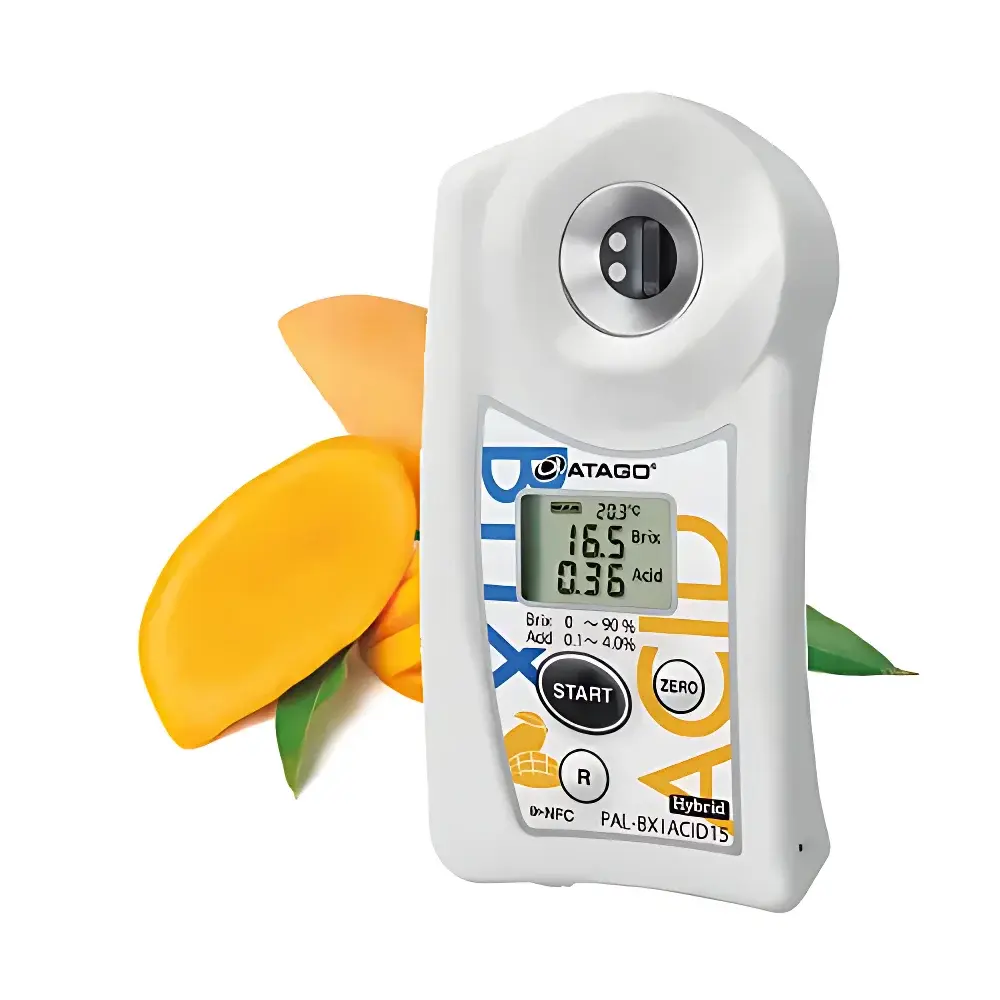
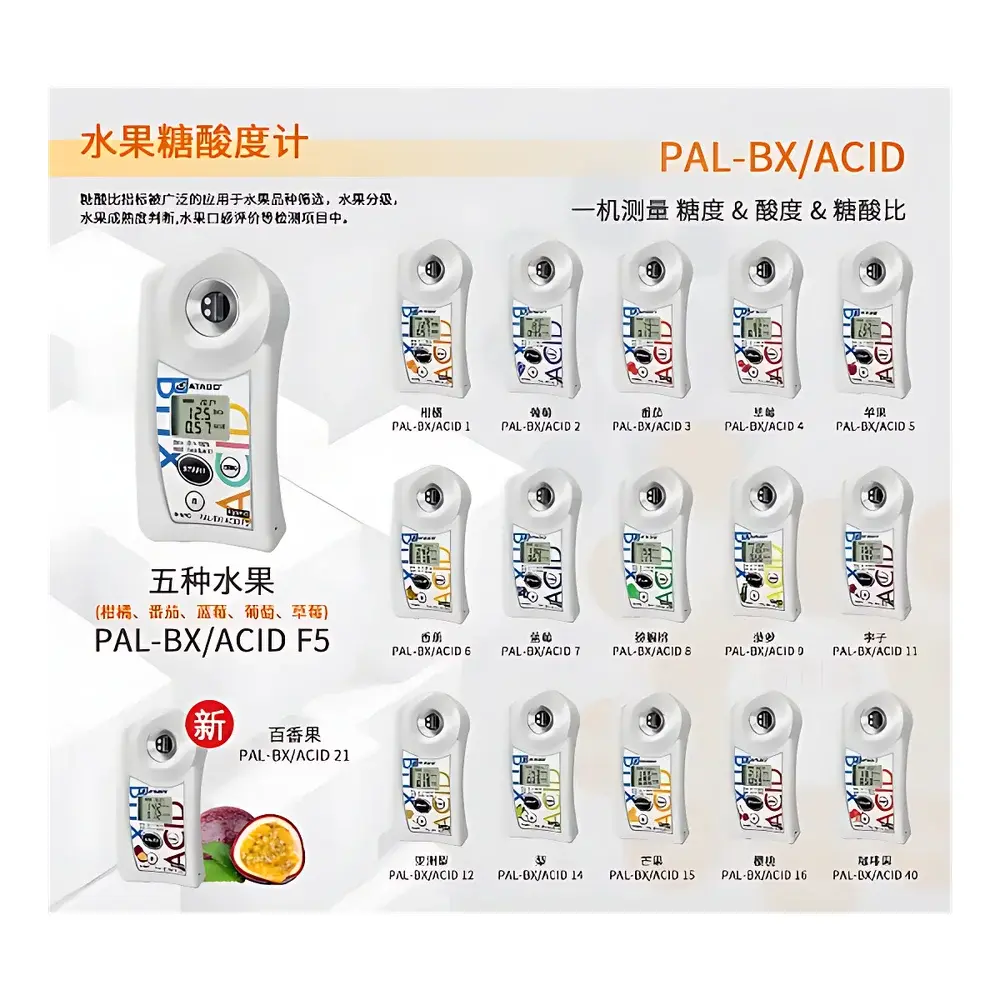
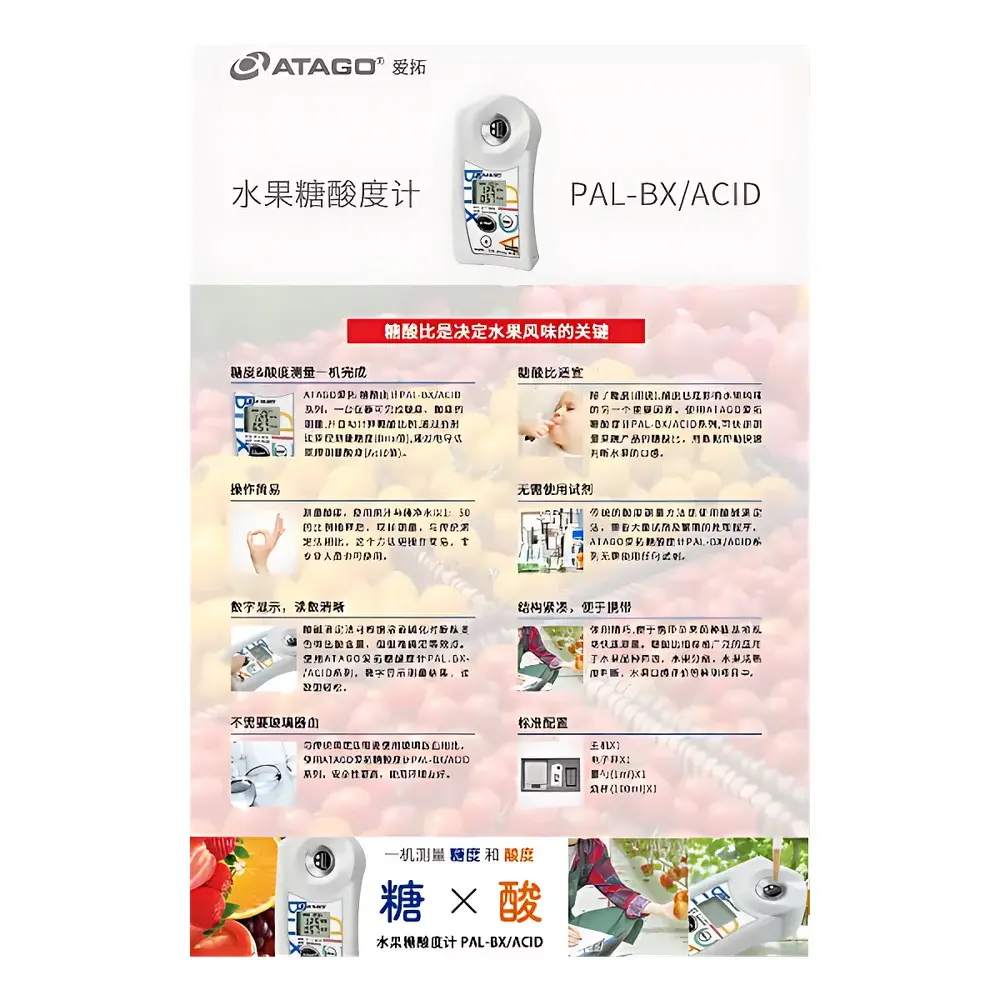
ATAGO PAL-BX/ACID 15 Mango-Specific Brix and Titratable Acidity Meter
| Brand | ATAGO |
|---|---|
| Origin | Japan |
| Model | PAL-BX/ACID 15 |
| Measurement Principle | Refractometric Brix + pH-based Titration-Referenced Acid Quantification (Citric Acid Equivalent) |
| Measurement Range | Brix 0.0–60.0%, Acid 0.10–4.00% (as citric acid) |
| Accuracy | ±0.2% Brix, ±0.10% Acid (0.10–1.00%), ±10% relative (1.01–8.80%), ±1°C temperature |
| Resolution | 0.1% Brix, 0.01% Acid (0.00–9.99%), 0.1% Acid (≥10.0%), Sugar-Acid Ratio display with auto-scaling format (0.00 to ≥100) |
| ATC Range | 10–40°C |
| Power | 2×AAA alkaline batteries |
| IP Rating | IP65 |
| Dimensions | 5.5 × 3.1 × 10.9 cm |
| Weight | 100 g (instrument only) |
| Sample Type | Liquid fruit extracts (direct Brix |
| 1 | 50 w/w dilution with distilled water for acid) |
| Compliance | Designed for routine QC in horticultural labs, agri-processing facilities, and breeding programs per ISO 2173 (fruit juice Brix), AOAC 973.25 (titratable acidity), and internal GLP-aligned workflows |
Overview
The ATAGO PAL-BX/ACID 15 is a handheld, dual-parameter optical analyzer engineered specifically for rapid, field-deployable assessment of mango fruit quality. It integrates two independent measurement modalities within a single compact platform: refractometric determination of soluble solids content (expressed as °Brix) and a calibrated electrochemical estimation of titratable acidity—converted and reported as citric acid equivalent (% w/w). Unlike generic refractometers or standalone pH meters, the PAL-BX/ACID 15 applies an instrument-specific offset curve to align its acid readings with standardized titration results (e.g., AOAC 973.25), ensuring traceability across laboratory, orchard, and post-harvest processing environments. Its core application lies in calculating the sugar-acid ratio (SAR), a physicochemical index empirically correlated with sensory perception of sweetness, tartness, and overall flavor balance in mango cultivars. The device operates without reagents, consumables, or external calibration standards beyond factory-set references—making it suitable for high-throughput screening during harvest, variety trials, ripening studies, and commercial grading.
Key Features
- Integrated dual-mode measurement: Simultaneous °Brix (0.0–60.0%) and citric acid-equivalent acidity (0.10–4.00%) on one instrument
- One-touch sugar-acid ratio (SAR) calculation via dedicated “R” key, with auto-scaling numeric display (0.00–9.99, 00.0–99.9, or 000+ format)
- Offset correction algorithm pre-loaded for mango matrix, enabling cross-method alignment with classical titration data
- Automatic temperature compensation (ATC) across 10–40°C, critical for tropical fruit sampling under ambient field conditions
- IP65-rated enclosure ensures resistance to dust ingress and low-pressure water jets—validated for use in humid packing houses and open-field settings
- No reagent dependency: Acid measurement requires only 1:50 (w/w) dilution of fresh mango pulp/juice with distilled water prior to sampling
- High-resolution optical prism system with LED illumination and CMOS photodetector array for stable Brix quantification (±0.2% accuracy)
Sample Compatibility & Compliance
The PAL-BX/ACID 15 is validated for use with homogenized mango pulp, clarified juice, nectar, and puree preparations. For acid measurement, samples must be diluted at precisely 1.00 g sample + 49.00 g distilled water (w/w), followed by thorough mixing to ensure uniform dispersion of organic acids. The instrument’s acid algorithm is optimized for the dominant organic acid profile of mango (primarily citric and malic acids), and its offset curve has been empirically derived from correlation studies against AOAC 973.25-compliant titrations. While not a primary compliance tool for regulatory submissions, the device supports GLP-aligned documentation when used with defined SOPs—including operator ID logging, batch tracking, and environmental condition recording. It meets ISO 2173 requirements for Brix measurement reproducibility in fruit-derived liquids and is routinely deployed in certified agricultural laboratories operating under national horticultural quality assurance frameworks.
Software & Data Management
The PAL-BX/ACID 15 operates as a standalone instrument with no embedded memory or Bluetooth/Wi-Fi connectivity. All measurements are displayed in real time and intended for immediate manual recording or transcription into LIMS or Excel-based QC logs. To support audit readiness, users are advised to maintain contemporaneous records including date/time, sample ID, operator name, ambient temperature, and dilution verification. While the unit itself does not generate electronic audit trails, its consistent output and documented offset validation enable full traceability when integrated into laboratory quality systems compliant with ISO/IEC 17025 or FDA 21 CFR Part 11–aligned procedural controls (e.g., signed hard-copy worksheets, timestamped digital photos of readings).
Applications
- Cultivar selection and breeding programs: Rapid SAR profiling across hundreds of mango accessions to identify flavor-optimized lines
- Harvest timing decisions: Monitoring SAR trends during fruit development to determine optimal picking windows for export or fresh market
- Post-harvest quality control: Batch-level verification of ripeness consistency in cold chain logistics and ripening rooms
- Processing line monitoring: In-line checks of raw material acidity for pulp concentration, drying, or nectar formulation
- Educational and extension services: Demonstrating objective quality metrics to growers and cooperatives without requiring wet chemistry infrastructure
- Export certification support: Generating preliminary SAR data aligned with import requirements for mango shipments to EU, USA, and ASEAN markets
FAQ
Does the PAL-BX/ACID 15 require calibration before each use?
No. The instrument is factory-calibrated and designed for zero-maintenance operation. Only periodic verification using ATAGO-certified Brix standard solutions (e.g., 10.0% and 30.0% sucrose) is recommended every 30 days or after exposure to extreme thermal shock.
Can this meter be used for fruits other than mango?
It is optimized for mango-specific acid composition and dilution behavior. Use on other fruits (e.g., citrus, apple, pineapple) may yield non-representative SAR values due to differing acid profiles and matrix effects.
What is the purpose of the OFFSET function?
The OFFSET curve corrects for systematic deviation between the meter’s acid reading and reference titration results, ensuring numerical consistency across methods and operators—critical for longitudinal studies and multi-site trials.
Is the acid measurement truly titratable acidity, or is it pH-based?
It is not a direct pH measurement. The device uses conductivity and potential response characteristics calibrated against titration endpoints, then applies a mango-specific conversion factor to report results as % citric acid—fully aligned with AOAC-defined titratable acidity methodology.
How is measurement repeatability ensured across different operators?
By enforcing strict sample preparation SOPs (e.g., standardized dilution ratio, vortex mixing duration, temperature equilibration), combined with the instrument’s fixed optical path and ATC compensation—reducing inter-operator variance to ≤±0.05% Brix and ≤±0.03% Acid under controlled conditions.