
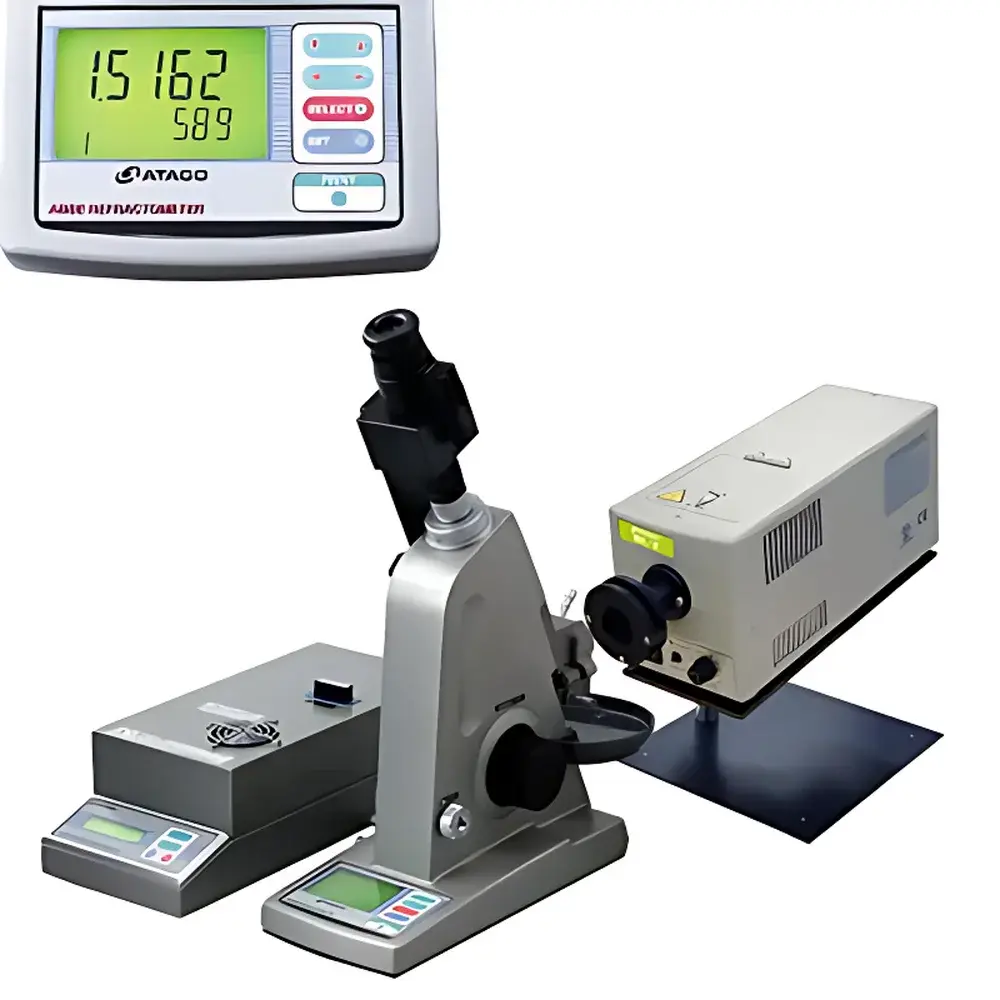
ATAGO DR-M2/1550 Multi-Wavelength Abbe Refractometer
| Brand | ATAGO |
|---|---|
| Origin | Japan |
| Model | DR-M2/1550 |
| Product Type | Benchtop Refractometer |
| Display | Digital LCD |
| Temperature Control | None |
| Refractive Index Range | 1.2662–1.7379 (wavelength-dependent) |
| Wavelength Range | 450–1550 nm |
| Resolution | 0.0001 (nD), 0.1 (Abbe number) |
| Accuracy | ±0.0002 (at 589 nm, verified with certified standard plate) |
| Operating Temperature | 5–50 °C |
| Power Supply | AC 100–240 V, 50/60 Hz |
| Dimensions (main unit) | 13 × 29 × 31 cm |
| Weight (main unit) | 6.0 kg |
Overview
The ATAGO DR-M2/1550 Multi-Wavelength Abbe Refractometer is a precision optical instrument engineered for high-accuracy, wavelength-resolved refractive index and Abbe number measurements across the visible to near-infrared spectrum (450–1550 nm). Based on the classical Abbe principle—utilizing collimated light incidence and critical angle detection at a prism-sample interface—the system delivers traceable, reproducible optical dispersion data without reliance on subjective visual interpolation. Unlike conventional single-wavelength refractometers, the DR-M2/1550 integrates tunable monochromatic illumination and automated spectral calibration, enabling direct acquisition of n(λ) curves essential for optical material characterization, lens design validation, and polymer formulation analysis. Its digital readout eliminates parallax error and operator dependency, supporting rigorous laboratory workflows where metrological integrity and inter-laboratory comparability are mandated.
Key Features
- Multi-wavelength capability spanning 450 nm (blue/violet) to 1550 nm (near-IR), covering key spectral bands used in optical coating, fiber optics, and photonic material testing
- Digital LCD display with 0.0001 resolution for refractive index (nD) and 0.1 resolution for Abbe number (vD), ensuring compliance with ISO 17025 documentation requirements
- Calibration traceable to NIST-traceable reference plates (e.g., SF10 glass at 589 nm), with accuracy verified at ±0.0002 under controlled ambient conditions (23 ± 2 °C, RH < 60%)
- Integrated RS-232 interface for bidirectional communication with external PCs or thermal printers—enabling automated data logging, timestamped measurement records, and export to CSV or Excel formats
- Benchtop architecture with rigid aluminum alloy housing and vibration-damped optical baseplate, minimizing thermal drift and mechanical instability during extended measurement sessions
- No moving parts in the optical path; solid-state monochromatic source ensures long-term wavelength stability and repeatability over >10,000 measurement cycles
Sample Compatibility & Compliance
The DR-M2/1550 accommodates liquid, paste, gel, and transparent solid samples (e.g., optical glasses, PMMA, silicone oils, pharmaceutical excipients) with refractive indices from 1.2662 (at 1550 nm) to 1.7379 (at 450 nm). Sample volume requirement is ≤0.5 mL for liquids; solids require polished, parallel-faced surfaces ≥10 mm × 10 mm. The instrument complies with ISO 21148:2021 (Refractometers — Vocabulary and general principles), JIS K 0061 (Testing methods for refractive index of chemical products), and supports GLP/GMP-aligned operation through audit-trail-capable software interfaces. While it lacks active temperature control, its built-in temperature sensor (±0.5 °C accuracy) allows manual correction using standard Sellmeier or Cauchy equation inputs in post-processing—essential for ASTM D1218 and ISO 489 conformance in polymer testing labs.
Software & Data Management
The DR-M2/1550 operates in standalone mode or integrates with ATAGO’s optional PC-based software suite (Refex v3.2), which provides real-time spectral plotting, multi-point dispersion curve fitting, and comparative overlay of up to eight n(λ) datasets. All measurements include embedded metadata: timestamp, wavelength setting, ambient temperature, operator ID (user-defined), and calibration status flag. Data exports meet FDA 21 CFR Part 11 requirements when used with validated software configurations—including electronic signatures, immutable audit logs, and user-access controls. Raw output supports direct import into MATLAB, OriginLab, or Zemax OpticStudio for advanced dispersion modeling and optical design validation.
Applications
- Optical glass certification per ISO 10110-2 and SCHOTT catalog matching
- Characterization of gradient-index (GRIN) materials and chalcogenide glasses for IR optics
- Quality control of UV-curable resins, photoresists, and encapsulants in semiconductor packaging
- Development and batch verification of ophthalmic lens monomers and contact lens hydrogels
- Refractive index profiling of multilayer thin films via variable-angle spectroscopic ellipsometry cross-validation
- Pharmaceutical excipient qualification per USP and EP 2.2.27 (Refractive Index)
FAQ
Does the DR-M2/1550 support automatic temperature compensation?
No—it does not incorporate Peltier or fluid-circulated temperature control. Users must record ambient temperature and apply empirical or equation-based corrections during data analysis.
Can it measure opaque or highly scattering samples?
No. The Abbe method requires optical transparency at the selected wavelength; turbid or absorbing samples yield unreliable critical angle detection.
Is calibration performed at multiple wavelengths out-of-the-box?
Factory calibration covers 450, 589, 680, 1100, and 1550 nm using certified reference standards. Full recalibration requires ATAGO-certified service centers.
What is the typical warm-up time before measurement stability?
Minimum 30 minutes after power-on to ensure thermal equilibrium of the prism block and light source.
Does the instrument comply with ISO/IEC 17025 for accredited testing labs?
Yes—when operated within specified environmental limits and paired with documented calibration procedures and uncertainty budgets per ISO/IEC 17025:2017 Clause 6.4.




