
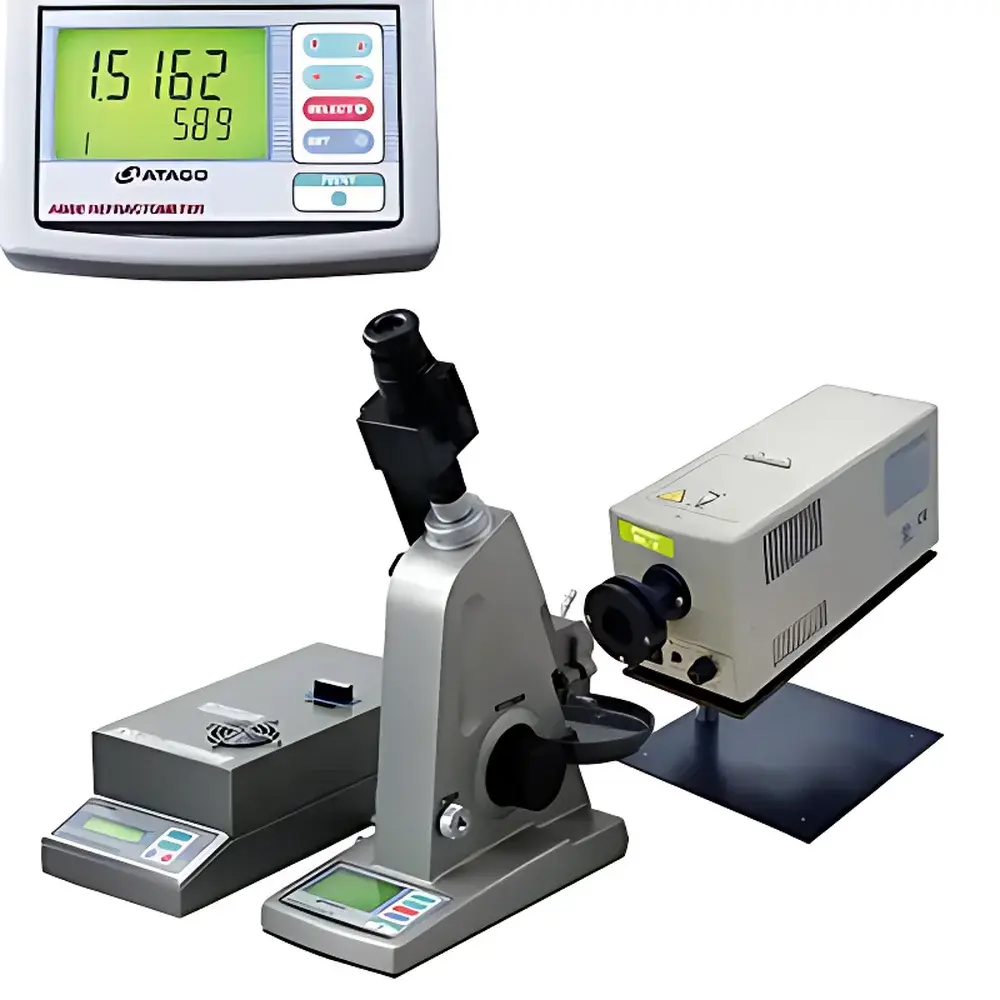
ATAGO DR-M4 Multi-Wavelength Abbe Refractometer for Birefringence Measurement
| Brand | ATAGO |
|---|---|
| Origin | Japan |
| Model | DR-M4 |
| Measurement Range | nD = 1.4260–1.9220 (at 1550 nm) |
| Accuracy | ±0.0002 (at 589 nm) |
| Wavelength Range | 450–1550 nm (interference filter-based) |
| Temperature Control | Yes |
| Digital Display | Yes |
| Resolution | 0.0001 (nD), 0.1 (Abbe number) |
| Operating Temperature | 5–50 °C |
| Power Supply | AC 100–240 V, 50/60 Hz |
| Dimensions (main unit) | 13 × 29 × 31 cm |
| Weight (main unit) | 6.0 kg |
Overview
The ATAGO DR-M4 Multi-Wavelength Abbe Refractometer is a precision optical instrument engineered for high-accuracy measurement of refractive index (nD) and Abbe number across a broad spectral range—from 450 nm to 1550 nm—specifically optimized for birefringent thin-film materials, including liquid crystal compounds, polymer-based optical films, and anisotropic lens substrates. Unlike conventional single-wavelength Abbe refractometers, the DR-M4 employs interchangeable interference filters to isolate discrete wavelengths, enabling wavelength-dependent dispersion analysis critical for characterizing optical anisotropy and phase retardation in advanced photonic materials. Its core optical design follows the classical Abbe principle: collimated monochromatic light passes through a sample-prism interface, and the critical angle of total internal reflection is determined via a sharp shadow line aligned precisely at the crosshair center of an integrated eyepiece. This analog-optical foundation is augmented by a high-stability digital readout system that converts mechanical alignment into a calibrated numeric display with 0.0001 resolution in nD. The instrument’s thermal management architecture supports active temperature stabilization within ±0.1 °C over its 5–50 °C operating range—essential for minimizing thermo-optic drift during extended measurements on temperature-sensitive polymeric or liquid-crystalline samples.
Key Features
- Multi-wavelength capability (450–1550 nm) via certified interference filters, supporting full dispersion curve acquisition
- Dual-mode operation: manual critical-angle alignment with real-time digital readout for traceable, operator-independent results
- Integrated Peltier-assisted temperature control (optional water-bath coupling via 60-C5 circulator) compliant with ISO 21348 and ASTM D1218 standards for thermal conditioning
- LCD digital display showing nD and Abbe number simultaneously; no subjective interpolation required
- High-precision quartz prism assembly with anti-reflective coating optimized for NIR transmission up to 1550 nm
- Robust aluminum-magnesium alloy chassis with vibration-damped base, designed for benchtop stability in QC laboratories and R&D cleanrooms
- Compliance-ready output interface supporting optional DP-63B digital printer (order code 3135) for GLP-compliant hardcopy records
Sample Compatibility & Compliance
The DR-M4 accommodates solid thin-film specimens ≥0.5 mm thickness and ≥10 mm × 10 mm lateral dimension—including LC cells, PET/PEN optical compensation films, CR-39 and polycarbonate ophthalmic lens blanks, and spin-coated photoresist layers. Sample mounting utilizes a spring-loaded prism clamp ensuring uniform contact pressure without deformation. For liquid crystal evaluation, the instrument supports controlled thermal ramping protocols when paired with external chiller units. All measurements adhere to the fundamental definitions in ISO 10752 (Abbe refractometry) and JIS K 0061, while its digital traceability framework meets audit requirements under FDA 21 CFR Part 11 when used with validated printer output and user-access-controlled firmware versions. Calibration verification is performed using NIST-traceable reference glasses (e.g., SF10, F2) at specified wavelengths.
Software & Data Management
While the DR-M4 operates as a standalone instrument without embedded PC software, its digital output port enables integration into laboratory data ecosystems via RS-232 or USB-to-serial adapters. Raw nD and Abbe values are transmitted as ASCII strings formatted for direct ingestion into LIMS platforms (e.g., LabWare, Thermo Fisher SampleManager) or spreadsheet-based QA databases. The DP-63B digital printer generates time-stamped, user-ID-annotated reports—including date/time stamp, filter ID, ambient temperature, and operator ID—supporting 21 CFR Part 11 electronic record integrity when paired with institutional signature policies. Firmware updates (available via ATAGO Technical Support portal) include enhanced error logging and calibration history retention.
Applications
- Characterization of birefringence dispersion in liquid crystal display (LCD) alignment layers and compensation films
- Refractive index profiling of gradient-index (GRIN) polymer lenses and AR-coated ophthalmic substrates
- Quality control of optical adhesives and encapsulants used in photonics packaging
- Development of tunable metasurface materials requiring multi-wavelength nD validation
- Verification of material homogeneity in roll-to-roll coated optical films per ISO 13660
- Academic research in nonlinear optics, where precise Sellmeier coefficient derivation depends on ≥3-point dispersion data
FAQ
What wavelength options are factory-calibrated for the DR-M4?
The DR-M4 ships with five standard interference filters: 450 nm, 589 nm (Na-D line), 680 nm, 1100 nm, and 1550 nm—all NIST-traceable and individually certified for peak transmittance and bandwidth (FWHM ≤5 nm).
Can the DR-M4 measure birefringence directly?
No. It measures ordinary (no) and extraordinary (ne) refractive indices separately by rotating the sample orientation relative to the prism; birefringence (Δn = ne − no) is calculated externally from two sequential readings.
Is temperature control internal or external?
The DR-M4 includes a built-in thermoelectric (Peltier) sensor and feedback loop for ambient temperature monitoring and stabilization; active cooling/heating requires connection to an external recirculating chiller (e.g., ATAGO 60-C5).
How is calibration verified between accredited service intervals?
Users perform daily verification using supplied reference glass blocks (certified at 589 nm and 1550 nm); deviation beyond ±0.0002 nD triggers recalibration by an ATAGO-authorized service center.
Does the instrument support GMP/GLP documentation workflows?
Yes—when used with the DP-63B printer and institutional procedural controls (e.g., defined operator roles, change logs, audit trail review), it fulfills core documentation requirements for ISO/IEC 17025 and ICH Q7 environments.






