
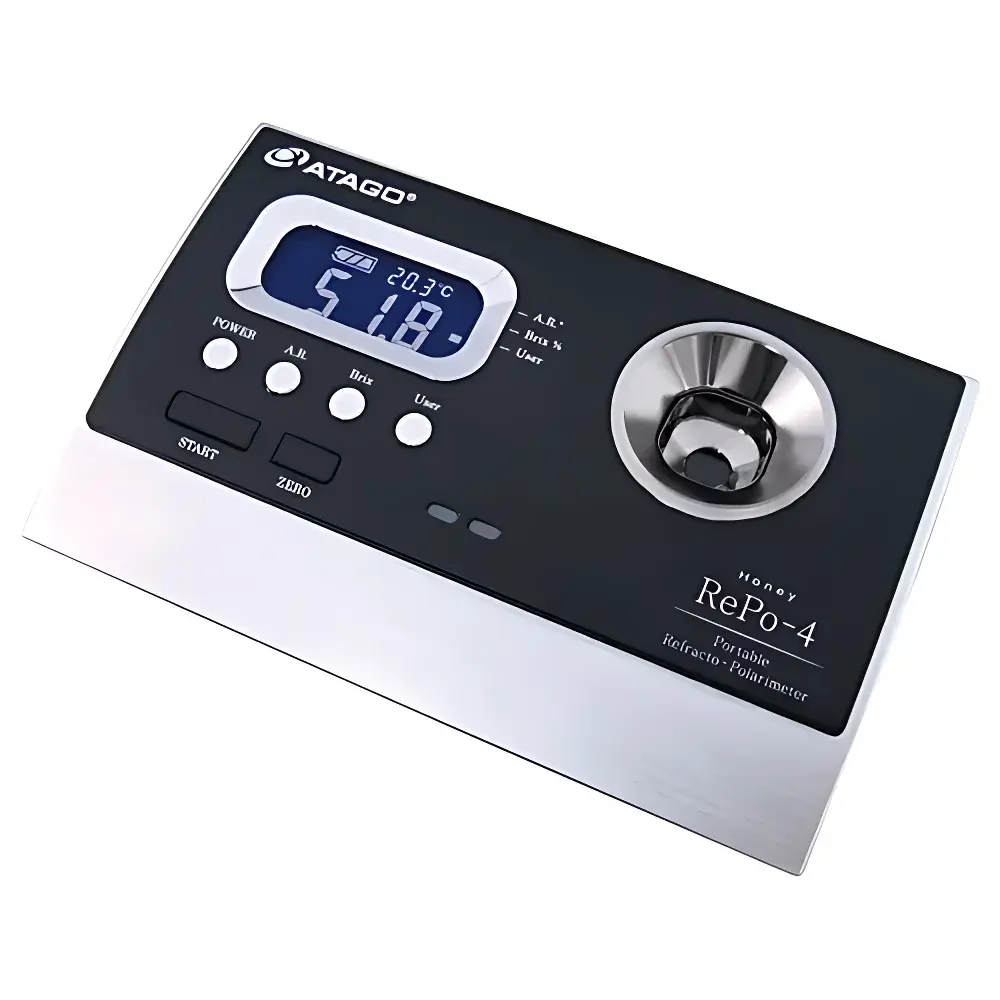
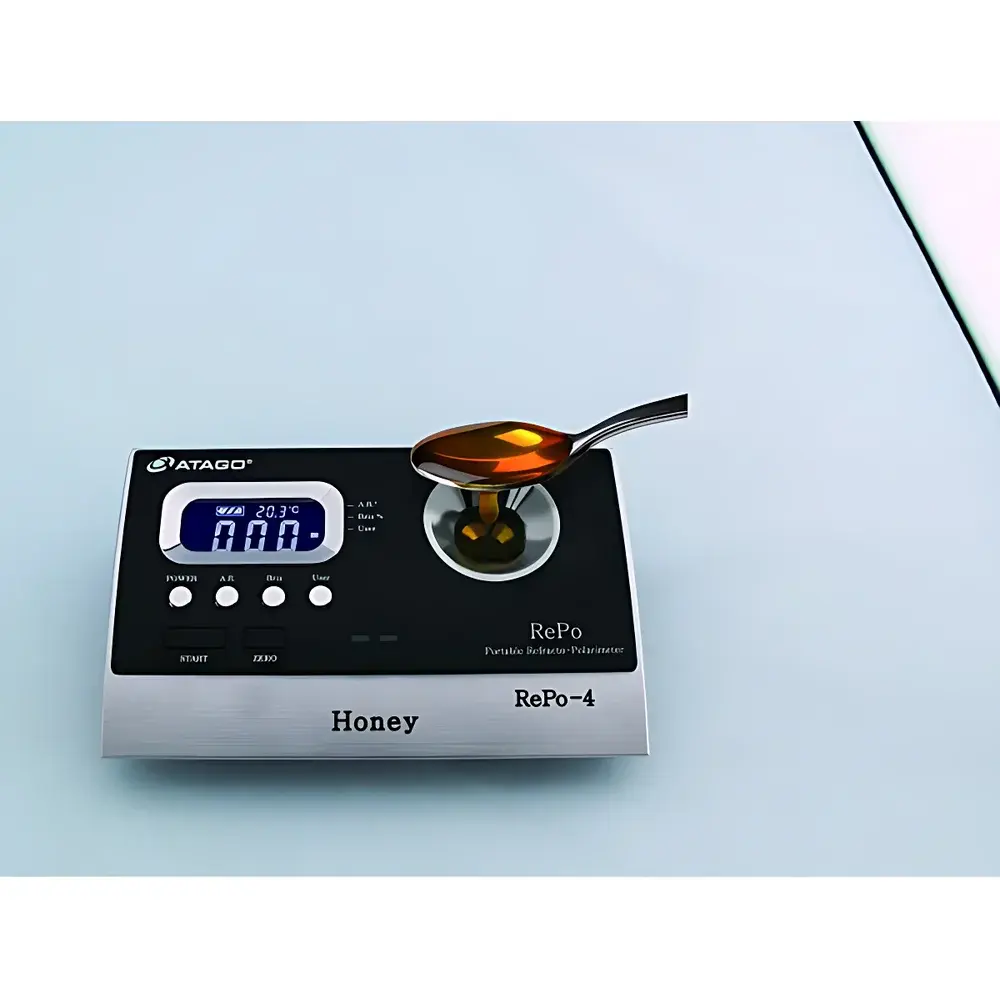
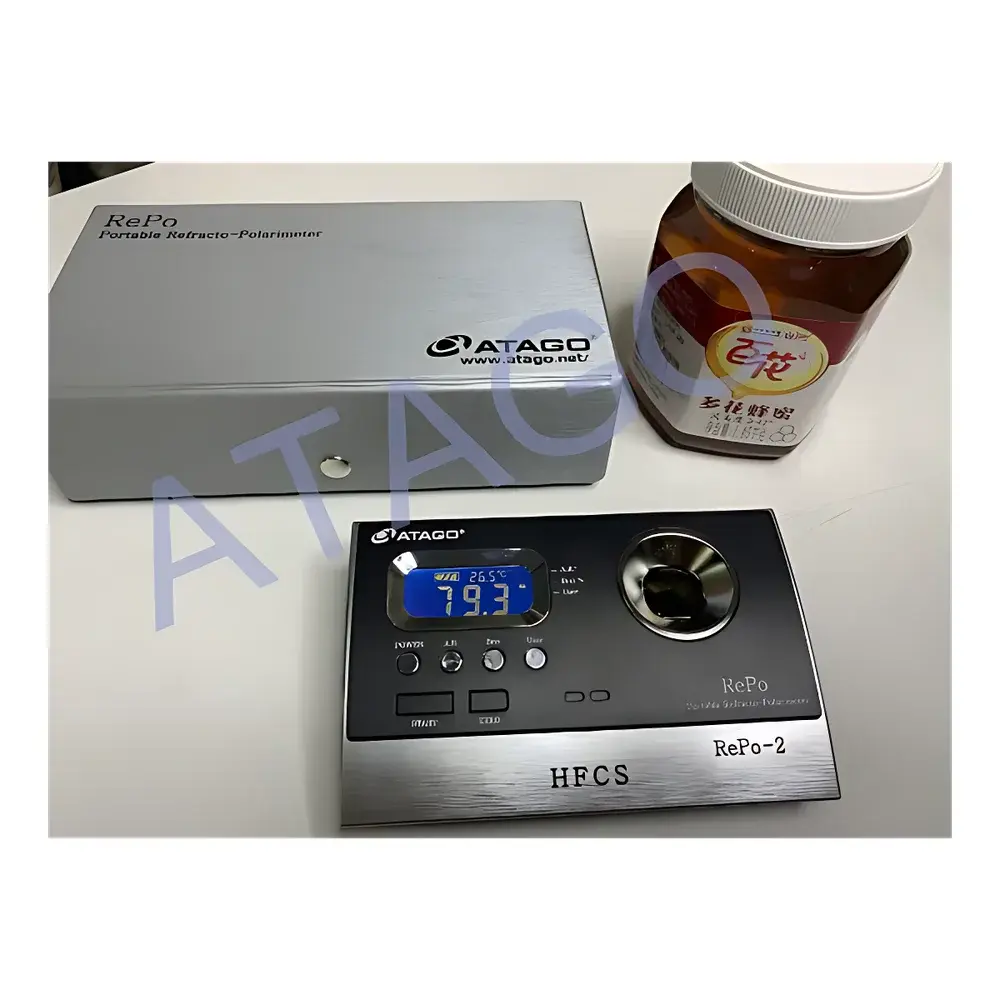
ATAGO RePo-4 Honey Moisture, Refractometer & Polarimeter Combo Instrument
| Brand | ATAGO |
|---|---|
| Origin | Japan |
| Model | RePo-4 |
| Product Type | Automatic Polarimeter with Integrated Refractometry |
| Temperature Control | None |
| Display | Digital LCD |
| Light Source | LED |
| Honey Moisture Range | 13.0–30.0% |
| Honey Moisture Accuracy | ±0.2% |
| Polarimetry Range (AR) | −5.00 to +5.00° |
| Brix Range | 0.0–85.0% |
| Fructose Content Range | 0.0–99.9% |
| Temperature Range | 15–40°C |
| Polarimetry Resolution | 0.01° |
| Brix Resolution | 0.1% |
| Fructose Resolution | 0.1% |
| Moisture Resolution | 0.1% |
| Temperature Resolution | 0.1°C |
| Polarimetry Accuracy | ±0.1° (at 20°C) |
| Brix Accuracy | ±0.2% |
| Temp. Accuracy | ±1°C |
| Temp. Compensation Range (Brix) | 15–40°C |
| Wavelength | 589 nm (D-line) |
| Power | 4 × AAA alkaline batteries |
| IP Rating | IP67 |
| Dimensions | 101 × 160 × 38 mm |
| Weight | 325 g (instrument only) |
Overview
The ATAGO RePo-4 is a compact, handheld analytical instrument engineered for the simultaneous measurement of optical rotation (polarimetry) and refractive index (refractometry) in honey samples—enabling rapid, field-deployable quality assessment without laboratory infrastructure. It operates on two complementary physical principles: sodium D-line polarimetry (589 nm) to quantify chiral molecular asymmetry—primarily from fructose and glucose enantiomers—and Abbe-type refractometry to determine total soluble solids (Brix %), from which moisture content and fructose concentration are derived via ATAGO’s proprietary calibration algorithms validated against AOAC and ISO 21527-1 honey composition standards. Unlike benchtop polarimeters requiring temperature stabilization or solvent-based sample preparation, the RePo-4 uses ambient-temperature, direct-droplet analysis (3 mL sample volume), delivering results in under two seconds. Its design prioritizes operational robustness in variable environments—evidenced by its IP67 ingress protection rating—and compliance-ready data handling for routine QC workflows in apiary cooperatives, honey packers, and regulatory inspection units.
Key Features
- Simultaneous dual-mode measurement: real-time polarization angle (AR) and refractive index (nD) acquisition in a single assay cycle
- Integrated honey-specific algorithm suite calculating four critical parameters: moisture content (% w/w), Brix (%), fructose concentration (%), and specific optical rotation (°/dm·g/mL)
- High-resolution digital display with user-configurable upper/lower limits; visual alarm (LED indicator) triggers upon out-of-specification readings
- Compact form factor (101 × 160 × 38 mm) and lightweight construction (325 g) optimized for mobile use in beekeeping operations, border inspection points, and warehouse QA stations
- Stable LED light source at 589 nm eliminates lamp aging drift and reduces warm-up time; no mercury vapor or halogen lamps required
- Battery-powered operation (4 × AAA alkaline) supports >5,000 measurements per set; power management includes auto-shutdown after 3 minutes of inactivity
Sample Compatibility & Compliance
The RePo-4 is calibrated exclusively for undiluted, filtered, room-temperature honey samples conforming to Codex Alimentarius Standard CXS 12-1981 and EU Directive 2001/110/EC. It accommodates viscous, non-aqueous matrices with minimal air bubble interference due to its shallow sample well geometry and surface-tension-optimized prism interface. While not designed for syrup adulterants (e.g., C4 sugar syrups), its polarimetric sensitivity enables detection of anomalous dextrose/fructose ratios outside natural honey variation (typically fructose:glucose ≈ 1.2:1). The instrument meets IEC 61010-1 safety requirements for portable electrical equipment and complies with RoHS 2011/65/EU material restrictions. Its measurement traceability aligns with NIST-traceable sucrose and quartz control standards used during factory calibration.
Software & Data Management
The RePo-4 operates as a standalone, firmware-driven device with no external software dependency or USB connectivity. All calibration coefficients, limit thresholds, and unit preferences are stored in non-volatile memory. Measurement records—including date/time stamp, operator ID field (manually entered), and pass/fail status—are retained in internal memory for up to 100 tests. Data export is not supported; however, the instrument satisfies GLP documentation requirements through its immutable on-device result logging, visual alarm history, and stable calibration verification protocol (performed using supplied quartz rotary standard and Brix reference fluid). For audit readiness, users may manually transcribe results into LIMS-compatible spreadsheets or paper-based QC logs compliant with ISO/IEC 17025 clause 7.7.
Applications
- Routine honey moisture screening to verify compliance with international limits (≤20% for most premium grades per Codex and national standards)
- Batch release testing prior to packaging or export, reducing reliance on oven-drying methods (AOAC 950.46) that require 3+ hours per sample
- On-site verification of botanical origin claims via correlation between measured optical rotation and region-specific fructose/glucose profiles
- Monitoring crystallization onset risk—samples with moisture >20.5% and low fructose exhibit accelerated granulation
- Training and extension services for beekeepers: immediate feedback supports real-time harvest decisions and post-extraction conditioning
FAQ
Does the RePo-4 require temperature control or thermostatic regulation?
No. It features automatic temperature compensation for Brix measurements across 15–40°C but lacks active thermal regulation. Measurements must be performed within this ambient range.
Can it measure adulterated honey or sugar syrup blends?
It detects deviations from expected polarimetric-refractometric correlation patterns but is not validated for quantitative adulterant identification; confirmatory GC or NMR analysis is required for forensic authentication.
Is calibration traceable to national metrology institutes?
Factory calibration uses NIST-traceable quartz rotary standards and certified sucrose solutions; end-user recalibration is not field-serviceable and requires return to ATAGO-authorized service centers.
What maintenance is required beyond prism cleaning?
Routine cleaning with lens-grade tissue and isopropyl alcohol; no optical alignment or lamp replacement needed over the instrument’s service life.
Does it comply with FDA 21 CFR Part 11 for electronic records?
No—it generates non-electronic, non-networked records. However, its deterministic measurement logic, immutable display output, and visual alarm log meet predicate rule requirements for manual data transcription into Part 11-compliant systems.





