
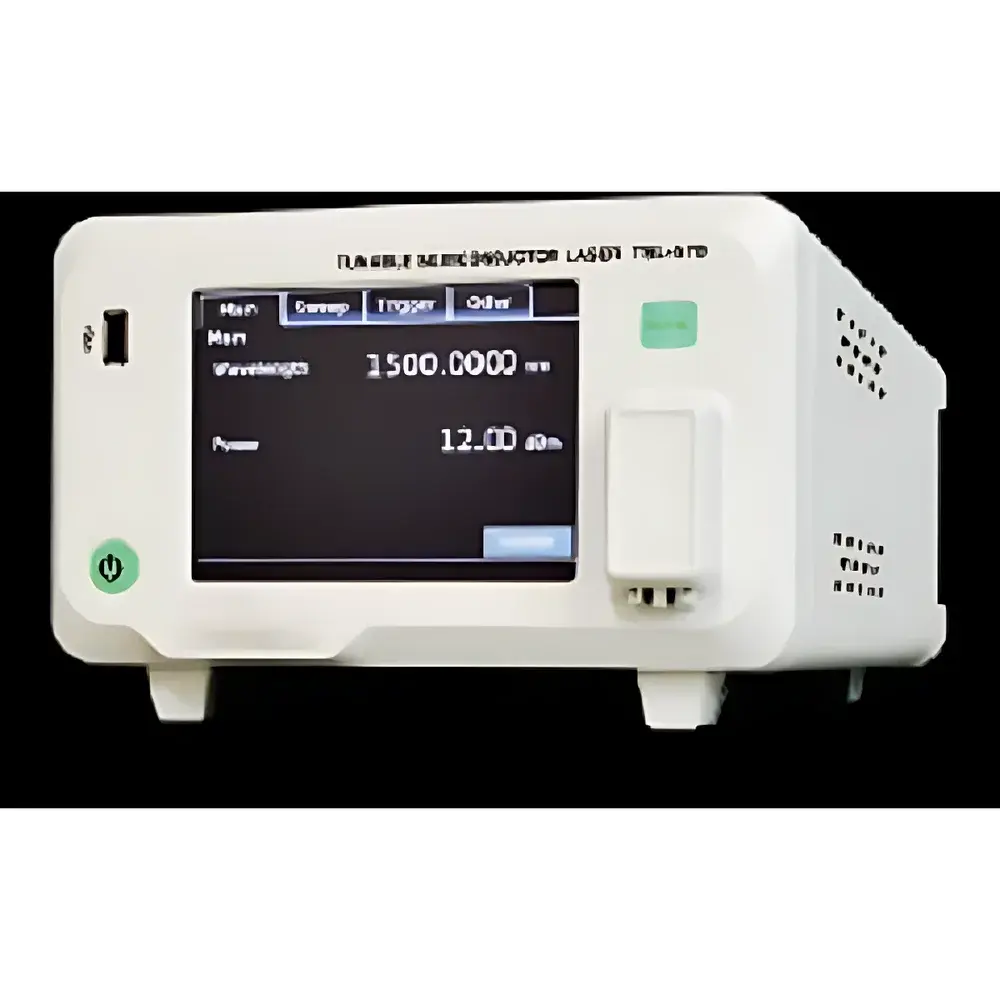
Auniontech TL-2000 High-Power Tunable Semiconductor Laser
| Brand | Auniontech |
|---|---|
| Model | TL-2000 |
| Output Power | +20 dBm (max) |
| Tuning Range | 1260–1360 nm (O-band) or 1500–1630 nm (C+L-band) |
| Wavelength Resolution | 0.1 pm |
| Scan Speed | up to 200 nm/s |
| Fine-Tuning Range | 10 GHz |
| Interface Options | Ethernet, USB, GPIB |
| Control | Touchscreen GUI + Remote Command Set (SCPI-compliant) |
Overview
The Auniontech TL-2000 is a high-power, continuously tunable semiconductor laser engineered for precision optical characterization in research and industrial photonics laboratories. Based on advanced external cavity diode laser (ECDL) architecture with integrated thermal and piezoelectric wavelength stabilization, the TL-2000 delivers exceptional spectral purity, long-term wavelength stability (< ±1 pm over 8 hours), and high output power suitable for demanding applications involving high-loss photonic integrated circuits (PICs), silicon photonics test platforms, and multi-channel coherent systems. Its operation relies on grating-based wavelength selection within a rigid, athermal optical cavity, enabling continuous, mode-hop-free tuning across either the O-band (1260–1360 nm) or C+L-band (1500–1630 nm)—two key windows aligned with ITU-T grid specifications for datacom and telecom applications.
Key Features
- High Optical Output Power: Up to +20 dBm (100 mW) typical, with > +16 dBm maintained across full tuning range—enabling reliable excitation of lossy waveguide structures, arrayed waveguide gratings (AWGs), and edge-coupled photonic devices.
- Sub-picometer Spectral Resolution: 0.1 pm resolution (equivalent to ~12.5 MHz at 1550 nm) supports high-fidelity spectral mapping of narrow-linewidth components such as microresonators, Bragg gratings, and quantum dot emitters.
- High-Speed Continuous Tuning: Linear scan speeds up to 200 nm/s with programmable acceleration/deceleration profiles—optimized for rapid spectral acquisition in optical coherence tomography (OCT), swept-source interferometry, and dynamic filter characterization.
- Stable Fine-Tuning Capability: Integrated 10 GHz fine-tuning range via piezoelectric actuator enables precise cavity-length adjustment without mechanical hysteresis—critical for locking to atomic transitions or stabilizing against environmental drift.
- Multi-Protocol Remote Control: SCPI-compliant command set accessible via Ethernet (TCP/IP), USB 2.0 (VCP), and IEEE-488 (GPIB); full integration with LabVIEW, Python (PyVISA), MATLAB, and Keysight PathWave.
- Integrated Touchscreen Interface: 5.7-inch capacitive display with intuitive waveform editor, real-time power monitoring, and built-in calibration trace logging—reducing dependency on external host PCs during benchtop operation.
Sample Compatibility & Compliance
The TL-2000 is designed for compatibility with standard fiber-pigtailed photonic test environments using FC/APC or SC/APC connectors (SMF-28e+ or PM1550 fiber options available). It meets IEC 60825-1:2014 Class 3B laser safety requirements and includes interlock-ready hardware ports for integration into automated test equipment (ATE) racks. Firmware supports audit-trail logging and user-access-level configuration management—facilitating compliance with GLP and ISO/IEC 17025 laboratory accreditation frameworks. While not FDA 21 CFR Part 11 certified out-of-box, its secure remote interface architecture allows integration into validated systems meeting Part 11 electronic record and signature requirements when deployed with appropriate IT governance controls.
Software & Data Management
Auniontech provides the TL-Control Suite—a cross-platform application (Windows/macOS/Linux) supporting scriptable sweep sequencing, multi-laser synchronization, and real-time power normalization against internal reference photodiodes. All measurement metadata—including timestamp, temperature, current, and wavelength calibration coefficients—is embedded in HDF5-formatted output files, ensuring traceability and interoperability with Python-based analysis pipelines (e.g., NumPy, SciPy, Lumerical INTERCONNECT). Optional API modules enable direct integration into custom CI/CD workflows for photonic IC wafer-level testing automation.
Applications
- Silicon photonics wafer-level testing and device-level characterization (e.g., ring resonator Q-factor mapping, Mach-Zehnder modulator transfer function analysis)
- LAN-WDM and Open ROADM-compliant transceiver testing for 100G/400G/800G/1.6T Ethernet standards
- High-resolution absorption spectroscopy of gas-phase molecules (e.g., CH₄, CO₂, NH₃) in the near-IR
- Quantum optics experiments requiring narrow-linewidth, frequency-stabilized sources (e.g., trapped-ion control, cavity QED setups)
- Calibration of optical spectrum analyzers (OSAs), wavelength meters, and tunable filters
- Development and validation of photonic neural networks and analog optical computing architectures
FAQ
What wavelength bands does the TL-2000 support?
The TL-2000 is available in two configurations: O-band (1260–1360 nm) and C+L-band (1500–1630 nm). Custom band variants (e.g., S-band or extended L-band) can be configured upon request.
Is the output polarization maintained across the tuning range?
Yes—the TL-2000 incorporates polarization-maintaining (PM) fiber output with extinction ratio >20 dB across full tuning range; optional free-space collimated output with adjustable half-wave plate is available.
Can the TL-2000 be locked to an external reference?
Yes—via analog voltage input (0–10 V) for closed-loop feedback control; digital locking protocols (e.g., Pound-Drever-Hall) are supported through external modulation input and synchronous detection interface.
Does the system include factory calibration documentation?
Each unit ships with NIST-traceable wavelength and power calibration certificates, including uncertainty budgets per ISO/IEC 17025 Annex A.3.
What is the typical warm-up time to achieve specified stability?
Less than 30 minutes from cold start to meet ±1 pm wavelength stability and ±0.02 dB power repeatability specifications.




