
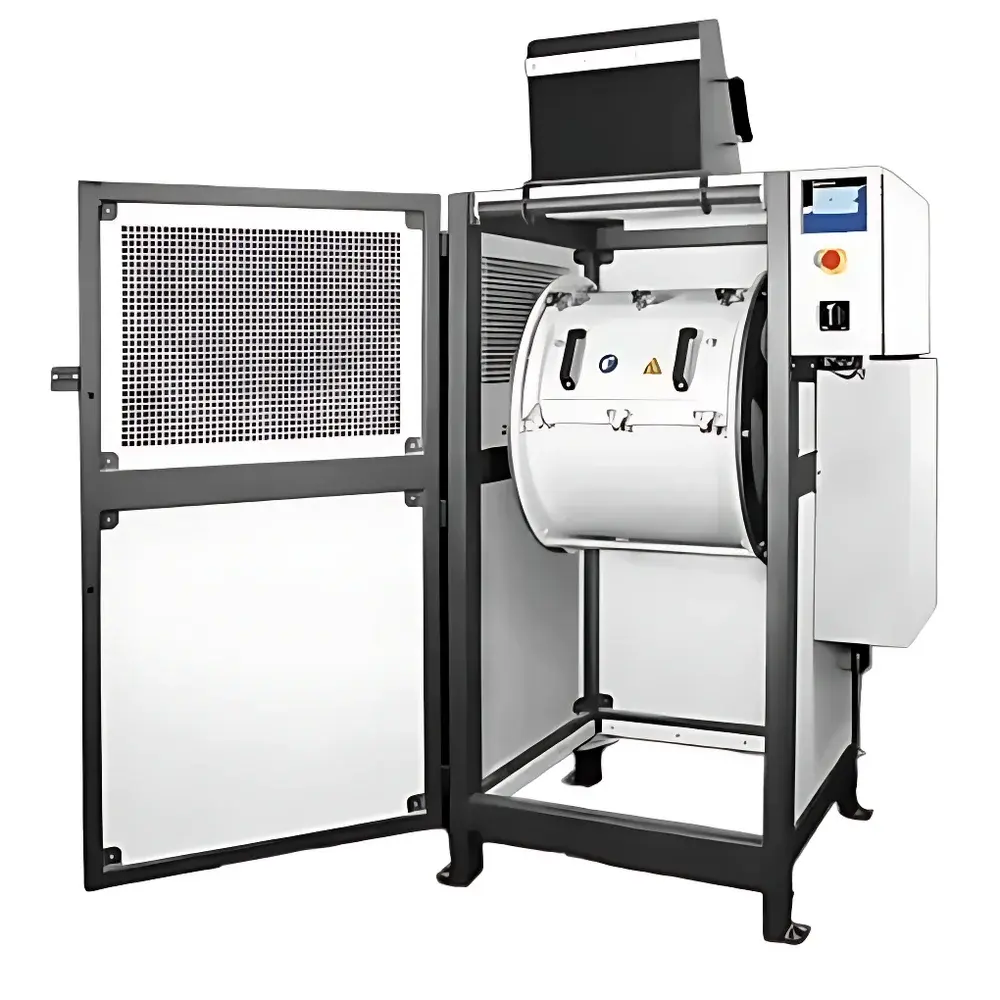
RETSCH TM 500 Drum Mill
| Brand | RETSCH |
|---|---|
| Origin | Germany |
| Model | TM 500 |
| Grinding Type | Rotational Drum Mill |
| Sample Hardness | Hard to Very Hard Materials |
| Max. Feed Size | < 20 mm |
| Final Particle Size | < 15 µm |
| Drum Capacity | 27 L (40 kg sample) |
| Grinding Media Load | 80 kg (e.g., 20 mm or 30 mm steel balls) |
| Rotation Speed | 50 rpm |
| Programmable Modes | Continuous, Intermittent (forward/reverse), Delayed Start |
| Safety | Emergency Stop Button |
| Compliance | CE, ISO 9001-certified manufacturing |
Overview
The RETSCH TM 500 Drum Mill is a heavy-duty, laboratory-scale rotational grinding instrument engineered for reproducible size reduction of hard, brittle, and fibrous materials. Operating on the principle of impact and attrition within a horizontally rotating cylindrical drum, the TM 500 subjects samples to controlled mechanical energy transfer via high-mass grinding media—typically hardened steel balls. Its robust cast-iron construction, precision-balanced drum assembly, and electronically controlled tilt mechanism ensure stable operation at 50 rpm while enabling ergonomic emptying and maintenance. Designed for batch processing up to 40 kg of feed material (27 L volume), the TM 500 delivers consistent sub-15 µm particle size distributions under optimized conditions—demonstrated empirically with gravel (D90 = 15 µm after 8 h) and gentian root (D90 = 130 µm after 1 h). The instrument adheres to fundamental principles of comminution kinetics, where particle size reduction follows first-order kinetics in the initial phase, asymptotically approaching a fineness limit governed by media size, energy input, and material fracture toughness.
Key Features
- Electronically actuated drum tilting system for safe, tool-free discharge of ground material and grinding media
- Intuitive membrane keypad interface with programmable parameters: grinding time, start delay, intermittent forward/reverse cycling, and pause intervals
- Ergonomic feed hopper and optional sieve-based ball/sample separation unit (e.g., 22 mm or 30 mm mesh) minimizing manual handling of 80 kg grinding media
- Dual-direction intermittent mode mitigates agglomeration and thermal buildup—critical for heat-sensitive biological or polymeric samples
- Integrated emergency stop switch compliant with EN/IEC 60204-1 for immediate power cutoff during operational anomalies
- CE-marked design; manufactured under ISO 9001 quality management system with traceable documentation for GLP/GMP-aligned laboratories
Sample Compatibility & Compliance
The TM 500 accommodates a broad spectrum of inorganic and organic matrices requiring coarse-to-fine comminution. Validated applications include cement clinker, ores, ceramics, coal, slag, soils, mineral concentrates, pharmaceutical excipients, botanicals (e.g., gentian root), and composite waste streams (e.g., electronic scrap, carbon fiber residues). Feed material must be dry or low-moisture (< 5% w/w) and mechanically stable enough to withstand impact loading without excessive ductility-induced deformation. Maximum feed particle size is strictly limited to < 20 mm to prevent jamming and ensure uniform energy distribution. All grinding protocols are compatible with ASTM C117 (material retained on sieve), ISO 13320 (laser diffraction particle sizing), and USP (particle size distribution for pharmaceutical powders). Routine operation supports audit-ready data integrity when paired with validated SOPs and operator training records.
Software & Data Management
While the TM 500 operates via embedded firmware without external PC connectivity, its control logic enables full parameter traceability through non-volatile memory storage. Each grinding program—including duration, rotation direction sequence, rest intervals, and start delay—is assigned a user-defined ID and timestamped upon execution. Operational logs (start/stop times, total runtime, cycle counts) can be manually recorded in laboratory notebooks or integrated into ELN systems via standardized entry templates. For regulated environments, the instrument’s deterministic behavior, absence of cloud dependency, and physical emergency cutoff satisfy FDA 21 CFR Part 11 requirements for “simple devices” when supported by procedural controls (e.g., access-restricted parameter modification, signed logbooks, periodic calibration verification against reference standards).
Applications
The TM 500 serves as a primary comminution tool in geochemical laboratories preparing ore homogenates for XRF and ICP-MS analysis; in cement R&D labs generating standardized fineness benchmarks per EN 196-6; in environmental testing facilities reducing soil/sediment composites to <15 µm for TCLP extraction; and in pharmaceutical development labs producing micronized herbal actives for dissolution profiling. Its capacity to process 40 kg batches ensures statistical representativeness in heterogeneous materials such as compost, fly ash, or mine tailings—where subsampling error dominates analytical uncertainty. The reversible intermittent mode proves especially effective for fibrous biomass (e.g., lignocellulosic feedstocks), preventing matting and enabling downstream enzymatic hydrolysis or pyrolysis feedstock conditioning.
FAQ
What is the maximum recommended feed size for the TM 500?
Feed particles must not exceed 20 mm in any dimension to ensure uniform drum loading and avoid mechanical interference with grinding media motion.
Can the TM 500 process wet or sticky samples?
No—it is designed exclusively for dry, free-flowing, or moderately cohesive solids. Moisture content above 5% w/w risks agglomeration, uneven wear, and inconsistent energy transfer.
Is the grinding time linearly correlated with final fineness?
No; comminution follows diminishing returns kinetics. Empirical data show D90 reductions from 98 µm (2 h) to 15 µm (8 h) for gravel—indicating asymptotic convergence toward a practical lower size limit dictated by media diameter and material hardness.
How is grinding media selected for optimal performance?
Steel balls of 20 mm diameter are standard for general-purpose hard materials; 30 mm balls are used for rapid initial size reduction of coarse feedstocks like gentian root, followed by secondary milling with smaller media if sub-10 µm targets are required.
Does the TM 500 support regulatory compliance for GMP environments?
Yes—when operated within documented procedures, with periodic mechanical verification (e.g., rpm calibration, drum balance check), and integrated into a broader quality system including equipment qualification (IQ/OQ) and change control, it meets core expectations for equipment used in GMP-compliant sample preparation.



