
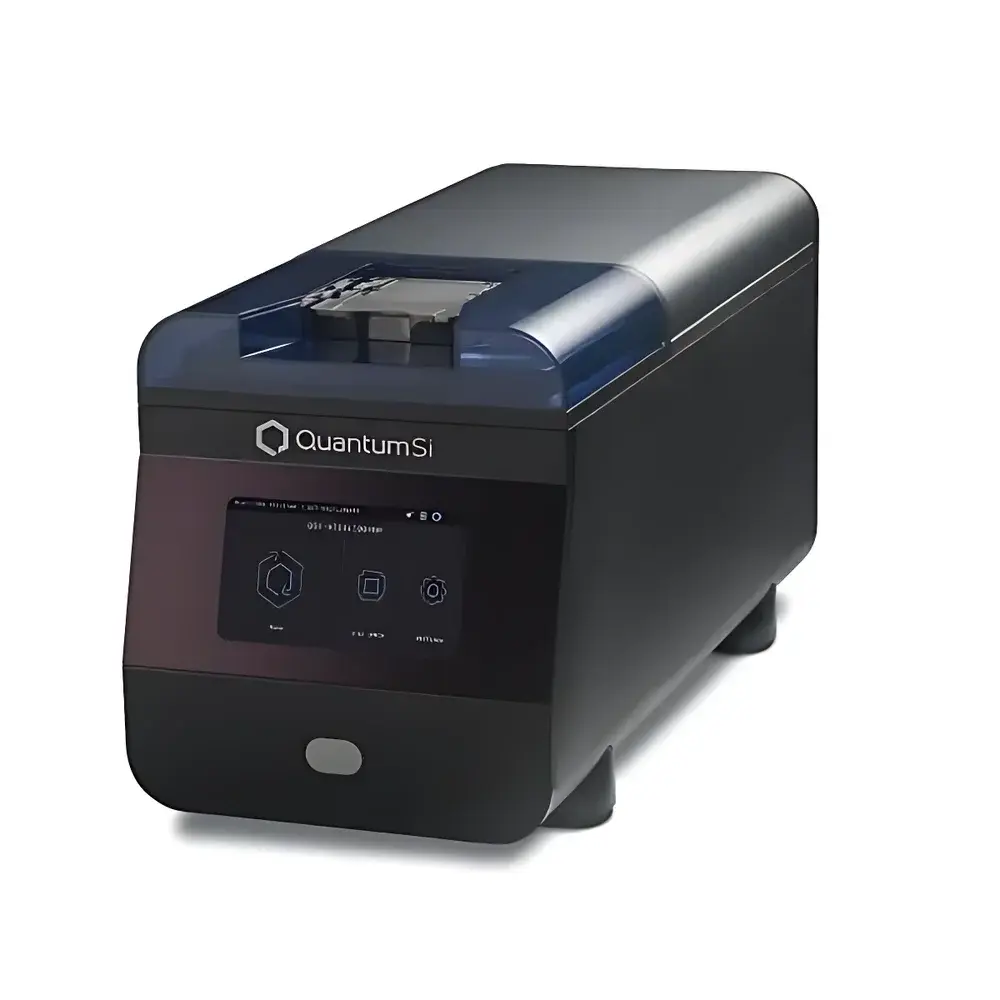
Quantum-Si Platinum™ Single-Molecule Protein Sequencer
| Brand | Quantum-Si |
|---|---|
| Model | Platinum™ |
| Technology | Semiconductor-based Nanowell Fluorescence Detection |
| Throughput | Up to 10M Active Nanowells per Chip |
| Read Length | >50 Amino Acids (N-terminal sequential) |
| Detection Method | Real-time Fluorescent Labeling of Cleaved N-terminal Amino Acids |
| Integration | Onboard Laser Excitation, FPGA-based Signal Processing, Cloud-Native Data Analysis |
| Compliance | Designed for GLP-compliant workflows |
| Software | Cloud-hosted Platinum™ Suite (web-based, browser-accessible, zero local installation) |
| Sample Prep | Integrated kit-based workflow (proteolysis, peptide functionalization, chip immobilization, aminopeptidase & receptor reagents) |
| Applicability | Discovery proteomics, variant protein detection, PTM-agnostic sequencing, antibody-independent identification |
Overview
The Quantum-Si Platinum™ Single-Molecule Protein Sequencer is an engineered platform for direct, label-free–adjacent, real-time N-terminal amino acid sequencing at single-molecule resolution. Unlike traditional mass spectrometry–based proteomics or antibody-dependent immunoassays, this instrument leverages semiconductor nanofabrication and enzymatic stepwise degradation to resolve primary sequence information without reliance on spectral library matching or epitope recognition. Each measurement occurs within a 2-million–well silicon chip, where individual peptides are covalently immobilized in sub-100-nm reaction chambers. An integrated aminopeptidase cleaves one N-terminal amino acid (NAA) per cycle, while dye-conjugated amino acid receptors bind the released residue, generating a time-resolved fluorescent signal captured by on-chip photodetectors. This approach enables de novo sequencing of native or modified peptides — including those bearing post-translational modifications (PTMs), truncations, or non-canonical residues — without prior knowledge of sequence or modification state.
Key Features
- Semiconductor nanowell architecture with 2 million active detection sites per standard chip; scalable to 10 million wells via process optimization
- Onboard 488-nm solid-state laser excitation and low-noise CMOS photodetection system, eliminating external optical alignment
- FPGA-accelerated real-time signal processing for event discrimination, background subtraction, and kinetic filtering
- Integrated microfluidic cartridge handling for reagent delivery, waste removal, and buffer exchange across >50 cleavage cycles
- Cloud-native Platinum™ Suite software with built-in base-calling algorithms, confidence scoring, and consensus assembly
- FDA 21 CFR Part 11–ready audit trail functionality, including user authentication, electronic signatures, and immutable run logs
Sample Compatibility & Compliance
The Platinum™ platform accepts tryptic (or alternative protease) digests from purified proteins, cell lysates, plasma fractions, or immunoprecipitated complexes. No enrichment or labeling is required beyond standard sample preparation kits. Peptides as short as 8 residues and as long as 65+ residues have been successfully sequenced under routine operating conditions. The system complies with ISO/IEC 17025 principles for analytical validation and supports GLP/GMP-aligned documentation workflows. All cloud-stored data reside in SOC 2 Type II–certified infrastructure with end-to-end TLS 1.3 encryption and role-based access control (RBAC). Instrument firmware and cloud software undergo quarterly security patching and annual penetration testing.
Software & Data Management
Platinum™ Suite operates entirely through a web browser — no local installation, no license dongles, no version conflicts. Users configure runs, monitor real-time fluorescence kinetics, and initiate automated base-calling from any device with internet connectivity. Raw photon-counting time series are stored in HDF5 format with embedded metadata (chip ID, lot number, reagent expiration, operator ID, timestamp). The cloud pipeline applies adaptive thresholding, dwell-time normalization, and cross-well calibration to suppress chip-level heterogeneity. Output includes FASTA-formatted peptide sequences, per-residue confidence scores (Q-scores), coverage heatmaps, and aggregated protein-level reports compatible with downstream tools such as MaxQuant or Spectronaut via CSV export. All data exports retain full traceability to original acquisition parameters.
Applications
- Discovery of sequence variants in clinical biosamples (e.g., tumor-derived neoantigens, splice isoforms, frameshift products)
- Characterization of biopharmaceuticals — confirming primary structure, detecting clipping sites, mapping C-/N-terminal heterogeneity
- Direct identification of PTM-bearing peptides without enrichment bias (e.g., phosphorylation, acetylation, glycosylation)
- Validation of CRISPR-edited cell lines at the protein level, independent of mRNA expression artifacts
- High-confidence identification of low-abundance proteins in complex matrices (e.g., cerebrospinal fluid, extracellular vesicles)
- Method development for orthogonal verification of LC-MS/MS identifications in regulated environments
FAQ
How does Platinum™ differ from bottom-up mass spectrometry?
Platinum™ sequences peptides directly from the N-terminus using enzymatic cleavage and fluorescent detection — it does not rely on fragmentation patterns, spectral libraries, or ionization efficiency. This eliminates inference ambiguity in homologous regions and enables confident detection of unanticipated variants.
Is sample preparation performed on-chip or off-chip?
All upstream steps — proteolytic digestion, cysteine alkylation, peptide functionalization, and chip loading — are performed off-chip using standardized kit reagents. Only enzymatic cycling and detection occur on the semiconductor device.
Can Platinum™ identify post-translational modifications?
Yes — because sequencing is based on physical binding kinetics of labeled receptors, modifications that alter side-chain chemistry (e.g., phosphorylation at Ser/Thr/Tyr) produce distinct kinetic signatures distinguishable from canonical residues.
What is the minimum required peptide amount per run?
For robust detection across 2M wells, ≥50 fmol of total peptide (representing ~3×10¹⁰ molecules) is recommended. Sensitivity scales linearly with well density and integration time.
Does the system support LIMS integration?
Yes — Platinum™ Suite provides RESTful API endpoints for bidirectional communication with major laboratory information management systems (e.g., LabVantage, Thermo Fisher SampleManager), supporting automated sample assignment and result ingestion.




