
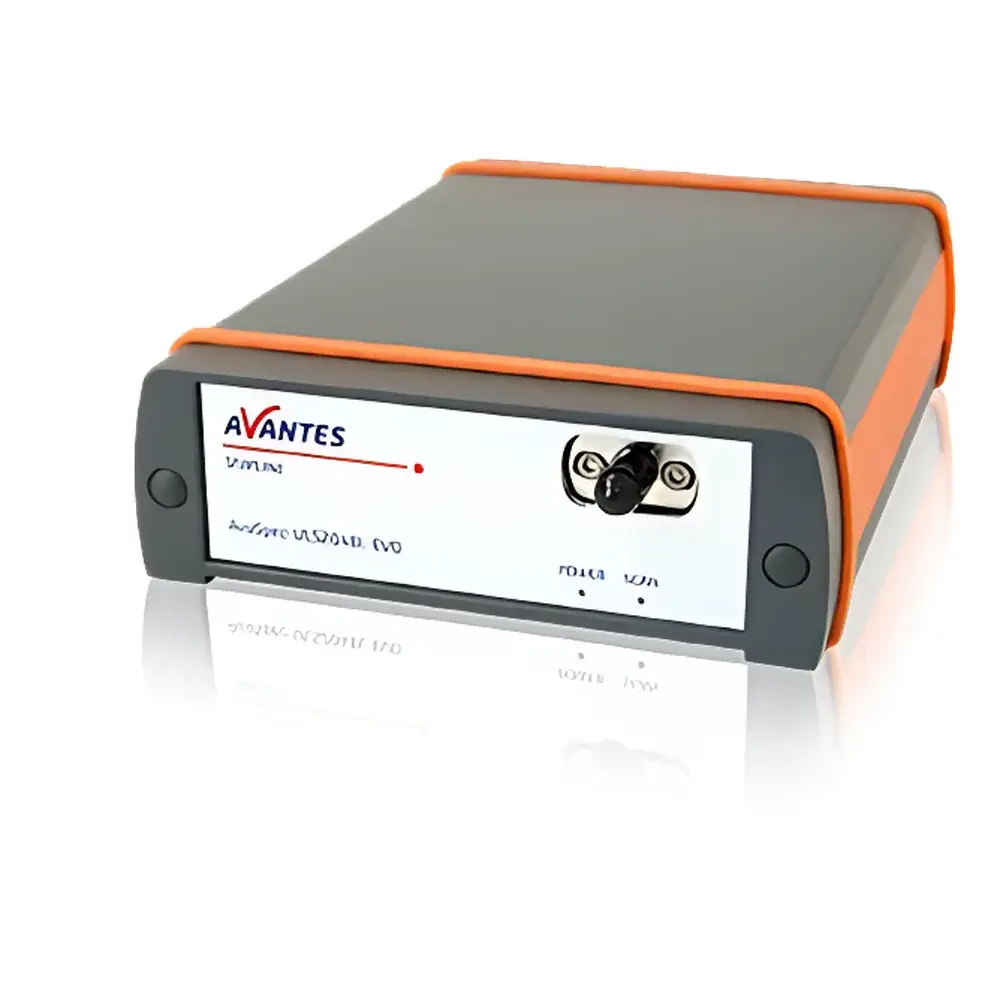
Avantes AvaSpec-ULS4096CL-EVO Fiber Optic Spectrometer
| Brand | Avantes |
|---|---|
| Origin | Netherlands |
| Model | AvaSpec-ULS4096CL-EVO |
| Spectral Range | 200–1100 nm |
| Detector | CMOS |
| Optical Resolution (FWHM) | 0.05–20 nm (configuration-dependent) |
| Sensitivity | 261,000 counts/µW per ms integration time |
| Signal-to-Noise Ratio | 300:1 |
| Dynamic Integration Time Range | 9 µs – 40 s |
| Stray Light | 0.19–1.0% (grating-dependent) |
| AD Converter | 16-bit, 6 MHz |
| Interface | USB 3.0 (5 Gbps), Gigabit Ethernet (1 Gbps) |
| Data Transfer Speed | 0.75 ms/scan (USB 3.0), 1.9 ms/scan (Ethernet) |
| Optical Design | Symmetrical Czerny-Turner, 75 mm focal length |
| Dimensions | 177 × 127 × 44.5 mm |
| Weight | 1135 g |
Overview
The Avantes AvaSpec-ULS4096CL-EVO is a high-performance fiber optic spectrometer engineered for demanding spectral analysis applications requiring broad wavelength coverage, high pixel density, and rapid data acquisition. Based on a symmetrical Czerny-Turner optical layout with a 75 mm focal length, the instrument delivers optimized optical throughput and minimized aberrations across its full 200–1100 nm spectral range. Its core innovation lies in the integration of a 4096-pixel linear CMOS detector—replacing legacy CCD architectures—to enable faster readout speeds, lower power consumption, improved dynamic range linearity, and enhanced resistance to blooming and cosmic-ray artifacts. Unlike CCD-based systems constrained by serial charge transfer bottlenecks, the CMOS architecture supports parallel pixel readout, enabling sub-millisecond scan rates without compromising spectral fidelity. The spectrometer is built around the AS-7010 electronics platform, featuring a high-speed ARM Cortex microprocessor, expanded onboard memory (50× increase over prior generations), and dual high-bandwidth communication interfaces: USB 3.0 (5 Gbps) and Gigabit Ethernet (1 Gbps). This dual-interface architecture supports both lab-integrated instrumentation and distributed industrial sensing deployments—including remote monitoring, OEM embedded systems, and networked process analytical technology (PAT) environments compliant with ISA-88/ISA-95 frameworks.
Key Features
- 4096-pixel back-thinned CMOS detector delivering superior quantum efficiency across UV-VIS-NIR (200–1100 nm)
- Configurable optical resolution from 0.05 nm to 20 nm FWHM via interchangeable slits (10–500 µm), gratings (300–3600 lines/mm), and optional order-sorting filters
- Ultra-low integration time range: 9 µs to 40 s—enabling transient event capture (e.g., plasma ignition, laser-induced breakdown spectroscopy (LIBS) decay kinetics) and long-term stability monitoring
- Dual high-speed interfaces: USB 3.0 (0.75 ms/scan) and Gigabit Ethernet (1.9 ms/scan) with deterministic latency for synchronized multi-instrument control
- Onboard digital I/O via HD-26 connector: 2 analog inputs, 2 analog outputs, 13 digital I/O lines—including TTL trigger, synchronization pulse, strobe, and laser gate control
- Robust mechanical design: aluminum housing with thermal stabilization architecture; operating temperature range: 5–40 °C; no active cooling required for standard operation
- OEM-ready form factor: supports bare optical bench, rack-mountable chassis, and custom firmware partitioning for embedded integration
Sample Compatibility & Compliance
The AvaSpec-ULS4096CL-EVO is compatible with standard SMA 905 fiber optic couplings and supports all common fiber diameters (50–600 µm core). Optional accessories—including sensitivity-enhancing focus lenses, second-order suppression filters (for UV/VIS configurations), and calibrated NIST-traceable irradiance standards—extend its applicability across quantitative and regulatory-grade workflows. The spectrometer complies with CE, FCC Class B, and RoHS directives. When operated with AvaSoft software under validated configurations, it supports audit trails, electronic signatures, and secure user access controls aligned with FDA 21 CFR Part 11 requirements. Its stable thermal performance and low drift (<0.05 nm/°C typical) meet ASTM E275 and ISO 17025 criteria for calibration traceability in accredited laboratories. For pharmaceutical process monitoring, the device satisfies key elements of USP and ICH Q2(R2) guidelines when integrated into a documented PAT framework.
Software & Data Management
The spectrometer ships with AvaSoft-Basic—a modular, cross-platform application supporting real-time spectral acquisition, mathematical operations (e.g., baseline correction, peak integration, ratioing), and export to CSV, ASCII, or HDF5 formats. Advanced users may leverage the comprehensive AvaSoft SDK (C++, Python, LabVIEW, MATLAB APIs) for custom algorithm development, closed-loop feedback control, or integration into SCADA/MES systems. All firmware and driver packages are digitally signed and version-controlled. Data integrity is preserved through hardware-timestamped acquisition, lossless compression options, and configurable metadata embedding (including instrument ID, calibration date, slit/grating configuration, and environmental sensor readings when interfaced with optional external sensors). Firmware updates retain user calibration coefficients and preserve factory-certified wavelength and intensity calibrations.
Applications
- Laser-induced breakdown spectroscopy (LIBS) for elemental analysis in metallurgy, geology, and nuclear safeguards
- Plasma diagnostics in semiconductor etch chambers and fusion research facilities
- UV-Vis-NIR absorbance and reflectance measurements for thin-film characterization and solar cell R&D
- Real-time colorimetry and spectral radiometry in display manufacturing and LED quality assurance
- In-line process monitoring of chemical reactions, polymerization kinetics, and bioreactor metabolite profiling
- Environmental sensing: water quality (COD, nitrate, chlorophyll-a), atmospheric gas detection (O3, NO2), and particulate matter spectral signature analysis
- OEM integration into handheld analyzers, medical devices (e.g., oximetry, fluorescence endoscopy), and autonomous inspection platforms
FAQ
What is the difference between the CMOS detector in the ULS4096CL-EVO and traditional CCD detectors?
The CMOS detector enables parallel pixel readout, resulting in significantly faster scan rates (down to 0.75 ms), lower read noise at high speeds, improved linearity over 5 decades of intensity, and immunity to vertical smear during bright signal exposure—unlike serial-read CCDs.
Can this spectrometer be used for quantitative absorbance measurements?
Yes—when paired with a deuterium-halogen light source, matched reference cuvettes, and NIST-traceable calibration, it achieves photometric accuracy within ±0.5% OD across 0–3 OD, meeting ISO 17025 requirements for routine QC labs.
Is the device suitable for GLP/GMP-regulated environments?
With proper validation documentation, electronic signature implementation, and audit trail configuration in AvaSoft-Advanced, it supports compliance with 21 CFR Part 11 and Annex 11 for regulated pharmaceutical and clinical testing applications.
How does stray light performance vary with grating selection?
Stray light ranges from 0.19% (with high-end blazed holographic gratings and order-sorting filters) to 1.0% (with low-line-density ruled gratings in broadband configurations); detailed stray light curves are provided in the instrument-specific calibration report.
What OEM integration support is available?
Avantes provides mechanical drawings, electrical schematics, firmware binaries, SDK source examples, and technical liaison support for co-development projects—including custom bootloaders, real-time OS porting (FreeRTOS, VxWorks), and EMC pre-compliance testing assistance.





