
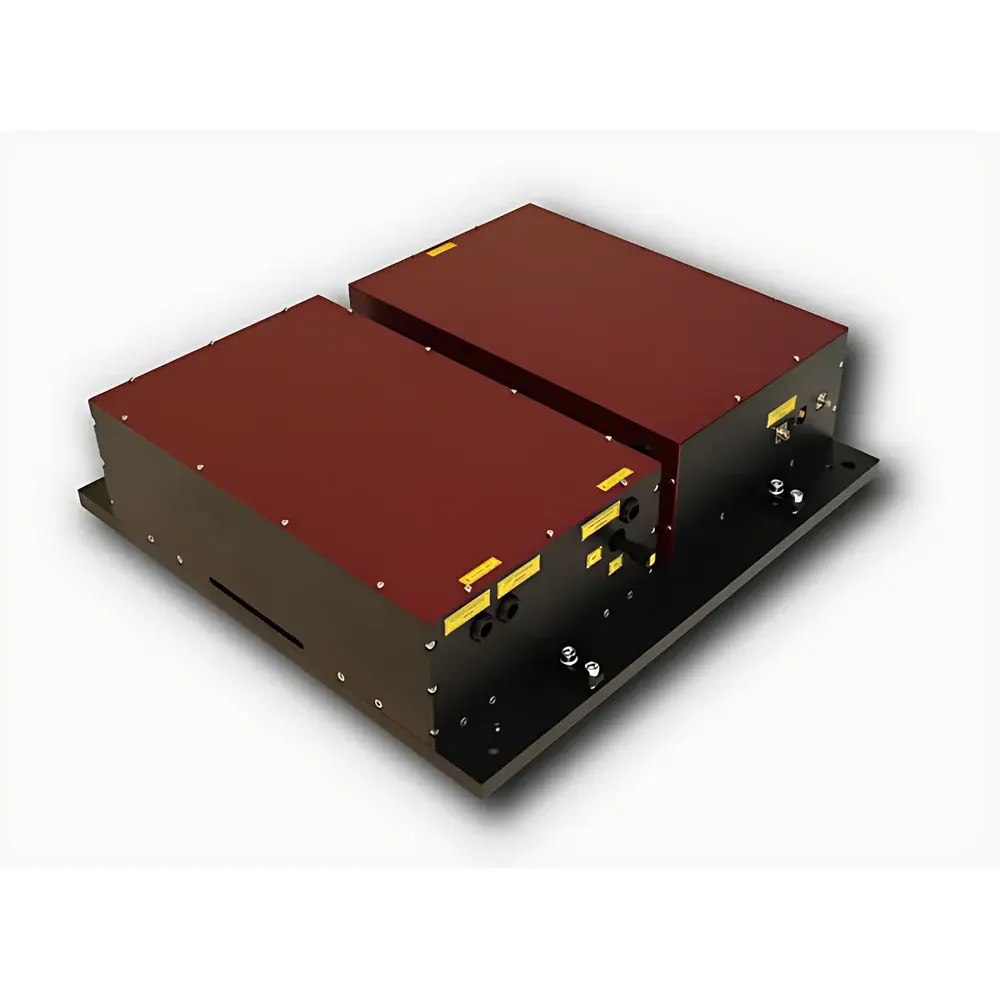
Avesta EFOA-SH-UB Multi-Wavelength Femtosecond Laser System
| Brand | Avesta |
|---|---|
| Origin | Russia |
| Model | EFOA-SH-UB |
| Wavelengths | 1560 nm (fs), 780 nm (fs), 1100–2000 nm (supercontinuum) |
| Pulse Width | <150 fs |
| Repetition Rate | 70 ± 5 MHz |
| Output Power | >150 mW @1560 nm, >50 mW @780 nm, >130 mW @SC |
| Polarization | Linear (horizontal @1560 nm, vertical @780 nm) |
| Stability (24 h) | <1% RMS @780 nm |
| Power Supply | 110–220 VAC, 50/60 Hz |
| Operating Temperature | 22 ± 5 °C |
| Dimensions (Laser Head) | 430 × 455 × 120 mm |
| Dimensions (Control Unit) | 353 × 260 × 155 mm |
| Dimensions (SHG Unit) | 200 × 160 × 60 mm |
| Output Coupling | FC/APC fiber port (1560 nm), free-space (780 nm & SC) |
| Sync Output | SMA (TTL), Mode-Lock Status: SMA + LED |
Overview
The Avesta EFOA-SH-UB Multi-Wavelength Femtosecond Laser System is an integrated ultrafast laser platform engineered for advanced photonics research requiring simultaneous access to three spectrally distinct, phase-coherent femtosecond pulse trains. At its core lies a mode-locked Yb-doped fiber oscillator operating at 1560 nm, serving as the fundamental source. This seed laser drives two parallel nonlinear conversion stages: a second-harmonic generation (SHG) module producing 780 nm pulses, and a photonic crystal fiber-based supercontinuum (SC) generator spanning 1100–2000 nm. Unlike conventional Ti:sapphire or Cr:F2 systems, the EFOA-SH-UB leverages all-fiber architecture and diode-pumped solid-state pumping—eliminating reliance on costly, alignment-sensitive green pump lasers. Its design reflects decades of expertise from the P.N. Lebedev Physical Institute’s Quantum Radiophysics Department, where foundational work in quantum electronics—pioneered by Nobel laureates Basov and Prokhorov—continues to inform industrial-grade ultrafast instrumentation. The system delivers high temporal coherence, exceptional amplitude stability (<1% RMS over 24 hours), and deterministic synchronization across all output channels—enabling time-resolved experiments with sub-100-fs timing fidelity.
Key Features
- Triple-wavelength femtosecond output: 1560 nm (fundamental), 780 nm (second harmonic), and broadband supercontinuum (1100–2000 nm) generated from a single oscillator
- Pulse duration <150 fs across all spectral bands, with fixed repetition rate of 70 ± 5 MHz and intrinsic jitter <100 fs (RMS)
- High optical stability: <1% RMS power fluctuation at 780 nm over 24-hour continuous operation under controlled thermal environment (22 ± 5 °C)
- Compact modular architecture: Separated laser head (430 × 455 × 120 mm), control unit (353 × 260 × 155 mm), and SHG unit (200 × 160 × 60 mm) for flexible optical table integration
- Dual synchronization interfaces: TTL-compatible SMA output for external triggering and real-time mode-lock status monitoring via SMA + LED indicator
- Fiber-coupled 1560 nm output (FC/APC connector, ~1 mW tap), plus free-space collimated beams for 780 nm and SC—enabling hybrid coupling into interferometers, vacuum chambers, or microscope scan heads
Sample Compatibility & Compliance
The EFOA-SH-UB is designed for use in ISO 17025-accredited laboratories and GLP-compliant research environments. Its stable, low-noise output meets requirements for traceable optical frequency metrology per IEEE Std 1139 and supports calibration protocols aligned with NIST-traceable wavelength standards. While not certified for medical device use under IEC 60601, its 780 nm and 1560 nm outputs fall within Class 4 laser safety limits per IEC 60825-1:2014; full compliance requires integration with interlocked enclosures and beam path containment per local institutional laser safety officer (LSO) protocols. The system’s thermal management and EMI shielding meet EN 61326-1:2013 for electromagnetic compatibility in laboratory settings. No proprietary consumables or recalibration services are required—long-term performance relies solely on factory-set optomechanical alignment and passive thermal stabilization.
Software & Data Management
Operation is fully hardware-controlled via front-panel tactile switches and status LEDs—no host PC or proprietary software is required for basic functionality. For advanced integration, the system provides analog voltage inputs (0–5 V) to modulate pump diode current and digital TTL triggers for external pulse picking or gated detection. All synchronization signals—including mode-lock confirmation and repetition-rate reference—are accessible via SMA connectors, enabling seamless integration with data acquisition systems compliant with NI-DAQmx, MATLAB Data Acquisition Toolbox, or Python-based PyVISA frameworks. Audit trails for operational parameters (e.g., power-on time, thermal sensor readings) are not logged internally; however, external DAQ systems may record TTL timestamps and analog monitor outputs for FDA 21 CFR Part 11–compliant workflows when paired with validated timestamping hardware.
Applications
- Multi-photon microscopy: Simultaneous excitation at 780 nm (two-photon) and 1560 nm (three-photon) enables depth-resolved imaging in scattering tissues without spectral crosstalk
- Pump-probe spectroscopy: Cross-correlation between 780 nm pump and SC probe pulses supports sub-100-fs transient absorption measurements across NIR-MIR
- Optical parametric amplification (OPA) seeding: Broadband SC output serves as tunable white-light seed for non-collinear OPAs generating mid-IR idlers (3–12 µm)
- Frequency comb applications: 1560 nm fundamental and its 780 nm harmonic provide f–2f self-referencing capability for carrier-envelope offset detection
- Ultrafast materials processing: High-peak-power 780 nm pulses enable precision ablation of transparent dielectrics with minimal thermal diffusion
- Time-resolved fluorescence lifetime imaging (FLIM): Synchronized 780 nm excitation with TCSPC detectors achieves <20 ps instrument response function
FAQ
Is the 1560 nm output fiber-coupled or free-space?
The 1560 nm fundamental is delivered via FC/APC-terminated single-mode fiber (~1 mW auxiliary tap); the main beam is free-space collimated for optimal SHG conversion efficiency.
Can the supercontinuum bandwidth be spectrally filtered in real time?
Yes—the SC output is spatially dispersed and accessible via adjustable slit or bandpass filters mounted externally in the free-space beam path.
Does the system support cavity dumping or pulse picking?
No internal pulse picker is integrated; however, the 70 MHz repetition rate and TTL sync output allow external acousto-optic or electro-optic pulse selection with standard commercial drivers.
What maintenance is required beyond periodic cleaning of optics?
None—fiber-coupled pump diodes and monolithic nonlinear crystals ensure long-term alignment stability; no user-serviceable optical adjustments are specified in the technical manual.
Is remote operation possible over Ethernet or USB?
No native network interface is provided; all control is local via hardware switches and analog/digital I/O ports compatible with third-party automation platforms.




