
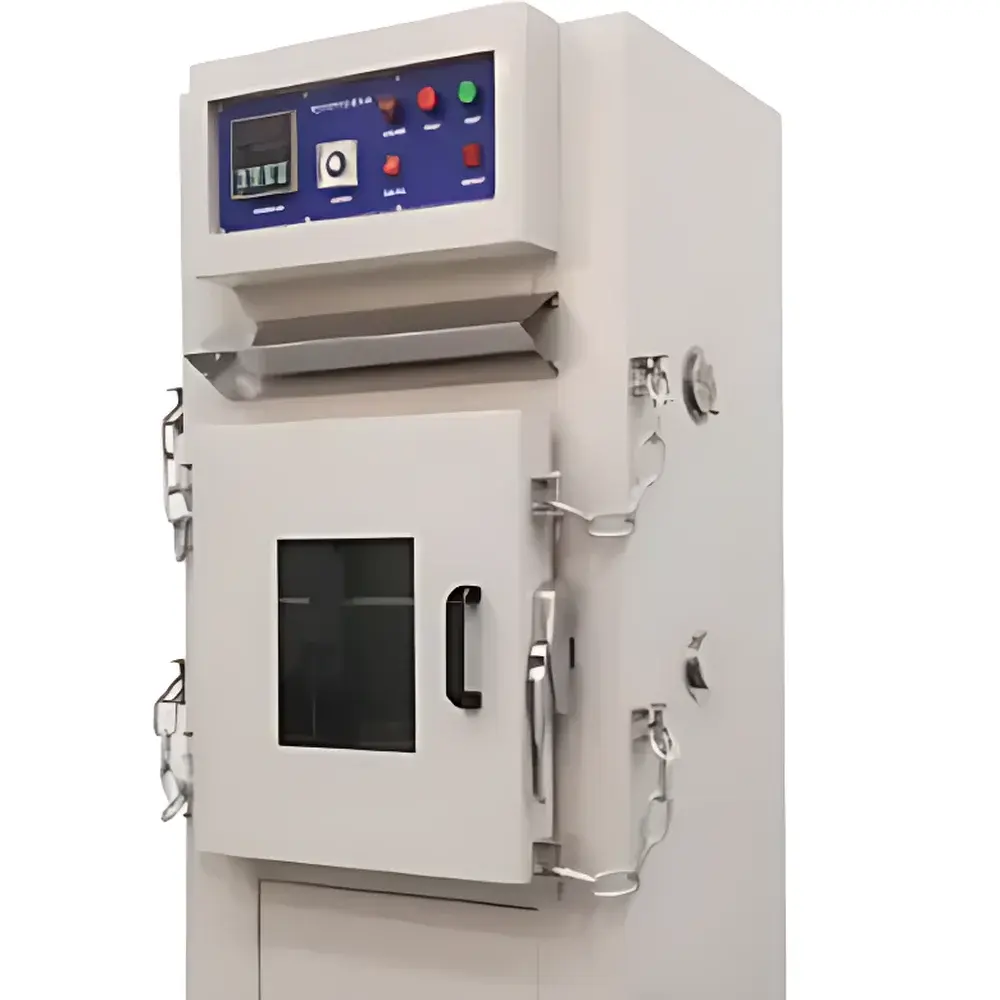
Battery Thermal Abuse Test Chamber TTech-GB38031
| Brand | TESTech |
|---|---|
| Origin | Jiangsu, China |
| Manufacturer Type | Direct Manufacturer |
| Country of Origin | China |
| Model | TTech-GB38031 |
| Price Range | USD 150–300 (FOB) |
| Temperature Range | Ambient to 200 °C |
| Temperature Control Accuracy | ±0.5 °C |
| Temperature Uniformity (Empty Chamber) | ±2.0 °C |
| Heating Rate | 5 °C/min (linear, RT to 150 °C, under standard load) |
| Temperature Overshoot | ≤2 °C |
| Internal Chamber Dimensions | W1000 × D1000 × H1000 mm |
| Interior Material | SUS304 Stainless Steel |
| Viewing Window | 390 × 360 mm, 20 mm Thick Tempered Blast-Resistant Glass |
| Power Supply | 380 V, 50 Hz |
| Heating Capacity | ≈12 kW |
| Safety Protections | Overvoltage, Overtemperature, Overcurrent, Short-Circuit, Reverse Polarity, and Misconnection Safeguards |
Overview
The TTech-GB38031 Battery Thermal Abuse Test Chamber is an engineered environmental simulation system designed specifically for evaluating thermal stability and failure response of lithium-ion and lithium-metal battery cells, modules, and small packs under standardized abuse conditions. It operates on the principle of controlled, accelerated thermal exposure in a convection-heated chamber—mimicking worst-case thermal runaway initiation scenarios such as external fire exposure, adjacent cell propagation, or thermal management system failure. The chamber complies with the core thermal abuse test protocols defined in GB 38031–2020 (Electric Vehicle Traction Battery Safety Requirements), GB 31241–2014 (Safety Requirements for Portable Lithium Batteries), UN Manual of Tests and Criteria, Part III, Subsection 38.3 (Thermal Abuse Test), and GB/T 18287–2000 (Cell Safety Specifications). Its primary function is to subject fully charged batteries to a precisely ramped and held temperature profile—(5±2) °C/min heating rate to 130±2 °C, followed by a 30-minute dwell—to assess whether the unit exhibits fire, explosion, venting, or electrolyte leakage.
Key Features
- High-fidelity thermal control architecture delivering ±0.5 °C setpoint accuracy and ≤±2.0 °C temperature uniformity across the empty workspace—validated per IEC 60068-3-5 and ASTM E145 Class I requirements;
- Linear 5 °C/min heating ramp (RT to 150 °C) under standard thermal load, with overshoot limited to ≤2 °C—ensuring reproducible thermal stress profiles critical for comparative safety qualification;
- Robust 1 m³ internal chamber constructed entirely from mirror-finished SUS304 stainless steel, resistant to corrosion from off-gassed electrolytes and thermal decomposition products;
- Integrated forced-air circulation system with optimized baffle geometry and dual axial fans, ensuring uniform heat distribution and eliminating localized hot/cold spots;
- 20 mm thick tempered blast-resistant viewing window (390 × 360 mm), rated for transient overpressure events up to 0.5 MPa—enabling real-time visual monitoring without compromising operator safety;
- Multi-layer safety interlock system including independent overtemperature cutouts, solid-state relay redundancy, current-limiting circuitry, and polarity-sensing terminals to prevent miswiring-induced short circuits during cell insertion;
- Front-panel programmable controller with data logging capability (optional USB/RS485 interface), supporting user-defined ramp-hold profiles compliant with multiple international standards.
Sample Compatibility & Compliance
The TTech-GB38031 accommodates cylindrical (18650, 21700, 26650), prismatic, and pouch-format cells up to 150 mm in longest dimension; module-level testing is feasible for configurations ≤300 mm × 300 mm × 100 mm. All test procedures are aligned with mandatory regulatory frameworks for lithium battery safety certification in China (GB 38031, GB 31241), global transport compliance (UN 38.3 Section 5.2), and consumer electronics (IEC 62133-2:2017 Annex A). The chamber’s thermal performance validation report includes traceable calibration against NIST-traceable RTDs, and its design supports GLP-compliant audit trails when paired with optional software-enabled event logging.
Software & Data Management
While the base configuration features an embedded PID controller with local display and manual profile setup, an optional PC-based data acquisition package provides time-stamped temperature logging at 1 Hz resolution, real-time graphing, alarm history export (CSV), and configurable pass/fail thresholds. The system supports 21 CFR Part 11–compliant user access levels (operator, supervisor, administrator) and electronic signature capture when deployed in GMP-regulated R&D or QC environments. All thermal profiles—including ramp rate, dwell duration, and termination criteria—are stored with metadata (date, operator ID, sample ID) to satisfy ISO/IEC 17025 documentation requirements.
Applications
- Pre-certification thermal abuse testing for EV traction batteries prior to GB 38031 submission;
- Comparative evaluation of thermal barrier materials and cell packaging integrity under sustained high-temperature stress;
- Root-cause analysis of thermal runaway propagation in multi-cell modules;
- Validation of battery management system (BMS) thermal cutoff logic under controlled boundary conditions;
- Accelerated aging studies correlating thermal exposure duration with impedance rise and capacity fade;
- Supplier qualification testing per OEM-specific safety specifications (e.g., CATL, BYD, or VW TL 82462).
FAQ
What standards does the TTech-GB38031 explicitly support?
It is configured and validated for GB 38031–2020, GB 31241–2014, UN 38.3 Section 5.2, and GB/T 18287–2000 thermal abuse test clauses.
Can the chamber accommodate 48 V battery modules?
Yes—modules up to 300 mm × 300 mm × 100 mm may be tested, provided external cabling and thermal mass remain within the specified load envelope for linear ramp fidelity.
Is third-party calibration certification included?
A factory calibration report with uncertainty values (k=2) is supplied; ISO/IEC 17025-accredited field calibration services are available upon request.
How is operator safety maintained during thermal runaway events?
The chamber integrates pressure-relief vents, flame arrestor mesh, integrated gas detection (optional), and automatic power cutoff triggered by internal pressure or temperature excursion beyond safe thresholds.
Does the system support automated test sequencing across multiple samples?
With the optional software suite, up to 99 programmable test sequences can be queued and executed unattended, each with unique ramp/dwell parameters and pass/fail logic.






