
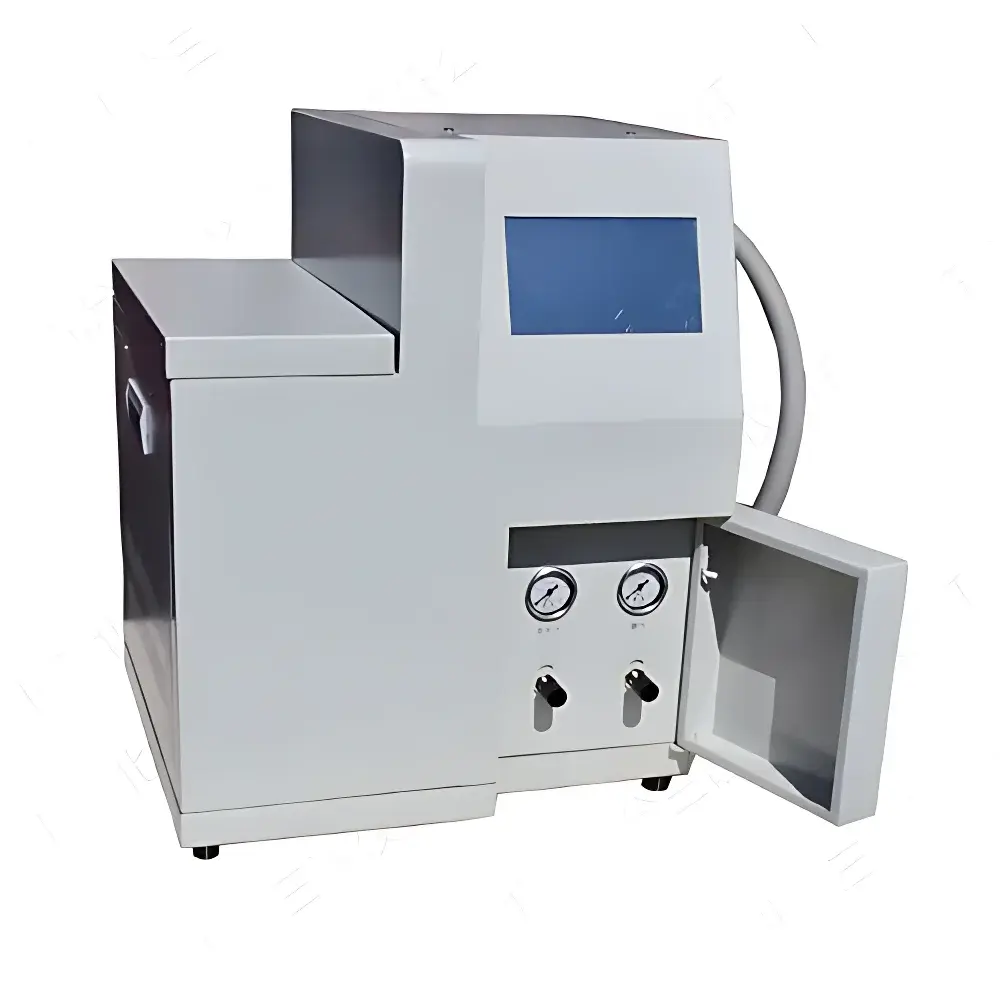
Beifen Sanpu AHbS-20A Plus Fully Automated Static Headspace Sampler for GB 5009.37–1985 Residual Solvent Analysis in Vegetable Oils
| Brand | Beifen Sanpu |
|---|---|
| Origin | Beijing, China |
| Manufacturer Type | Direct Manufacturer |
| Instrument Type | Static Headspace Sampler |
| Automation Level | Fully Automatic |
| Sample Vial Heating Range | Ambient to 200 °C (1 °C increments) |
| Valve & Transfer Line Temperature Range | 40–220 °C (±1 °C accuracy) |
| Quantitative Loop Volume | 1 mL |
| Sample Position Capacity | 20 positions |
| Vial Sizes Supported | 10 mL or 20 mL |
| Temperature Stability | < ±0.5 °C |
| RSD | < 1.0% (100 ppm ethanol in water) |
| Pressure Control Range | 0–0.25 MPa (continuously adjustable) |
| Sampling Time | 0–30 min |
| Injection Time | 0–999 s |
| Purge/Flush Flow | 0–100 mL/min (adjustable) |
| Communication Interface | USB |
Overview
The Beifen Sanpu AHbS-20A Plus is a fully automated static headspace sampler engineered for precise, reproducible quantification of residual solvents in complex food matrices—specifically designed to comply with the Chinese national standard GB 5009.37–1985 for residual solvent analysis in vegetable oils. It operates on the principle of gas-phase equilibrium partitioning: volatile analytes in liquid or solid samples are thermally equilibrated within sealed vials; the headspace vapor is then pressurized and transferred via a high-inertness quantitative loop into a gas chromatograph (GC) for separation and detection. This method eliminates non-volatile matrix interferences, minimizes column contamination, and yields clean chromatograms with reduced co-elution risk—critical for regulatory compliance in food safety testing laboratories.
Key Features
- Fully automated 20-position sample carousel with intelligent vial detection—automatically skips empty positions and prevents mechanical collision during indexing.
- Triple-zone independent temperature control: sample vial oven (ambient–200 °C), six-port valve (40–220 °C), and transfer line (40–220 °C), all with ±0.5 °C stability and 0.5% absolute accuracy.
- High-inertness fluidic path: de-activated fused-silica tubing and passivated stainless-steel components ensure minimal adsorption, carryover, or cross-contamination—validated by <1.0% RSD using 100 ppm ethanol/water standard.
- Positive-pressure sampling architecture: enables direct analysis of viscous or semi-solid samples (e.g., refined oils, margarines, emulsions) without derivatization or dilution.
- Integrated EPC-ready architecture (optional): supports electronic pressure control for enhanced method robustness and retention time reproducibility across multi-day sequences.
- 7-inch full-color graphical LCD interface with animated workflow guidance—parameter setup, real-time status monitoring, and diagnostic logs accessible without PC dependency.
- USB host interface and TTL-level GC synchronization: triggers GC start, data acquisition, and instrument event logging in alignment with chromatographic runtime—fully compatible with Agilent, Shimadzu, Thermo Fisher, and国产 GC platforms.
Sample Compatibility & Compliance
The AHbS-20A Plus supports 10 mL and 20 mL crimp-top headspace vials (custom sizes available), accommodating both aqueous and lipid-rich matrices. Its thermal and pressure control fidelity ensures adherence to method requirements specified in GB 5009.37–1985, which mandates strict control over equilibration temperature (typically 80–120 °C), pressurization duration (≥10 min), and injection precision for solvents including hexane, petroleum ether, acetone, and ethyl acetate. The system also meets technical prerequisites for multiple environmental and pharmaceutical standards, including HJ 642–2013 (soil VOCs), HJ 736–2015 (sediment halocarbons), SN/T 4068–2014 (food-contact materials), and ChP 2015 Vol. IV, p.522 (residual solvents in pharmaceutical excipients). All firmware and hardware design elements support audit-ready operation under GLP environments, including timestamped parameter logs and full sequence traceability.
Software & Data Management
Instrument parameters—including vial heating ramp profiles, valve actuation timing, purge flow rates, and pressure setpoints—are configurable either locally via the touchscreen or remotely via USB-connected PC software. The embedded controller records complete method metadata (date/time, operator ID, vial position, actual temperatures, pressure traces) for each run, enabling full traceability per ISO/IEC 17025 and FDA 21 CFR Part 11 requirements when paired with compliant chromatography data systems (CDS). No proprietary drivers required: native HID-class USB communication allows seamless integration with OpenLab CDS, Chromeleon, Empower, or open-source GC control platforms. Optional EPC modules provide real-time flow calibration and pressure compensation—critical for long-term retention time stability in regulated labs.
Applications
- Quantitative determination of residual hydrocarbon solvents (e.g., n-hexane, cyclohexane) in edible vegetable oils per GB 5009.37–1985.
- Analysis of vinyl chloride monomer (VCM) in PVC resins (GB 4615–1984) and packaging films.
- Screening of volatile organic compounds (VOCs) in drinking water (GB 5749–2006), soil (HJ 642–2013), and sediment (HJ 736–2015).
- Detection of pesticide fumigants (e.g., dichloropropane, chloropicrin) in cereals and dried fruits.
- Residual solvent profiling in pharmaceutical intermediates and excipients (ChP 2015, ICH Q3C).
- Flavor compound profiling in beverages, fruit juices, and fermented products using static headspace-GC-FID or GC-MS.
FAQ
What regulatory standards does the AHbS-20A Plus support for food testing?
It is validated for GB 5009.37–1985 (vegetable oil solvents), GB 5749–2006 (drinking water), and SN/T 4068–2014 (food-contact materials), with thermal and timing parameters fully traceable to method specifications.
Can the system handle high-viscosity samples like crude plant oils?
Yes—the positive-pressure sampling mechanism and heated transfer line (up to 220 °C) prevent condensation and ensure quantitative transfer of volatiles from viscous or semi-solid matrices without pre-dilution.
Is method validation documentation available?
Yes—system suitability test protocols, RSD verification reports (<1.0% at 100 ppm ethanol), and temperature uniformity mapping data are provided with each unit to support IQ/OQ/PQ qualification.
Does it support dynamic headspace or only static mode?
The AHbS-20A Plus is optimized for static headspace analysis; dynamic (purge-and-trap) functionality requires external trapping hardware and is not integrated.
How is carryover mitigated between runs?
Each cycle includes programmable high-flow inert gas purge (0–100 mL/min) of the valve, loop, and transfer line, validated to reduce carryover to <0.1% for high-concentration standards.





