
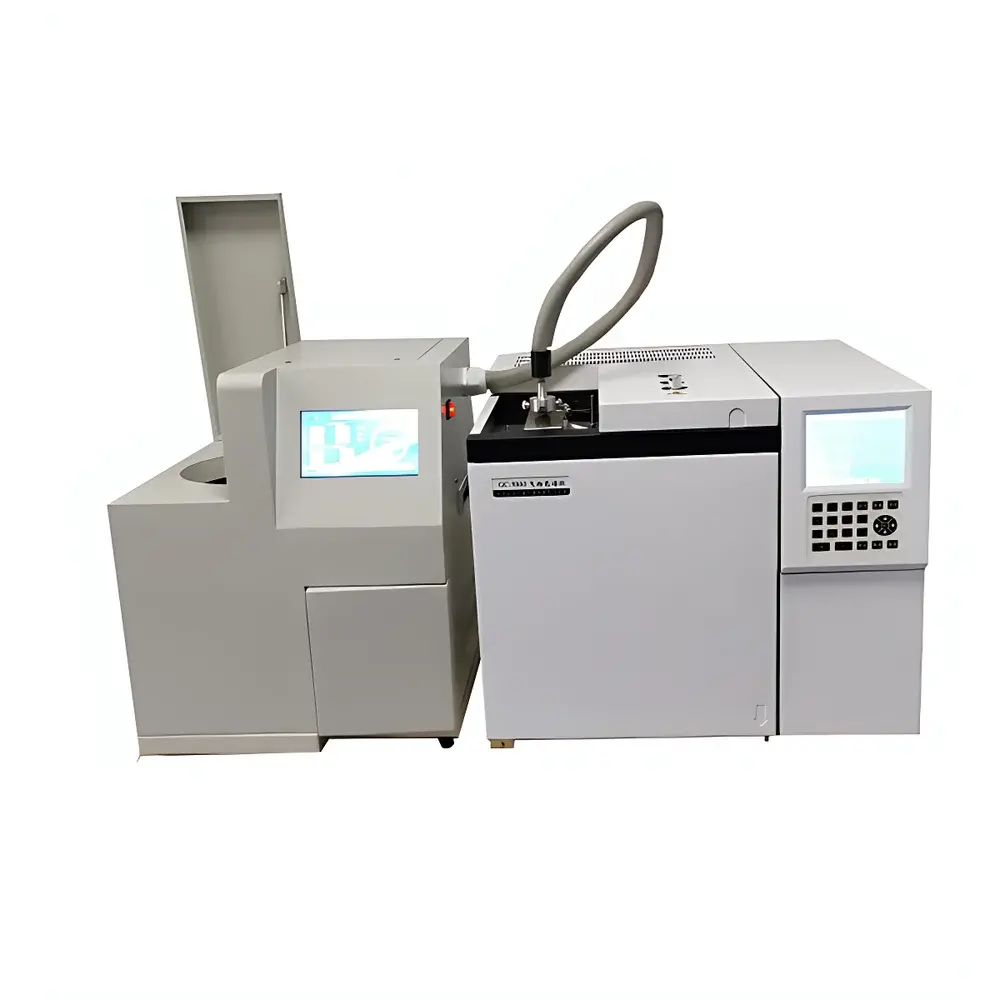
Beifen Sanpu AHS-20A PLUS Fully Automated Static Headspace Sampler for Water Analysis of BTEX and Styrene
| Brand | Beifen Sanpu |
|---|---|
| Origin | Beijing, China |
| Manufacturer | Yes |
| Instrument Type | Static Headspace Sampler |
| Automation Level | Fully Automatic |
| Vial Heating Range | Ambient to 200°C (1°C increment) |
| Valve & Transfer Line Temperature Control | 40–220°C (±1°C accuracy) |
| Sample Loop Volume | 1 mL |
| Vial Capacity | 20 positions |
| Compatible Vial Sizes | 10 mL or 20 mL |
Overview
The Beifen Sanpu AHS-20A PLUS is a fully automated static headspace sampler engineered for precise, reproducible quantification of volatile aromatic hydrocarbons—including benzene, toluene, ethylbenzene, xylenes (o-, m-, p-), isopropylbenzene (cumene), and styrene—in aqueous environmental matrices. Designed in strict alignment with HJ 1067–2019 (Chinese EPA standard for determination of BTEX compounds in water by headspace gas chromatography), the system enables compliant execution of the equilibrium-based static headspace method. It operates on the fundamental principle that, under controlled temperature and pressure, volatile analytes partition between the liquid phase and the overlying vapor phase until thermodynamic equilibrium is achieved. At equilibrium, the concentration of each compound in the headspace gas is directly proportional to its aqueous-phase concentration—enabling accurate quantitation via calibration against aqueous standard solutions. The AHS-20A PLUS interfaces seamlessly with benchtop GC-FID systems, delivering high-throughput, low-contamination sample introduction without manual intervention.
Key Features
- Fully automated 20-position carousel with programmable vial selection, eliminating manual handling and reducing analyst exposure to hazardous volatiles.
- Precise, independent thermal control of vial oven (ambient to 200°C, ±1°C), injection valve (40–220°C), and transfer line (40–220°C), ensuring consistent equilibration and minimizing condensation artifacts.
- 1-mL fixed-volume sampling loop with inert internal surface (e.g., SilcoNert®-treated stainless steel), guaranteeing repeatable injection volume and minimal carryover across high-concentration samples.
- Integrated vial agitator function (optional setting) enhances mass transfer kinetics during equilibration—particularly beneficial for viscous or particulate-laden wastewater samples.
- Robust architecture with corrosion-resistant components, compatible with acidic sample matrices (pH ≤ 2 per HJ 1067–2019 protocol) and salt-saturated headspace conditions (3 g NaCl per 10 mL sample).
- Compliant thermal ramping and hold timing logic supports method-defined equilibration (e.g., 60°C for 30 min) and ensures adherence to regulatory timing tolerances.
Sample Compatibility & Compliance
The AHS-20A PLUS accommodates standard 10 mL and 20 mL crimp-top or screw-cap headspace vials with PTFE/silicone septa, meeting ISO 10810 and ASTM D6866 compatibility requirements for volatile organic analysis. Its operational parameters satisfy the instrumental criteria specified in HJ 1067–2019 (Section 5.5), including ±1°C temperature control precision for both vial and valve zones. When deployed in conjunction with GC-FID systems configured per HJ 1067–2019 (e.g., DB-FFAP or equivalent polar capillary column, FID detection), the complete workflow achieves method-defined detection limits of 2–3 µg/L and quantitation limits of 8–12 µg/L for all eight target BTEX compounds at 10.0 mL sample volume. The system supports GLP-compliant data integrity through audit-trail-ready operation logs and time-stamped run sequences—facilitating traceability in regulated environmental testing laboratories.
Software & Data Management
The AHS-20A PLUS is controlled via PC-based software with intuitive graphical interface, supporting method storage, sequence scheduling, real-time status monitoring, and error logging. All method parameters—including vial position, incubation temperature/time, valve heat zone setpoints, loop fill/flush cycles, and injection timing—are digitally defined and saved with version control. Raw instrument events (e.g., vial puncture confirmation, loop pressurization, GC trigger signal) are timestamped and exportable in CSV format for integration into LIMS environments. While the base configuration does not include 21 CFR Part 11-compliant electronic signature modules, the software architecture allows third-party validation packages to be implemented for GMP/GLP-aligned deployment. Data files retain full metadata (operator ID, date/time, method name, vial ID), satisfying ISO/IEC 17025 documentation requirements for accredited testing.
Applications
Primary applications include routine monitoring of BTEX contaminants in surface water, groundwater, municipal wastewater, and industrial effluents per Chinese national standards (HJ 1067–2019). The system is also validated for use in compliance testing against US EPA Method 502.2 (volatile organics in drinking water) and ASTM D5172 (determination of benzene in gasoline via headspace GC), provided GC method parameters are appropriately adapted. Additional use cases encompass method development for emerging aromatic pollutants (e.g., alkylated benzenes, halogenated styrenes), QA/QC of laboratory reagent blanks and matrix spikes, and interlaboratory comparison studies requiring high inter-run reproducibility (RSD < 3% for replicate injections of 5 µg/L standards). Its robustness in high-salt, low-pH aqueous matrices makes it suitable for leachate analysis from landfills and contaminated soil extraction studies.
FAQ
Does the AHS-20A PLUS support dynamic headspace (purge-and-trap) mode?
No. The AHS-20A PLUS is designed exclusively for static headspace analysis. Dynamic headspace functionality requires separate purge-and-trap instrumentation.
Can it be interfaced with GC systems from non-Chinese manufacturers (e.g., Agilent, Thermo, Shimadzu)?
Yes. The sampler provides standard TTL-level GC start/stop triggers and configurable contact closure outputs, enabling reliable synchronization with all major GC platforms equipped with external event inputs.
What maintenance intervals are recommended for long-term reliability?
Valve seals and septa should be replaced every 1,000–1,500 injections; the vial carousel drive belt inspected annually; and the entire thermal module calibrated biannually using NIST-traceable reference thermometers.
Is method validation documentation available for HJ 1067–2019 compliance?
Beifen Sanpu provides a technical application note detailing system suitability tests, carryover assessments, linearity verification (5–12 mg/L range), and precision data (intra-day RSD ≤ 2.8%) generated under HJ 1067–2019 conditions.
How is carryover mitigated during high-concentration sample runs?
The system employs three-stage loop purging (carrier gas flush + vacuum evacuation + inert gas backfill) prior to each injection, validated to reduce carryover to < 0.05% for 10 mg/L benzene standards.




