
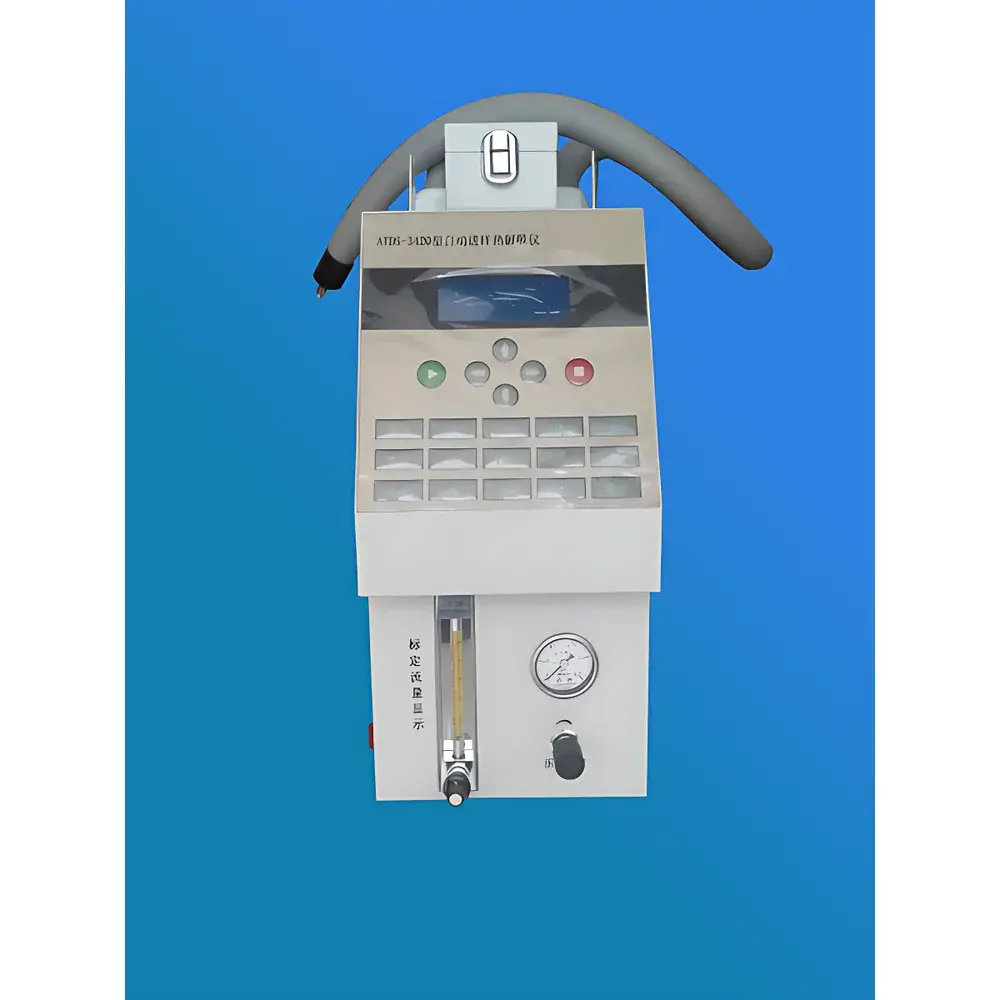
Beifen Sanpu ATDS-3420 Automated Thermal Desorber for GC Coupling
| Brand | Beifen Sanpu |
|---|---|
| Origin | Beijing, China |
| Manufacturer Type | OEM Manufacturer |
| Instrument Type | Single-Stage Thermal Desorber |
| Primary Desorption Temperature Range | Ambient to 400 °C |
| Secondary Desorption / Focusing Temperature Range | 100–400 °C |
| Cold Trap Temperature Range | Down to –35 °C |
| Desorption Recovery Rate | >90% (compound-dependent) |
| Sample Capacity | 20 adsorbent tubes |
| Dimensions | 360 × 170 × 390 mm |
| Weight | ~10 kg |
Overview
The Beifen Sanpu ATDS-3420 Automated Thermal Desorber is a benchtop sample introduction system engineered for quantitative trace-level analysis of volatile and semi-volatile organic compounds (VOCs and SVOCs) by gas chromatography (GC) or GC–MS. It operates on the principle of thermal desorption—where analytes pre-concentrated on sorbent tubes are thermally released in two sequential stages: primary desorption from the tube into a heated transfer line, followed by cryo-focusing in a low-temperature cold trap (down to –35 °C), and rapid secondary desorption directly into the GC inlet. This two-stage architecture ensures high sensitivity (detection limits down to sub-ppb levels in air), minimal analyte degradation, and excellent reproducibility across complex environmental and occupational matrices. Designed for seamless integration with both domestic and international GC platforms—including Agilent, Thermo Fisher, Shimadzu, and PerkinElmer systems—the ATDS-3420 requires no hardware modification to the host GC; it interfaces via standard pneumatic triggers and optional event synchronization protocols.
Key Features
- Automated 20-position carousel for unattended batch processing of sorbent tubes (e.g., Tenax TA, Carbopack, or mixed-bed media)
- Independent temperature control of three critical zones: primary desorption furnace (ambient to 400 °C), valve manifold (ambient to 160 °C), and transfer line (ambient to 160 °C), each with ±0.5 °C accuracy and stability
- Cryo-focusing capability using a Peltier-cooled cold trap (–35 °C minimum), enabling sharp band focusing and improved chromatographic resolution
- Programmable 8-step time-sequence control with up to 9 user-editable, stored methods—supporting full automation of desorption, transfer, GC trigger, post-run purge, and tube back-flush
- Dual-mode operation: compatible with external GC event signals or internal timer-based initiation; supports simultaneous GC and data system startup
- Integrated back-flush function for post-desorption cleaning of sampling tubes using adjustable carrier gas flow (0–20 mL/min)
- Modular pneumatic design featuring imported solenoid valves and actuators for long-term reliability and leak-tight performance
- Optional 0.53 mm ID fused silica transfer line for enhanced transmission of polar or reactive analytes
- Intuitive Chinese-language LCD interface with real-time status display, date/time stamping, and programmable brightness control
Sample Compatibility & Compliance
The ATDS-3420 is validated for use with standardized sorbent tubes compliant with ISO 16017-1, ASTM D6196, and EPA TO-17 methodologies. It supports direct coupling to GC systems configured for split/splitless, PTV, or cold-on-column injection. The instrument meets functional requirements outlined in key regulatory frameworks including HJ 644–2013 (VOCs in ambient air), HJ 583–2010 (benzene homologues), HJ 734–2014 (stationary source emissions), GB/T 18883–2002 (indoor air quality), and GB 50325–2020 (civil building indoor pollution control). While not certified to IEC 61000 or CE for EU market placement without additional conformity assessment, its electrical safety design adheres to GB 4793.1–2007 (equivalent to IEC 61010-1), and operational parameters align with GLP-compliant laboratory practices when paired with audit-trail-capable GC data systems.
Software & Data Management
The ATDS-3420 operates as a hardware controller independent of proprietary software—no dedicated PC application is required. All method parameters (temperatures, timing, gas flows, trigger logic) are configured locally via the front-panel membrane keyboard and stored in non-volatile memory. Time-stamped run logs—including date, method ID, tube position, and thermal profile activation—are retained onboard. For laboratories implementing 21 CFR Part 11 compliance, the unit supports external electronic record linkage through TTL-compatible event outputs synchronized with GC acquisition software (e.g., OpenLab CDS, Chromeleon, or Empower). Audit trail integrity is maintained at the GC data system level; the desorber itself provides deterministic, repeatable hardware-level execution without embedded user-accessible firmware updates.
Applications
- Indoor and ambient air monitoring per national standards (e.g., benzene, toluene, ethylbenzene, xylenes, C2–C12 alkanes, aldehydes)
- Occupational exposure assessment in manufacturing, petrochemical, and pharmaceutical facilities
- Material emission testing: packaging films, adhesives, composites, and polymer substrates
- Forensic toxicology: detection of volatiles in blood headspace or post-mortem tissue samples
- Pharmaceutical residual solvent analysis (ICH Q3C guidelines)
- Rapid field-deployable screening for chemical threat agents or accidental releases
- Flavor and fragrance profiling in food, cosmetic, and essential oil applications
- Medical breath analysis research (e.g., acetone, isoprene, alkanes as metabolic biomarkers)
FAQ
Is the ATDS-3420 compatible with GC–MS systems?
Yes—it delivers narrow, focused analyte bands ideal for mass spectrometric detection, especially when coupled with cryo-focusing and fast secondary desorption.
Can it be used for multi-bed sorbent tubes (e.g., Tenax TA + Carbograph 1TD)?
Yes—temperature programming accommodates staged desorption profiles optimized for multi-layer traps.
Does it support automated calibration with internal standards?
Yes—via optional liquid standard introduction port or vapor-phase spiking prior to tube loading.
What maintenance is required for long-term operation?
Annual verification of temperature calibration, periodic replacement of O-rings and septa, and inspection of pneumatic tubing integrity are recommended.
Is remote monitoring or network connectivity available?
No native Ethernet or Wi-Fi interface is provided; however, analog/digital I/O signals allow integration into centralized lab automation systems via PLC or SCADA.
Related Products






