
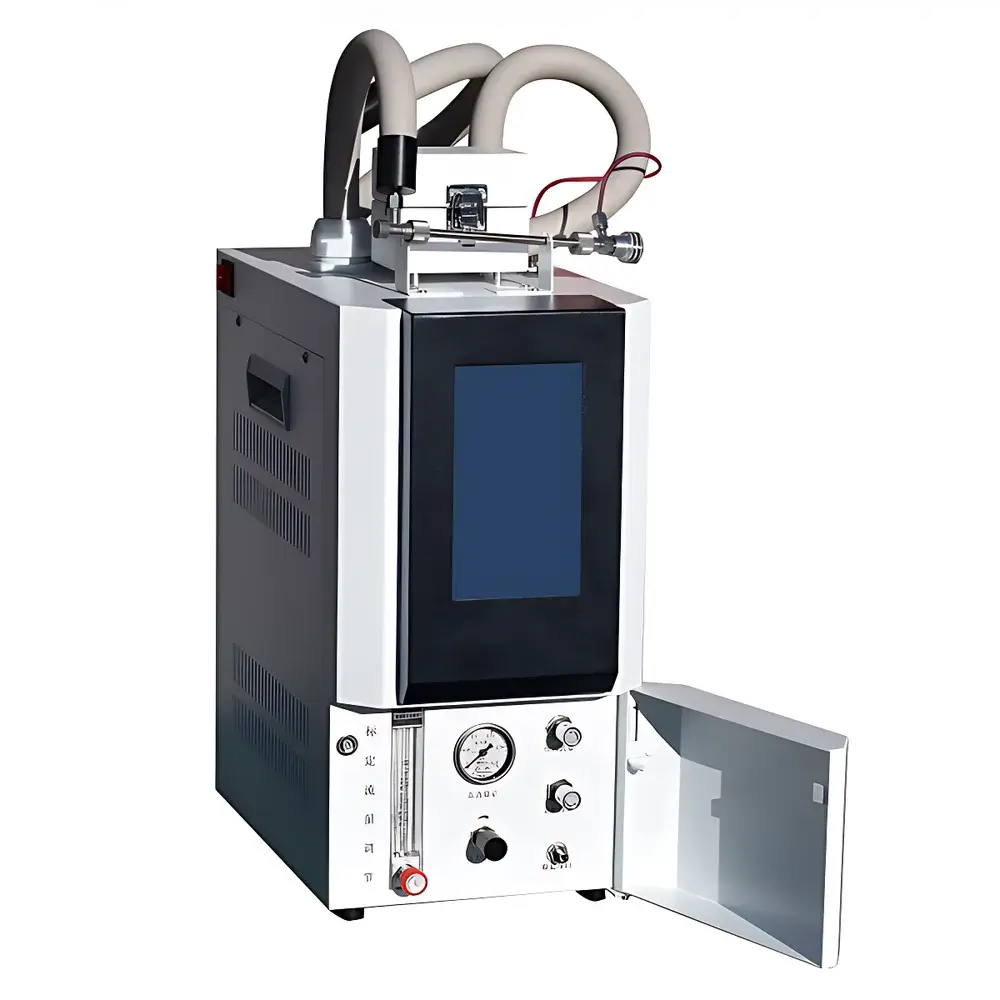
Beifen Sanpu ATSD-3430 Dual-Stage Thermal Desorber
| Brand | Beifen Sanpu |
|---|---|
| Origin | Beijing, China |
| Manufacturer Type | Direct Manufacturer |
| Instrument Type | Dual-Stage Thermal Desorber |
| Desorption Temperature Range | Ambient to 450 °C |
| Cold Trap Temperature Range | −35 °C to Ambient |
| Desorption Recovery Rate | >99% (compound-dependent) |
| Sample Position Capacity | 1 tube |
| Heating Ramp Rate (2nd Stage) | >3000 °C/min |
| Peak Width (2nd Stage) | <3 s |
| Valve Type | High-Temperature 6-Port Rotary Valve (up to 240 °C) |
Overview
The Beifen Sanpu ATSD-3430 Dual-Stage Thermal Desorber is a laboratory-grade, fully automated thermal desorption system engineered for trace-level volatile and semi-volatile organic compound (VOC/SVOC) analysis in environmental, industrial hygiene, food safety, and building material testing applications. It operates on the principle of two-stage thermal desorption—first-stage thermal release from sorbent tubes under controlled inert gas flow, followed by cryofocusing in a thermoelectrically cooled cold trap (−35 °C), and rapid second-stage flash desorption directly into the GC injection port. This architecture ensures high analyte transfer efficiency, minimal band broadening, and compatibility with both capillary and packed-column gas chromatographs—including all major domestic and international GC and GC-MS platforms. Designed to meet method requirements specified in EPA TO-17, ISO 16017-1, ASTM D6196, and China’s HJ 644–2013 and HJ 734–2014 standards, the ATSD-3430 delivers reproducible, quantitative results for compounds boiling below 350 °C, including BTEX, aldehydes, PAHs, phthalates, and emerging contaminants such as SVOCs in indoor air and consumer product emissions.
Key Features
- Thermoelectric (Peltier) cooling for cold trap operation—eliminates reliance on liquid nitrogen or mechanical chillers, reducing operational cost and increasing system uptime.
- Independent four-zone temperature control: primary desorption oven, valve oven, transfer line, and secondary desorption/focusing zone—each precisely regulated to prevent cold spots and ensure quantitative analyte transfer.
- High-inertness, de-activated fused-silica and stainless-steel sample pathways—minimizing adsorption, carryover, and memory effects across sequential analyses.
- Programmable multi-step sequence: primary desorption → inert gas purge → cold trap focusing → rapid second-stage desorption (≥3000 °C/min ramp) → GC injection → post-run valve/line backflush.
- Integrated 240 °C-rated high-temperature 6-port rotary valve housed within a heated enclosure—ensuring zero condensation at critical junctions and preserving peak integrity.
- 7-inch full-color touchscreen interface with Chinese/English toggle support; intuitive method editor with real-time status animation and elapsed time tracking.
- GC synchronization capability via TTL trigger output or external software command—enabling seamless integration with Agilent, Thermo Fisher, Shimadzu, PerkinElmer, and domestic GC data systems.
- Onboard standard vapor generation mode for direct calibration curve construction without external spiking equipment.
Sample Compatibility & Compliance
The ATSD-3430 accepts standard 6 mm OD × 89 mm length stainless-steel or glass sorbent tubes (e.g., Tenax TA, Carbopack B/C, Carboxen 1000), supporting both single-tube and multi-tube configurations (1-position configuration standard; optional multi-tube autosampler available). It complies with QA/QC requirements for GLP and ISO/IEC 17025-accredited laboratories, providing audit-ready run logs, method versioning, and user-access-level controls. All temperature zones are calibrated traceable to NIST-certified references. The system supports 21 CFR Part 11-compliant data handling when paired with validated chromatography data systems (CDS), including electronic signatures, change history, and secure archive export.
Software & Data Management
The embedded firmware supports method storage (≥100 methods), time-segmented temperature programming, and event-triggered actions (e.g., GC start, valve actuation, cooling activation). Raw instrument logs—including temperature setpoints, actual readings, valve timing, and error codes—are timestamped and exportable in CSV format. Optional PC-based control software (Windows 10/11 compatible) enables remote monitoring, batch method deployment, and integration with LIMS via OPC UA or TCP/IP protocols. All software modules undergo annual functional verification per internal validation SOPs aligned with ISO/IEC 17025 clause 5.9.
Applications
- Indoor air quality assessment: formaldehyde, acetaldehyde, benzene, toluene, xylenes (BTX), terpenes, and plasticizer emissions from furniture, flooring, and insulation materials.
- Workplace exposure monitoring per OSHA/NIOSH methods and GBZ/T 160 series standards.
- VOC profiling in food packaging headspace, roasted coffee volatiles, and flavor-release kinetics.
- Regulatory compliance testing for automotive interior materials (VDA 278), electronics enclosures (IEC 62474), and children’s products (CPSIA).
- Method development for emerging contaminants including siloxanes, fluorotelomer alcohols, and halogenated flame retardants.
FAQ
What sorbent tube formats are supported?
Standard 6 mm OD × 89 mm stainless-steel or borosilicate glass tubes filled with single- or multi-bed sorbents (e.g., Tenax TA + Carbopack B + Carbosieve SIII). Custom tube dimensions require mechanical adapter evaluation.
Does the system support unattended overnight operation?
Yes—fully programmable sequences with automatic shutdown, thermal cooldown, and error recovery enable unattended multi-sample runs when used with compatible GC autosamplers.
How is carryover minimized between samples?
Through three independent mechanisms: (1) high-temperature valve/line backflush with inert gas post-injection, (2) active heating of all transport paths above analyte condensation points, and (3) integrated cold trap bake-out cycles prior to each analysis.
Can the ATSD-3430 be validated for GMP environments?
Yes—the hardware design, firmware architecture, and documentation package (including IQ/OQ templates, calibration certificates, and traceability records) support qualification per Annex 15 and FDA guidance for analytical instrument qualification.
Is remote diagnostics available?
Standard Ethernet connectivity enables secure remote access via VPN for firmware updates, log review, and basic troubleshooting—subject to customer network policy approval.
Related Products





