
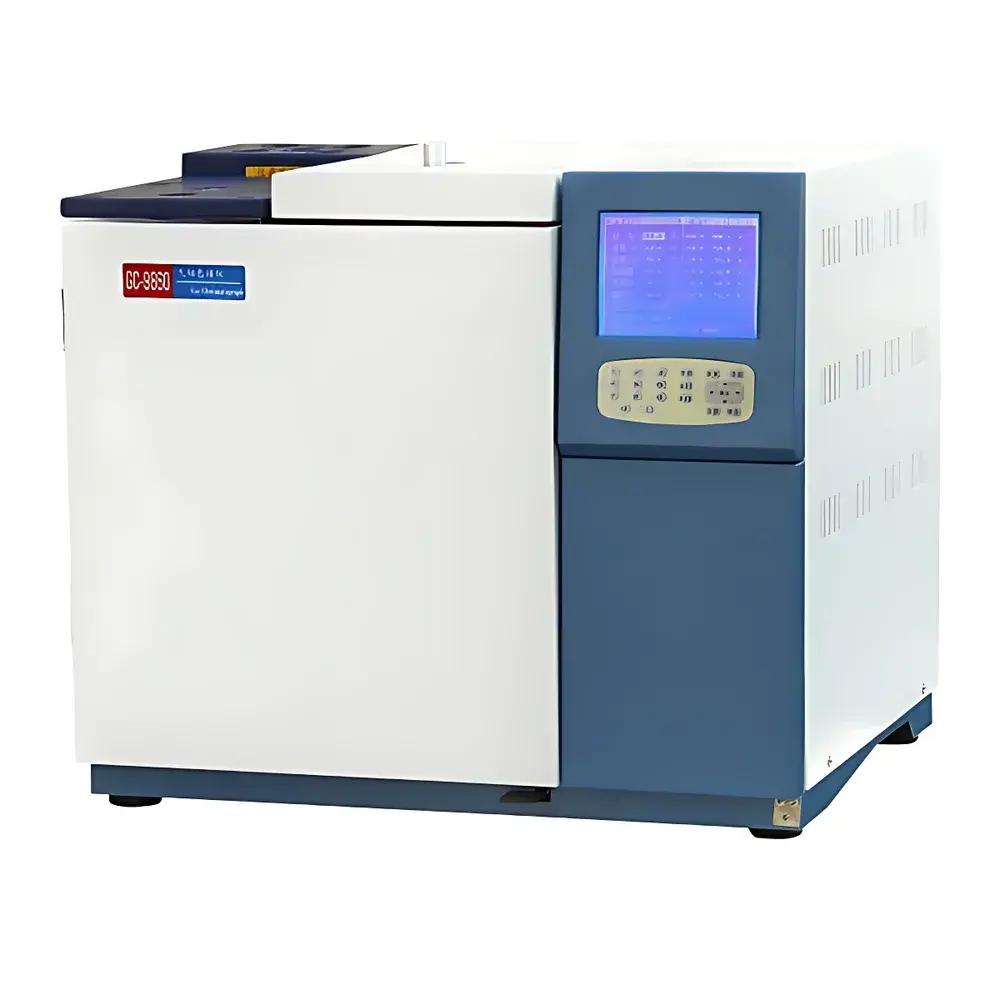
Beifen Sanpu BFSPGC-9860 High-Performance Gas Chromatograph
| Brand | Beifen Sanpu |
|---|---|
| Origin | Beijing, China |
| Manufacturer Type | Original Equipment Manufacturer (OEM) |
| Model | BFSPGC-9860 |
| Dimensions (L×H×W) | 520 × 480 × 500 mm |
| Column Oven Size | 260 × 250 × 150 mm |
| Column Installation Span | 152.4 mm (6-inch standard interface) |
| Weight | 50 kg |
| Power Consumption | 2500 W |
| Voltage | 220 V ±10% |
| Oven Temperature Range | +5 °C to 400 °C (1 °C increment) |
| Temperature Accuracy | ±0.1 °C |
| Temperature Gradient | ±1% (100–350 °C) |
| Ramp Rate | 0.1–50 °C/min (0.1 °C increment) |
| Max Programmed Time | 6000 min |
| Programmable Steps | 8 |
| FID Detection Limit | ≤2×10⁻¹² g/s (n-hexadecane) |
| FID Linear Range | ≥10⁷ |
| TCD Sensitivity | ≥10,000 mV·mL/mg (n-hexadecane) |
| ECD Detection Limit | ≤1×10⁻¹⁴ g/mL (⁶³Ni source) |
| FPD Detection Limit (P/S) | ≤1×10⁻¹² g/s |
| NPD Detection Limit (N/P) | ≤5×10⁻¹³ g/s |
Overview
The Beifen Sanpu BFSPGC-9860 is a high-performance gas chromatograph engineered for precision separation, identification, and quantification of volatile and semi-volatile organic compounds in complex matrices. Built upon the proven GC-9660 platform and significantly upgraded in hardware architecture, thermal control, detection sensitivity, and software intelligence, the BFSPGC-9860 employs classical capillary and packed-column gas chromatography principles—based on differential partitioning of analytes between a mobile gas phase (carrier gas) and a stationary phase coated inside the column. Its dual independent oven temperature control system—including intelligent dual rear doors enabling near-ambient cooling—and eight-step linear programmable temperature ramping support method development across wide boiling point ranges (C₂–C₄₀+), making it suitable for applications from light hydrocarbons to high-molecular-weight pesticides or pharmaceutical impurities. Designed and manufactured in Beijing, China, the instrument meets international mechanical, electrical, and electromagnetic compatibility standards (IEC 61000 series), and its structural integrity supports long-term operation in regulated laboratory environments requiring GLP-compliant data traceability.
Key Features
- Industrial-grade chassis with ergonomic front-panel layout and robust aluminum-alloy column oven housing for thermal stability and mechanical durability.
- Dual independent rear-door cooling system enabling column oven temperature control as low as +5 °C above ambient—critical for early-eluting compound resolution and method transfer reproducibility.
- Eight-stage programmable temperature ramping with 0.1 °C/min resolution and ±0.1 °C accuracy over full range (5–400 °C), supporting ASTM D3606, ISO 6416, and USP method requirements.
- Integrated microcurrent amplification circuitry enhancing FID baseline stability (noise ≤2×10⁻¹⁴ A) and detection limit (≤2×10⁻¹² g/s n-hexadecane), while TCD sensitivity is elevated fivefold versus prior-generation models.
- Modular detector configuration supporting simultaneous installation and operation of up to four detectors—including dual FID, dual TCD, dual ECD, or mixed configurations—with independent gas flow control and real-time event-triggered switching.
- Advanced self-diagnostic firmware with Chinese/English bilingual prompts, flash-based non-volatile memory (no battery backup required), and comprehensive thermal protection (over-temperature cutoff, Pt100 open/short detection).
- High-precision pressure and flow control via digital mass flow controllers (MFCs), ensuring stable carrier gas delivery across multiple columns and detectors under varying backpressure conditions.
Sample Compatibility & Compliance
The BFSPGC-9860 accommodates both packed columns (3–5 mm OD, stainless steel or glass) and fused-silica capillary columns (up to 100 m length, 0.53 mm ID). Its universal inlet design supports split, splitless, on-column, and PTV injection modes. The system complies with national metrological verification regulations for gas chromatographs (JJG 700–2016) and is routinely validated per ISO/IEC 17025 for testing laboratories. Optional accessories—including thermal desorbers, headspace samplers, pyrolyzers, and methanizers—extend analytical scope into environmental VOC monitoring (EPA TO-17), residual solvent analysis (ICH Q3C), and petrochemical hydrocarbon fingerprinting. All detector modules are designed to meet CE marking requirements for safety and EMC, and data acquisition firmware supports audit trail generation aligned with FDA 21 CFR Part 11 principles when integrated with compliant LIMS or CDS platforms.
Software & Data Management
The instrument features an embedded 5.7-inch TFT-LCD display (320×240 pixels) with bilingual UI (Chinese/English), offering 20 customizable operational screens and local storage for up to 20 complete chromatographic methods—including method parameters, calibration curves, integration settings, and report templates. Raw signal data (voltage vs. time) is recorded at ≥10 Hz sampling rate and exportable in ASCII or CSV format for third-party processing. While the onboard software does not include full electronic signature or role-based access control, its structured data output enables seamless integration with validated chromatography data systems (CDS) such as OpenLab CDS, Chromeleon, or LabSolutions for full 21 CFR Part 11 compliance. FLASH-based memory ensures retention of method and calibration data for >10 years without volatile battery dependency.
Applications
The BFSPGC-9860 serves as a core analytical platform across multiple regulated and research-driven sectors: petroleum refining (hydrocarbon group-type analysis per ASTM D5186); environmental monitoring (BTEX, PAHs, chlorinated solvents per EPA 8260/8021); pharmaceutical quality control (residual solvents, genotoxic impurities); food safety (pesticide residues, flavor volatiles, packaging migrants); public health (blood alcohol, toxicology screening); and academic research (polymer degradation products, metabolomics profiling). Its ability to operate dual TCDs with independent carrier gases allows concurrent analysis of permanent gases (H₂, O₂, N₂, CO, CO₂, CH₄) and hydrocarbons on separate columns—eliminating column changeover downtime and improving lab throughput.
FAQ
Does the BFSPGC-9860 support remote control and network connectivity?
The base configuration includes RS-232 and USB interfaces for direct PC connection; optional Ethernet module enables TCP/IP communication for integration into centralized lab networks.
Can the instrument be configured for GLP-compliant audit trails?
While the embedded software lacks built-in electronic signatures, raw data files and method logs are timestamped and immutable—enabling full traceability when paired with validated third-party CDS software meeting 21 CFR Part 11 requirements.
What maintenance intervals are recommended for detector components?
FID jet cleaning every 200–300 injections; TCD filament resistance verification quarterly; ECD ⁶³Ni source replacement every 2–3 years depending on usage intensity and sample matrix cleanliness.
Is the column oven compatible with cryogenic cooling for sub-ambient separations?
No—oven minimum operating temperature is +5 °C above ambient. For true sub-ambient operation, external cryo-cooling accessories must be interfaced separately.
How many injection valves can be installed simultaneously?
Up to two independent rotary valves (e.g., 6-port or 10-port) may be mounted externally and triggered via TTL events synchronized with oven temperature programs.






