
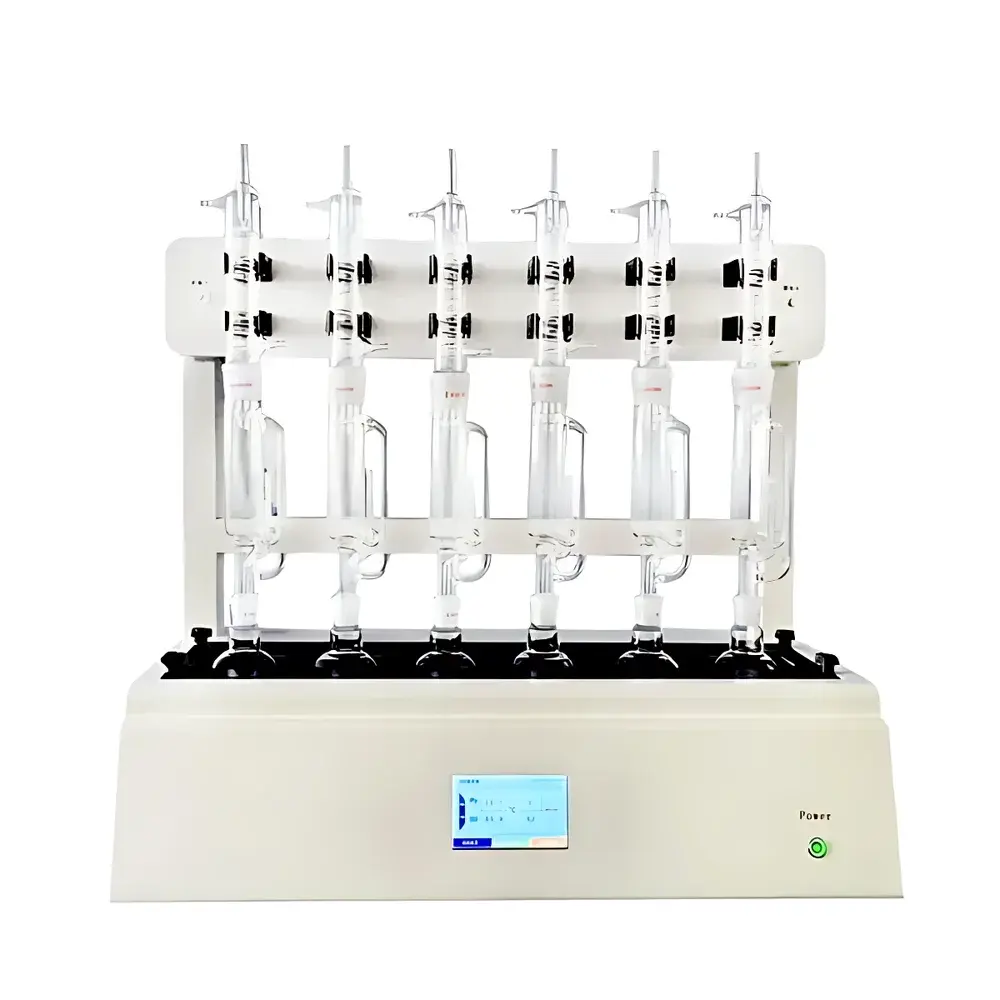
Beifen Sanpu CA-ST25 Soxhlet Extractor
| Brand | Beifen Sanpu |
|---|---|
| Origin | Beijing, China |
| Manufacturer Type | Manufacturer |
| Product Origin | Domestic (China) |
| Model | CA-ST25 |
| Pricing | Upon Request |
| Sample Capacity per Batch | 2–6 units |
| Extraction Flask Volume | 250 mL or 500 mL (selectable) |
| Sample Mass per Vessel | 0–5 g |
| Temperature Control Range | Ambient +5 °C to 100 °C |
| Power Supply | 220 V ±10 V, 50 Hz |
| Heating Power | 1000 W |
| Net Weight | 20 kg |
| Optional Cooling Power | 1000 W |
Overview
The Beifen Sanpu CA-ST25 Soxhlet Extractor is a laboratory-grade automated solvent extraction system engineered for quantitative fat determination in solid and semi-solid matrices. It operates on the classical Soxhlet principle—continuous cyclic percolation of hot solvent through a thimble-contained sample, followed by condensation, reflux, and siphon-driven return of enriched extract to the boiling flask. This thermodynamically efficient process ensures exhaustive lipid recovery while minimizing operator intervention. Designed to comply with GB/T 5512–1985 “Determination of Crude Fat in Cereals and Cereal Products,” the CA-ST25 delivers reproducible results aligned with internationally recognized gravimetric fat analysis protocols used in food safety testing, feed quality assurance, agricultural research, and environmental soil analysis.
Key Features
- Integrated three-zone architecture: independent heating zone for extraction flask, reflux condenser with precision temperature regulation, and optional active cooling module for enhanced solvent recovery efficiency.
- Programmable extraction duration with audible end-of-cycle alarm—enabling unattended operation across extended timeframes (e.g., 4–24 h typical for complete lipid extraction).
- Adjustable heating setpoint (ambient +5 °C to 100 °C) accommodates diverse solvents including petroleum ether (bp ≈ 40–60 °C), diethyl ether (bp ≈ 35 °C), and chloroform (bp ≈ 61 °C), ensuring compatibility with method-specific volatility requirements.
- Modular sample handling: accommodates 2 to 6 parallel extraction vessels, each supporting sample masses from 0.1 g to 5.0 g—optimized for both high-throughput screening and low-mass precision assays.
- Standardized 250 mL or 500 mL round-bottom extraction flasks—compatible with common volumetric calibration standards and GLP-compliant glassware traceability practices.
- Robust stainless-steel chassis and borosilicate glass components ensure long-term chemical resistance against organic solvents and thermal cycling stability.
Sample Compatibility & Compliance
The CA-ST25 supports a broad range of matrix types, including cereal grains, oilseeds, animal feed pellets, dairy powders, meat products, and homogenized soil samples. Its design adheres to fundamental principles outlined in AOAC Official Method 920.39 and ISO 6496:1999 (Animal feeding stuffs — Determination of ether extract), serving as a functional equivalent to validated reference instrumentation. While not certified to IEC 61010-1 or CE marking for EU market placement, its electrical architecture meets GB 4793.1–2007 (Safety requirements for electrical equipment for measurement, control, and laboratory use). All operational parameters—including temperature setpoints, cycle timing, and vessel configuration—are manually configured and documented per user-defined SOPs, supporting internal GLP compliance frameworks.
Software & Data Management
The CA-ST25 is a standalone benchtop instrument without embedded microprocessor control or digital interface. All operational parameters are adjusted via analog thermostatic controls and mechanical timers. Consequently, data recording follows manual logbook or LIMS-integrated entry protocols. Users are advised to maintain contemporaneous records of batch ID, sample mass, solvent type, extraction duration, flask tare weight, and final dried residue mass—consistent with FDA 21 CFR Part 11 expectations for audit-ready documentation when deployed in regulated environments. Optional external data loggers may be interfaced via RS-232 or USB-to-serial adapters for time-stamped temperature profiling.
Applications
- Routine crude fat quantification in QC laboratories for edible oils, bakery ingredients, and infant formula according to national food standards.
- Feed formulation validation and nutritional labeling compliance in compound feed manufacturing facilities.
- Soil organic matter assessment in agronomic studies and contaminated land remediation projects.
- Extraction of waxes, resins, and non-polar contaminants from polymer matrices or environmental filter media.
- Method development and validation studies requiring controlled, reproducible solvent reflux kinetics under ambient or elevated temperature conditions.
FAQ
Is the CA-ST25 compliant with AOAC or ISO fat determination methods?
It implements the core Soxhlet principle required by AOAC 920.39 and ISO 6496; however, full method compliance depends on user-executed procedural adherence—including solvent purity, drying conditions, and gravimetric technique—not instrument certification.
Can the unit operate continuously for 24 hours?
Yes, provided proper ventilation, solvent level monitoring, and thermal safety margins are maintained per manufacturer guidelines.
What is the expected lifetime of the heating element and condenser tubing?
Under standard usage (≤8 h/day, clean solvent, no dry-firing), the 1000 W tubular heater and borosilicate condenser typically exceed 5 years of service life with routine descaling.
Is remote monitoring or Ethernet connectivity available?
No—this is an analog-controlled system without digital communication ports or IoT capability.
Does the optional 1000 W cooling module require external water supply or refrigerant charge?
The cooling module is air-cooled and self-contained; no plumbing or refrigerant servicing is required.
Related Products





