
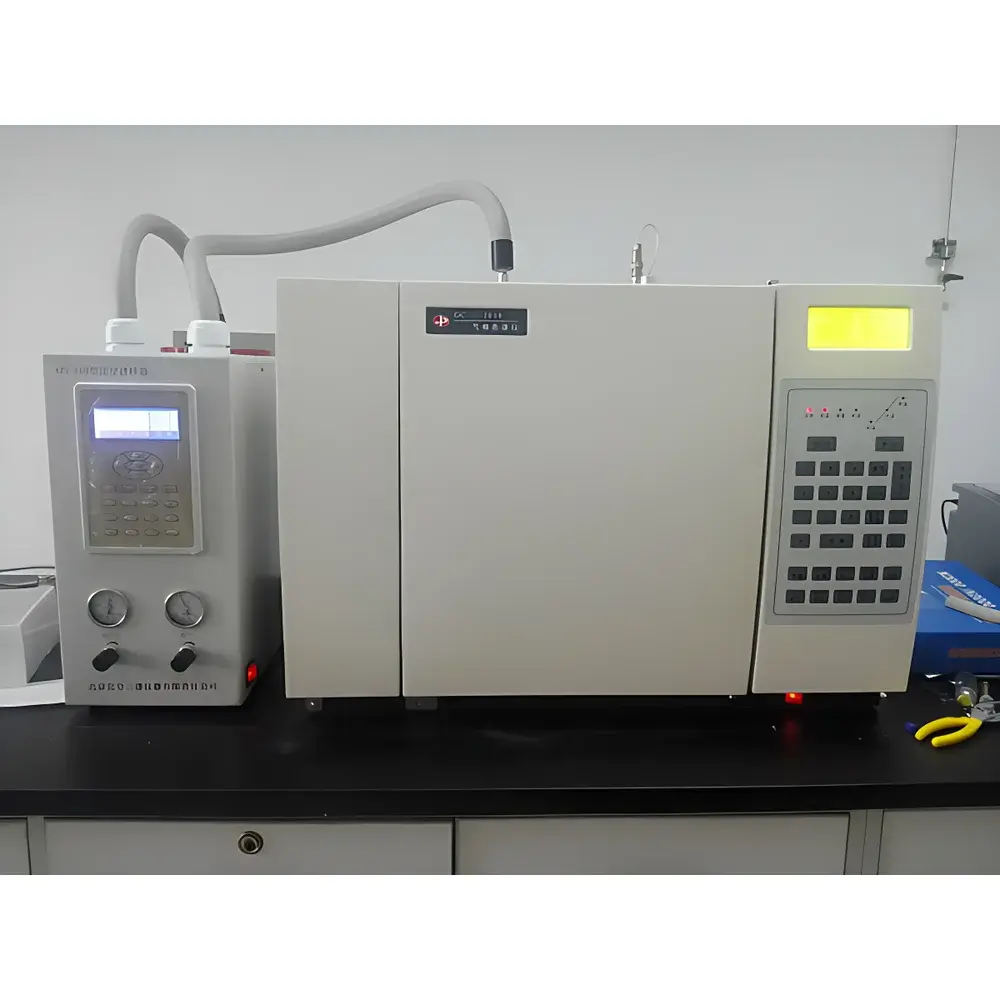
Beifen Sanpu GC-2010B Laboratory Gas Chromatograph for Ethanol Content Determination in Tincture of Iodine (ChP 2015, Vol. IV)
| Brand | Beifen Sanpu |
|---|---|
| Origin | Beijing, China |
| Manufacturer Type | Direct Manufacturer |
| Instrument Type | Laboratory Gas Chromatograph |
| Application Field | Pharmaceutical Analysis |
| Oven Temperature Range | Up to 420 °C |
| Maximum Ramp Rate | 40 °C/min |
| Cooling Rate | 420 °C → 50 °C in ~6 min |
| Carrier Gas Flow Range & Control | 0–999 mL/min |
| Carrier Gas Pressure Range & Control | 0–990 kPa |
| Injector Temperature | Up to 420 °C |
| Injector Pressure Setting Range | 0–990 kPa |
| Total Injector Flow Setting Range | 0–999 mL/min |
Overview
The Beifen Sanpu GC-2010B is a dedicated laboratory gas chromatograph engineered for precise, reproducible quantification of ethanol content in iodine tincture and other alcohol-containing pharmaceutical preparations, in full compliance with the Chinese Pharmacopoeia (ChP) 2015 Edition, Volume IV, specifically General Chapter 0711 “Determination of Ethanol Content” and General Chapter 0521 “Gas Chromatography”. This system implements headspace gas chromatography with flame ionization detection (FID) and internal standard calibration using n-propanol—ensuring trace-level accuracy, robust peak resolution, and regulatory alignment with pharmacopeial methodology. The instrument operates on the principle of volatile compound partitioning between liquid phase and headspace vapor, followed by separation on a capillary column (e.g., 30 m × 0.53 mm × 3.00 µm, 6% cyanopropylphenyl–94% dimethylpolysiloxane) and quantitative detection via FID response linearity over defined concentration ranges. Its thermal architecture supports stringent temperature programming required by ChP protocols—including dual-ramp oven profiles (40 °C hold → 3 °C/min → 65 °C → 25 °C/min → 200 °C hold), injector stability at 200 °C, and detector operation at 220 °C.
Key Features
- Integrated high-precision oven with programmable temperature control (range: 40–420 °C; ramp rate up to 40 °C/min; cooling from 420 °C to 50 °C in approximately 6 minutes)
- Dual independent pressure and flow control modules for carrier gas (N₂, H₂, or He), supporting stable, repeatable retention times and optimized resolution of ethanol and n-propanol peaks
- High-temperature split/splitless injector (up to 420 °C) with adjustable split ratio (1:1 default per ChP 0711), compatible with both capillary and packed column configurations
- FID detector with linear dynamic range >10⁷, optimized sensitivity for low-concentration ethanol quantitation (detection limit ≤0.01% v/v in aqueous matrix)
- Modular design enabling seamless integration with AHS-610 headspace autosampler—ensuring consistent vial equilibration (85 °C, 20 min), precise syringe injection, and minimal carryover
- Full compliance-ready hardware architecture: pressure/flow logging, method parameter locking, and audit trail support via N2000 chromatography data system (CDS)
Sample Compatibility & Compliance
The GC-2010B is validated for use in pharmacopeial ethanol assays across iodine tincture, topical antiseptics, oral solutions, and veterinary formulations. It meets all critical system suitability criteria specified in ChP 2015 Vol. IV, including theoretical plate count ≥10,000 for ethanol (capillary method) or ≥700 for n-propanol (packed method), and resolution (Rs) >2.0 between ethanol and internal standard peaks. The system supports GLP- and GMP-aligned workflows through electronic signature capability, user access levels, and 21 CFR Part 11-compliant data integrity features when paired with N2000 CDS. All methods adhere to ISO/IEC 17025 requirements for testing laboratories, with documented instrument qualification (IQ/OQ/PQ) templates available upon request.
Software & Data Management
The bundled N2000 chromatography workstation provides method development, sequence execution, peak integration, calibration curve generation (linear/non-linear), and report export in PDF, CSV, and XML formats. It enables automated calculation of correction factors per ChP 0711—accepting triplicate injections of reference standards and applying relative standard deviation (RSD) filtering (<2.0% threshold). Audit trails record all method modifications, integration events, and reprocessing actions with timestamps and operator IDs. Raw data files are stored in vendor-neutral formats compliant with long-term archival standards (e.g., FDA guidance on electronic records). Optional LIMS connectivity supports batch tracking, sample ID propagation, and electronic batch record (EBR) generation.
Applications
- Quantitative determination of ethanol (v/v %) in iodine tincture per ChP 2015 Vol. IV, General Chapter 0711
- Residual solvent analysis in pharmaceutical excipients and finished dosage forms (ICH Q3C)
- Alcohol content verification in disinfectant formulations, veterinary antiseptics, and herbal extracts
- Method transfer and validation studies for pharmacopeial monographs requiring headspace-GC/FID
- Stability-indicating assays monitoring ethanol loss during storage or formulation degradation
FAQ
Which column specifications does the GC-2010B support for ChP 0711 compliance?
The system is optimized for 30 m × 0.53 mm × 3.00 µm capillary columns coated with 6% cyanopropylphenyl–94% dimethylpolysiloxane, as recommended in ChP 0711 Annex. Alternative packed columns (e.g., Divinylbenzene–Ethylvinylbenzene polymer) are supported via configurable inlet and oven settings.
Is the AHS-610 headspace autosampler required for pharmacopeial testing?
Yes—consistent equilibration (85 °C, 20 min), precise vial pressurization, and reproducible syringe sampling are essential for meeting ChP repeatability and RSD requirements. Manual headspace injection is not recommended for routine QC use.
How does the GC-2010B ensure data integrity under regulatory inspection?
Through hardware-enforced parameter locking, time-stamped audit trails in N2000 CDS, electronic signatures, and secure user authentication—all aligned with 21 CFR Part 11 and EU Annex 11 expectations for analytical instrumentation.
Can this system be used for other residual solvents beyond ethanol?
Yes—the GC-2010B’s broad temperature range, flexible carrier gas control, and FID sensitivity allow validated extension to ICH Q3C Class 2 and 3 solvents (e.g., acetone, methanol, isopropanol) with appropriate method optimization and column selection.
What maintenance intervals are recommended for sustained ChP compliance?
Daily: leak check, baseline stability verification; Weekly: inlet liner replacement, FID jet cleaning; Quarterly: column trimming, detector optimization; Annually: full IQ/OQ recertification with certified reference standards.
Related Products





