
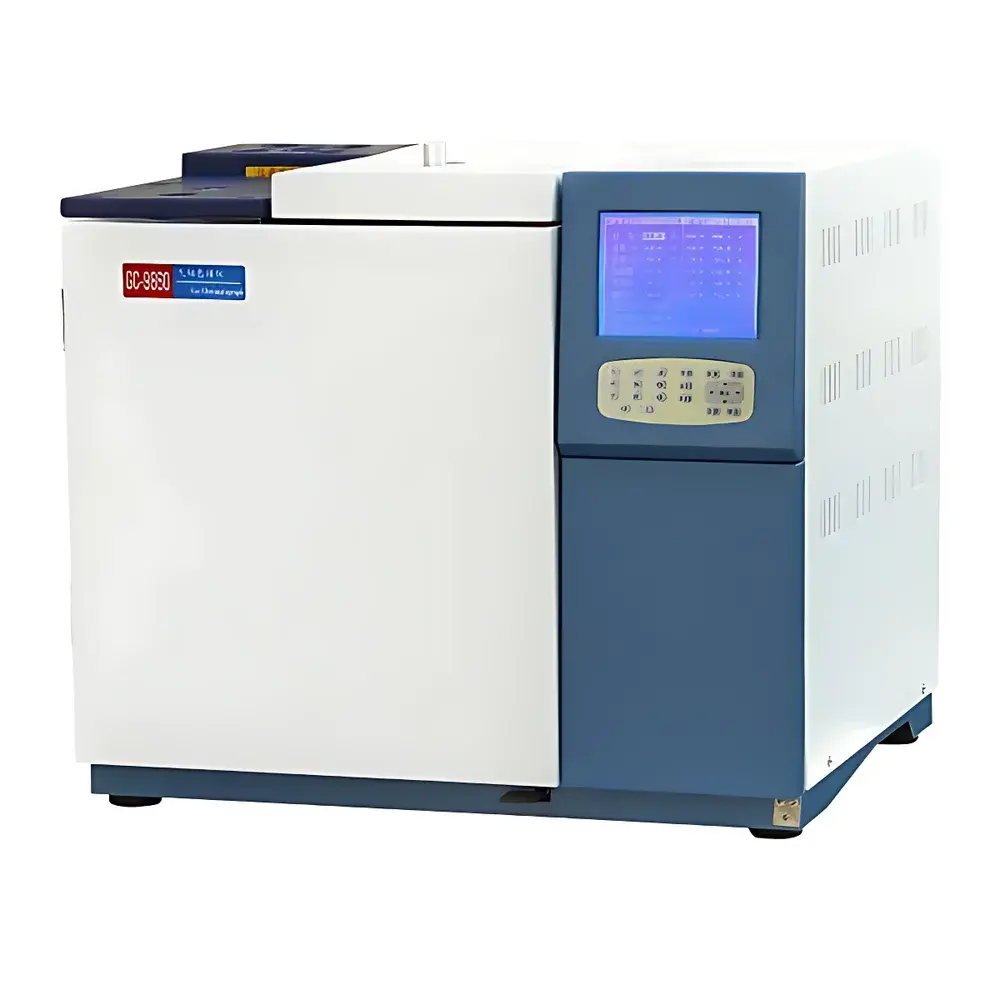
Beifen Sanpu GC-9860 Advanced Gas Chromatograph
| [Origin | Hebei, China |
|---|---|
| Manufacturer Type | Authorized Distributor |
| Origin Category | Domestic (PRC) |
| Model | GC-9860 |
| Price Range | USD 7,000–14,000 |
| Instrument Type | Benchtop Laboratory Gas Chromatograph |
| Application Scope | General-Purpose |
| Oven Temperature Range | +5 °C to 450 °C |
| Heating Rate | 0.1–40 °C/min |
| Cooling Rate | 450 °C → 50 °C (ambient-assisted) |
| Carrier Gas Flow Range & Control | 0–1200 mL/min |
| Carrier Gas Pressure Range & Control | 0–970 kPa |
| Injector Maximum Operating Temperature | 450 °C |
| Injector Pressure Setting Range | 0–970 kPa |
| Injector Total Flow Setting Range | 0–1200 mL/min |
| Column Installation Span | 152.4 mm (6-inch standard) |
| Oven Temperature Stability | ±0.1 °C |
| Temperature Gradient Uniformity | ±1% (100–350 °C) |
| Programmable Temperature Ramps | 8-step linear |
| Maximum Run Time | 6000 min |
| Dimensions (L×H×W) | 520×480×500 mm |
| Net Weight | 50 kg |
| Power Requirement | 220 V ±10%, 2500 W] |
Overview
The Beifen Sanpu GC-9860 Advanced Gas Chromatograph is a high-performance, microprocessor-controlled benchtop analytical instrument engineered for precision separation and quantitative analysis of volatile and semi-volatile organic compounds. Based on robust packed and capillary column chromatography principles, it employs temperature-programmed elution in a precisely regulated oven environment to resolve complex mixtures according to analyte volatility and polarity. Its dual independent detector capability—supporting simultaneous operation of up to three detectors including FID, TCD, ECD, FPD, or NPD—enables multi-analyte detection without hardware reconfiguration. Designed for compliance with international laboratory practice standards, the GC-9860 integrates hardware-level fault diagnostics, real-time thermal protection, and non-volatile FLASH memory for audit-trail-capable method storage—making it suitable for GLP-compliant environments where data integrity and instrument reliability are critical.
Key Features
- Eight-stage linear programmable temperature ramping with ±0.1 °C oven temperature stability across a range of +5 °C to 450 °C, enabling high-resolution separation of compounds with broad boiling point distributions.
- Dual independent rear-opening oven design facilitates rapid cooling from 450 °C to 50 °C, reducing cycle time between analyses while maintaining column integrity.
- Integrated carrier gas control system featuring digital pressure and flow regulation (0–970 kPa / 0–1200 mL/min) for reproducible retention times and optimal detector response.
- Multi-detector compatibility: Supports concurrent installation and operation of up to four detectors—including dual FID, dual TCD, dual ECD, or hybrid configurations—with independent power, signal conditioning, and thermal management.
- Capillary inlet system with true split/splitless mode operation, optimized for low-dead-volume vaporization and minimal band broadening.
- Self-diagnostic firmware with real-time error logging and Chinese/English bilingual display (5.7″ LCD, 320×240 resolution), presenting over 20 operational interfaces and storing up to 20 complete method/data sets.
- Hardware-based safety features: Automatic carrier gas failure shutdown, platinum RTD open/short circuit alarm, overtemperature cutoff, and flame-out detection for FID.
- Modular expansion architecture supporting auxiliary devices including thermal desorbers, headspace samplers, pyrolyzers, and auto-samplers via standardized electrical and pneumatic interfaces.
Sample Compatibility & Compliance
The GC-9860 accommodates both packed columns (3–5 mm OD, stainless steel or glass) and fused-silica capillary columns (standard 152.4 mm mounting span). Its universal inlet design supports liquid, gaseous, and solid-phase micro-extract samples across environmental, pharmaceutical, petrochemical, food safety, and clinical toxicology applications. The instrument conforms to core performance verification requirements outlined in ISO 8573-1 (compressed gas purity), ASTM D3612 (petroleum hydrocarbon analysis), USP (chromatography), and GB/T 30431–2013 (Chinese national standard for gas chromatographs). All thermal and flow parameters are traceable to NIST-certified references; data storage complies with ALCOA+ principles when used with validated software workflows.
Software & Data Management
Data acquisition and processing are managed through an embedded 32-bit ARM-based controller with FLASH-based non-volatile memory—eliminating reliance on backup batteries for method persistence. Raw chromatograms and processed results are exportable in ASCII (.csv) and standard CDF formats compatible with third-party software (e.g., OpenChrom, Chromeleon, Empower). While the base system operates standalone, optional PC connectivity (RS-232/USB) enables remote monitoring, batch report generation, and integration into LIMS environments. Audit trail functionality—including user login timestamps, parameter change logs, and run history—is retained locally and exportable for FDA 21 CFR Part 11–aligned review processes when paired with validated electronic signature modules.
Applications
The GC-9860 serves as a primary analytical platform in accredited quality control laboratories across multiple sectors: residual solvent quantification in APIs (ICH Q2(R2)), hydrocarbon profiling in fuels (ASTM D5292), pesticide residue screening in food matrices (EN 15662), VOC emissions testing per EPA TO-17, and volatile metabolite profiling in biomedical research. Its dual-TCD configuration allows simultaneous analysis of permanent gases (O₂, N₂, CO, CH₄) and light hydrocarbons on separate columns with independent carrier streams—ideal for refinery gas assays. The high-sensitivity ECD variant meets WHO-recommended detection limits for organochlorine pesticides in drinking water (WHO Guidelines for Drinking-water Quality, 4th ed.), while the FPD supports sulfur/phosphorus-selective detection in environmental soil extracts at sub-ppt levels.
FAQ
What types of columns can be installed on the GC-9860?
Standard 6-inch (152.4 mm) spacing supports 1/4″ packed columns (3–5 mm OD) and 0.1–0.53 mm ID fused-silica capillaries. Both single- and dual-column configurations are supported, with independent flow control for each.
Does the GC-9860 support regulatory-compliant data handling?
Yes—the embedded FLASH memory ensures method and result persistence without battery backup, and all parameter changes are timestamped. When integrated with validated third-party software, it supports 21 CFR Part 11 audit trails and electronic signatures.
Can I operate multiple detectors simultaneously without signal interference?
Yes. The GC-9860 provides electrically isolated detector compartments, independent power supplies, and dedicated analog-to-digital converters for each detector channel—ensuring no crosstalk during concurrent FID/TCD/ECD operation.
Is ambient temperature compensation available for oven control?
The system uses dual platinum RTD sensors with digital PID feedback and dynamic ambient offset correction, achieving ±0.1 °C stability across laboratory environments ranging from 15 °C to 30 °C.
What maintenance intervals are recommended for routine operation?
Carrier gas filters should be replaced every 6 months; inlet liners and septa every 100 injections or 2 weeks (whichever comes first); and detector components (FID jet, TCD filament) inspected quarterly under heavy-use conditions. Full calibration verification against certified standards is advised before each regulated batch analysis.





