
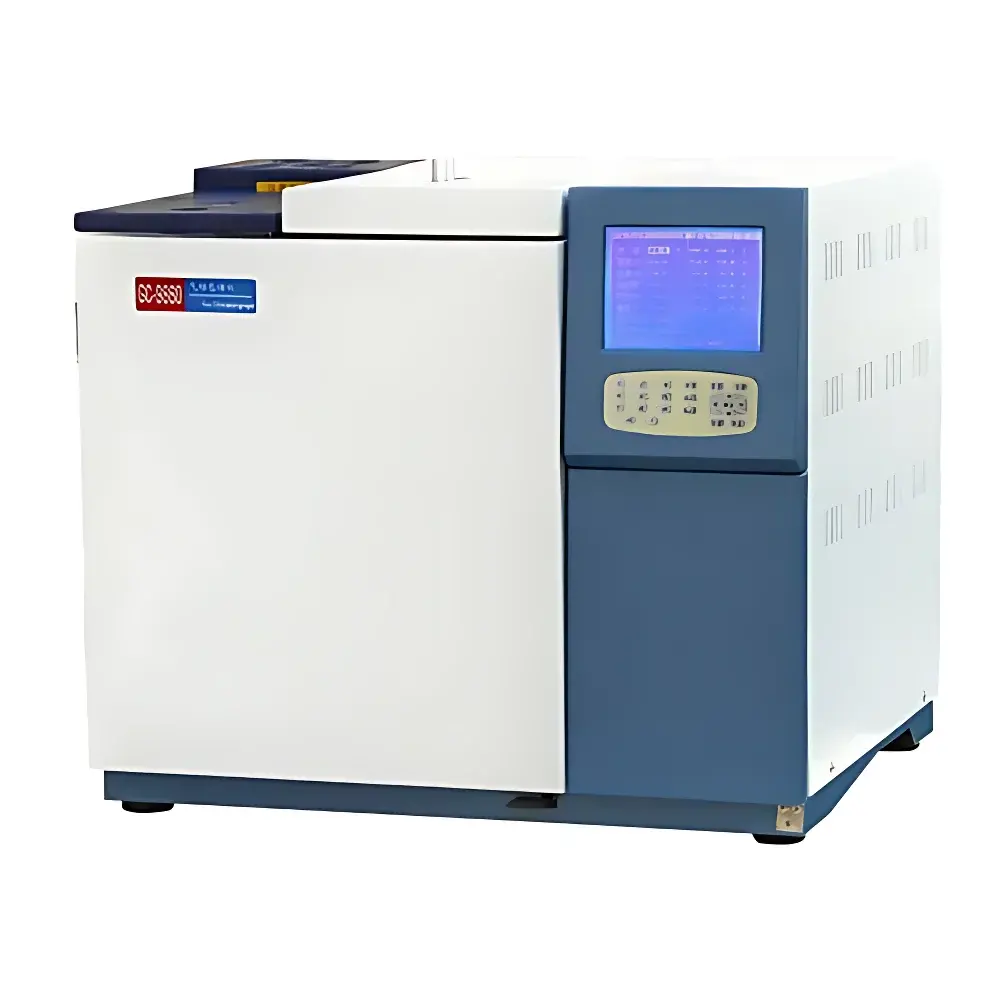
Beifen Sanpu GC-9860 Laboratory Gas Chromatograph with Electron Capture Detector for Multi-Residue Analysis of Organochlorine Pesticides in Food
| Brand | Beifen Sanpu |
|---|---|
| Origin | Beijing, China |
| Manufacturer Type | Manufacturer |
| Instrument Type | Laboratory Gas Chromatograph |
| Application Field | Food Safety Testing |
| Oven Temperature Range | 100–350 °C |
| Ramp Rate | 0.1–40 °C/min |
| Cool-down Time (350→100 °C) | ~6 min |
| Carrier Gas Flow Range & Control | 0–1200 mL/min |
| Carrier Gas Pressure Range & Control | 0–970 kPa |
| Injector Maximum Temperature | 100–350 °C |
| Injector Pressure Setting Range | 0–970 kPa |
| Injector Total Flow Setting Range | 0–1000 mL/min |
Overview
The Beifen Sanpu GC-9860 is a dedicated laboratory gas chromatograph engineered for the precise, reproducible quantification of multi-class organochlorine pesticide residues in complex food matrices. It operates on the principle of capillary gas chromatography coupled with electron capture detection (GC-ECD), a highly selective and sensitive technique for halogenated compounds. Designed to meet the analytical requirements of national and international food safety standards—including GB 23200.13–2016 (China), ISO 14501:2007, and AOAC Official Method 991.22—the instrument delivers robust performance for routine regulatory testing of HCH isomers (α-, β-, γ-, δ-), DDT metabolites (p,p′-DDT, o,p′-DDT, p,p′-DDE, p,p′-DDD), chlordane congeners, heptachlor, aldrin, dieldrin, endrin, endosulfan (α/β), hexachlorobenzene (HCB), pentachloronitrobenzene (PCNB), and mirex. Its optimized thermal management system, high-stability ECD, and programmable inlet configuration ensure consistent retention time alignment and low detection limits (typically sub-pg on-column for key analytes) under validated multi-residue workflows.
Key Features
- Programmable temperature-controlled oven with linear ramp rates from 0.1 to 40 °C/min and rapid cool-down (~6 minutes from 350 °C to 100 °C), enabling high-throughput method cycling without thermal memory effects.
- Dual independent pressure/flow control modules for carrier gas (N₂) and makeup gas, supporting both constant-flow and constant-pressure operation modes with resolution down to 0.1 kPa and 0.1 mL/min.
- High-temperature split/splitless injector (up to 350 °C) with electronic pressure programming, compatible with large-volume injection (LVI) and cold-on-column (COC) configurations for trace-level analysis.
- Optimized electron capture detector (ECD) featuring low-noise pulse-mode electronics, thermally stabilized cell design, and adjustable make-up gas flow (0–60 mL/min N₂ or Ar/CH₄), delivering stable baselines and high signal-to-noise ratios over extended run times.
- Integrated hardware architecture compliant with GLP/GMP documentation requirements, including real-time audit trail logging for method parameters, sequence execution, and calibration events.
- Modular column compartment accommodating up to two capillary columns (e.g., DM-5, DB-5, Rtx-1701) with independent temperature control and leak-tight connections per ASTM D3612 and USP .
Sample Compatibility & Compliance
The GC-9860 is validated for use in multi-residue analysis of organochlorine pesticides across diverse food categories—fresh vegetables, fruits, cereals, dairy products, eggs, meat, edible oils, and infant formula—following standardized sample preparation protocols involving solvent extraction (acetone, petroleum ether, ethyl acetate/cyclohexane), gel permeation chromatography (GPC) cleanup using Bio-Beads SX-3, and nitrogen-assisted concentration. The system supports full compliance with Chinese National Standard GB 23200.13–2016 (Method II for HCH/DDT), as well as harmonized EU SANTE/11312/2021 guidelines and FDA’s Pesticide Analytical Manual (PAM) Chapter 4. All operational parameters—including oven ramp profiles, injector settings, and ECD operating conditions—are fully configurable to match method-specific requirements defined in ISO/IEC 17025-accredited laboratories. Data integrity is reinforced via built-in support for 21 CFR Part 11-compliant electronic signatures and secure user access levels.
Software & Data Management
The instrument is operated via ChromaSight GC Control Software—a Windows-based platform supporting method development, sequence scheduling, real-time monitoring, and automated report generation. Raw data files adhere to AIA/ANDI format for interoperability with third-party quantitation tools (e.g., OpenLab CDS, Chromeleon). The software includes embedded tools for peak integration validation (tailing factor, asymmetry, resolution), calibration curve fitting (linear, quadratic, weighted), and uncertainty estimation per EURACHEM/CITAC Guide CG4. Audit trails record all parameter modifications, calibration verifications, and reprocessing events with timestamp, operator ID, and reason-for-change fields. Export options include PDF analytical reports with embedded chromatograms, calibration summaries, and QC check results—formatted to meet internal QA review and external regulatory submission requirements.
Applications
- Quantitative determination of 25+ organochlorine pesticide residues in raw and processed foods per GB 23200.13–2016 and equivalent international protocols.
- Routine surveillance testing in government food safety laboratories, third-party contract testing facilities, and corporate QC departments.
- Validation and verification of GPC cleanup efficiency and matrix interference assessment in method transfer studies.
- Support for residue monitoring programs targeting legacy contaminants in agricultural commodities and environmental food chain studies.
- Integration into multi-instrument workflows alongside QuEChERS extraction stations, rotary evaporators, and nitrogen evaporators for end-to-end residue analysis pipelines.
FAQ
What detection technology does the GC-9860 use for organochlorine pesticides?
It employs a high-sensitivity electron capture detector (ECD), specifically optimized for electronegative compounds such as chlorinated hydrocarbons.
Is the system compatible with USP and ISO 17025 requirements?
Yes—its hardware architecture, software audit trail functionality, and calibration traceability support compliance with ISO/IEC 17025:2017 and USP General Chapter for chromatographic system suitability.
Can the GC-9860 be used for other pesticide classes beyond organochlorines?
While optimized for ECD-detectable analytes, it can be reconfigured with alternative detectors (e.g., FID, NPD) for broader pesticide screening when paired with appropriate columns and methods.
Does the instrument support automated GPC-GC hyphenation?
It accepts standard GPC fraction collection tubes and integrates seamlessly with commercial GPC systems via timed fraction triggering and external event signaling.
What level of technical support and service coverage is available internationally?
Beifen Sanpu provides remote diagnostics, application method transfer assistance, and certified field service through authorized regional partners aligned with ISO 9001-certified service processes.




