
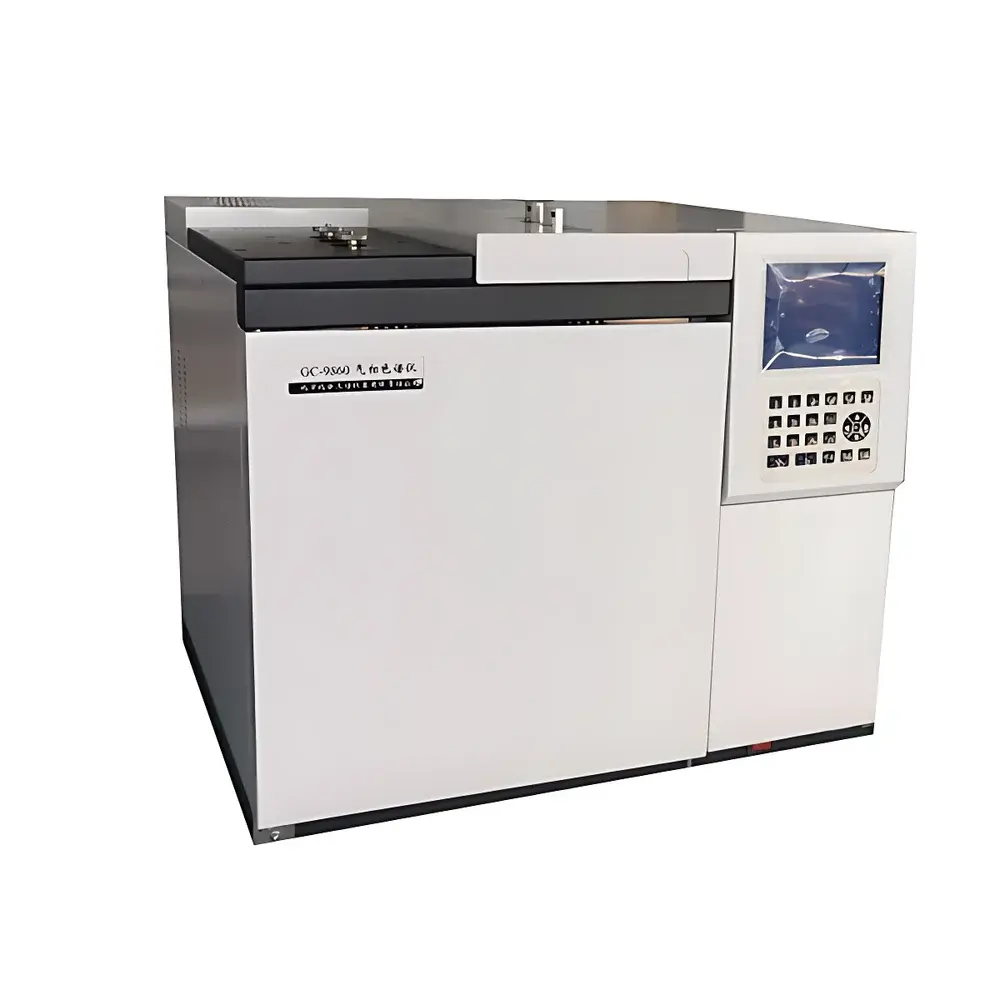
Beifen Sanpu GC-9860II Gas Chromatograph for 3-Methylthio-1-Propanol (MTP) Quantification in Sesame-Flavor Baijiu
| Brand | Beifen Sanpu |
|---|---|
| Origin | Beijing, China |
| Manufacturer Type | Direct Manufacturer |
| Instrument Type | Laboratory Gas Chromatograph |
| Application Scope | General-Purpose |
| Oven Temperature Range | Ambient to 400 °C |
| Maximum Ramp Rate | 40 °C/min |
| Maximum Cooling Rate | 40 °C/min |
| Carrier Gas Flow Range & Control | 0–1200 mL/min |
| Carrier Gas Pressure Range & Control | 0–970 kPa |
| Injector Maximum Operating Temperature | 450 °C |
| Injector Pressure Setting Range | 0–970 kPa |
| Injector Total Flow Setting Range | 0–1200 mL/min |
Overview
The Beifen Sanpu GC-9860II is a high-stability, laboratory-grade gas chromatograph engineered for precise quantification of trace volatile sulfur compounds—specifically 3-methylthio-1-propanol (MTP)—in sesame-flavor baijiu (Chinese distilled spirit). MTP is a key flavor-active marker defined in GB/T 20824–2007 “Sesame-Flavor Baijiu”, with a minimum specification of ≥0.5 ppm. Accurate measurement demands exceptional chromatographic resolution, low system noise, and robust thermal stability due to MTP’s co-elution risk with ethanol, ethyl acetate, and other esters in complex fermentation matrices. Unlike legacy FPD-based methods—which suffer from limited dynamic range, high operational cost, and poor compatibility with routine multi-analyte profiling—the GC-9860II leverages optimized flame ionization detection (FID), advanced temperature programming, and high-efficiency polar capillary columns (e.g., LZP-930 or CP-WAX 57CB) to deliver reproducible separation (Rs > 1.8) and quantification (RSD < 2.1% at 0.5–5.0 ppm) without detector switching or method revalidation.
Key Features
- Industrial-grade oven architecture with true ambient-to-400 °C operation, ±0.1 °C isothermal precision, and eight-ramp linear programmable temperature control.
- Dual independent back-oven doors enabling rapid cooling (up to 40 °C/min) and stable near-ambient hold capability for extended low-temperature separations.
- Intelligent carrier gas management: fully digital pressure/flow control across up to four independent channels (carrier, makeup, air, hydrogen), supporting split/splitless injection with active flow modulation.
- FID with automatic ignition, real-time flame monitoring, and integrated thermocouple-based temperature compensation for baseline stability over 72-hr continuous runs.
- Modular detector bay accommodating up to four detectors simultaneously—including dual-FID, dual-TCD, or hybrid configurations—with electrically isolated gas paths and event-driven detector switching.
- Self-diagnostic firmware with Chinese/English bilingual interface (5.7″ LCD, 320×240 resolution), 20 customizable method storage slots, and FLASH-based non-volatile data retention eliminating battery dependency.
- Comprehensive hardware protection suite: carrier-gas failure shutdown, platinum RTD open/short circuit alarms, overtemperature cutoff, and column bleed compensation algorithms.
Sample Compatibility & Compliance
The GC-9860II is validated for direct injection of liquid samples (neat or diluted in ethanol/water), headspace vials (with optional auto-sampler integration), and solid-phase microextraction (SPME) desorption. It meets core requirements for food safety and quality control laboratories operating under GLP and GMP frameworks. While not pre-certified to ISO/IEC 17025, its hardware architecture supports full audit trail generation when paired with BF-2002白酒专用工作站 (Baijiu-Specific Chromatography Data System), which implements electronic signatures, user access levels, and raw-data immutability per FDA 21 CFR Part 11 principles. The instrument complies with GB/T 20824–2007 analytical methodology for MTP and is routinely deployed by provincial market supervision bureaus and distillery QC labs for routine batch release testing.
Software & Data Management
The BF-2002 chromatography workstation provides method-driven acquisition, peak integration with adaptive baseline correction, and automated calibration curve fitting (linear, quadratic, or weighted least squares). It includes built-in MTP-specific reporting templates aligned with GB/T 20824–2007 compliance documentation, including limit-of-quantitation (LOQ = 0.15 ppm), recovery validation (85–115%), and system suitability criteria (tailing factor 1.5). All raw data (.cdf), method files (.mtd), and audit logs are stored in vendor-neutral formats compatible with LIMS integration. Data integrity safeguards include timestamped operator login, immutable sequence logs, and version-controlled method archiving.
Applications
Beyond sesame-flavor baijiu MTP analysis, the GC-9860II supports broad-spectrum volatile profiling in fermented beverages: quantification of higher alcohols (isoamyl alcohol, propanol), esters (ethyl acetate, ethyl hexanoate), aldehydes (acetaldehyde, furfural), and organic acids (acetic, lactic). Its modular inlet and detector configuration enables method portability across beer, wine, soy sauce, and vinegar QC workflows. Research applications include yeast metabolism studies, aging trajectory mapping, and process optimization in traditional Chinese fermentation engineering.
FAQ
Does the GC-9860II comply with GB/T 20824–2007 for MTP analysis?
Yes—when configured with LZP-930 or CP-WAX 57CB column, FID, and BF-2002 software using the validated method parameters (e.g., 40 °C initial hold, 6 °C/min ramp to 220 °C), it fulfills all separation and sensitivity requirements specified in Clause 6.3.2 of the standard.
Can the instrument perform simultaneous analysis of MTP and major esters in one run?
Yes—its wide temperature range and high-resolution capillary column enable baseline separation of MTP (retention time ~12.4 min), ethyl acetate (~3.1 min), and ethyl hexanoate (~15.7 min) under a single 25-min gradient program.
Is remote monitoring or LIMS connectivity supported?
The BF-2002 workstation supports TCP/IP-based network deployment and exports ASCII/CSV reports compatible with major LIMS platforms; full OPC UA integration requires optional driver licensing.
What maintenance intervals are recommended for routine FID operation?
We recommend quarterly FID jet cleaning, biannual column trimming (10–15 cm), and annual verification of pressure/flow controller accuracy per ASTM D3612 Annex A3 guidelines.
Is on-site installation and operator training included?
Yes—Beifen Sanpu provides factory-trained engineer deployment, hardware commissioning, method validation assistance, and two-day hands-on training covering maintenance, troubleshooting, and regulatory documentation generation.






