
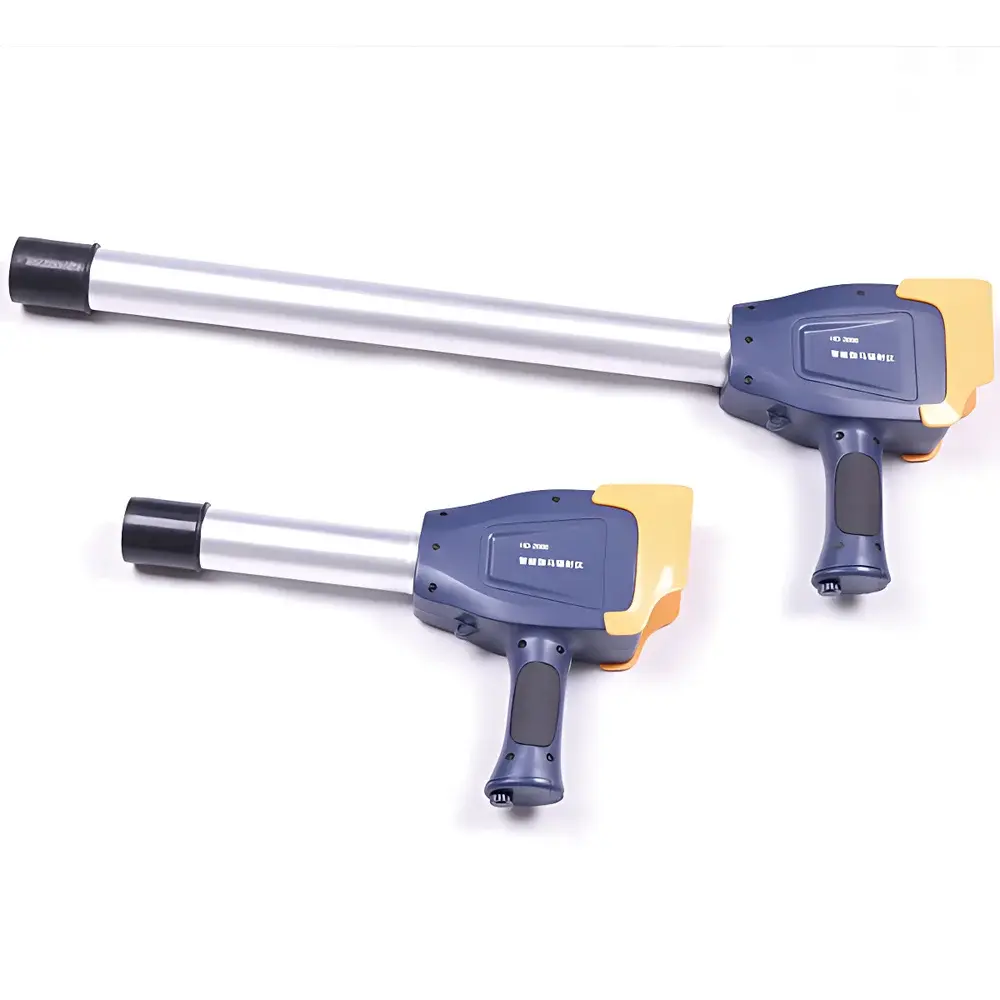
Beifen Sanpu HD-2000 Intelligent Gamma-ray Radiometer
| Brand | Beifen Sanpu |
|---|---|
| Origin | Beijing, China |
| Manufacturer | Yes |
| Country of Origin | China |
| Model | HD-2000 |
| Measurement Principle | Scintillation-based gamma spectrometry with NaI(Tl) detector |
| Energy Threshold | 40 keV |
| Measurement Ranges | Equivalent Uranium (1–30,000 Ur), Exposure Rate (0.30–5,000 nC·kg⁻¹·h⁻¹), Air Kerma Rate (0.01–300 µGy·h⁻¹) |
| Sensitivity | ≥5 s⁻¹/Ur (Uranium), ≥30 s⁻¹/nC·kg⁻¹·h⁻¹ (Exposure) |
| Stability | ≤5% relative error over 8 h |
| Nonlinearity | ≤10% |
| Accuracy | ±5% for gamma measurement |
| GPS positional accuracy | ≤5 m |
| Power Supply | 4 × Ni-MH rechargeable batteries |
| Power Consumption | ≤700 mW (standalone), ≤900 mW (with GPS active) |
| Operating Temperature | −5 to +50 °C |
| Relative Humidity | ≤95% at +40 °C |
| Alarm Threshold | Numerically adjustable |
| Integration Time | 3–9,999 s selectable |
| Data Storage | 120,000 measurement records |
| Dimensions (Long) | 673 × 51 × 230 mm, 1.4 kg |
| Dimensions (Short) | 371 × 51 × 230 mm, 1.2 kg |
| Certification | Verified by Radioactive Exploration Measurement Station of Nuclear Industry |
Overview
The Beifen Sanpu HD-2000 Intelligent Gamma-ray Radiometer is a field-deployable, scintillation-based radiation survey instrument engineered for quantitative in-situ measurement of natural gamma-emitting radionuclides—primarily 238U, 232Th, and 40K—in geological, environmental, and nuclear regulatory applications. It employs a thallium-doped sodium iodide [NaI(Tl)] scintillation detector coupled with pulse-height analysis circuitry to resolve gamma-ray energy spectra and compute equivalent uranium (Ur), exposure rate, and air kerma rate in real time. Designed for high reproducibility in variable terrain, the HD-2000 integrates a precision GPS module (CEP ≤5 m) for georeferenced data logging, enabling spatial mapping of radiometric anomalies across large-scale surveys. Its operational architecture complies with fundamental metrological requirements defined in JJG 331–2004, the Chinese national verification regulation for gamma-ray spectrometers, and supports traceability via calibration certificates issued by the Radioactive Exploration Measurement Station of the Nuclear Industry.
Key Features
- High-sensitivity NaI(Tl) scintillation detector with 40 keV energy threshold, optimized for low-level terrestrial gamma-ray detection
- Integrated GPS receiver providing real-time geotagging of each measurement point with ≤5 m circular error probable (CEP)
- Large-capacity onboard memory storing up to 120,000 georeferenced measurement records—including timestamp, coordinates, count rates, and derived parameters
- Adjustable integration time (3–9,999 s) to balance statistical precision and survey throughput
- Programmable audible and visual alarm thresholds for exposure rate, kerma rate, or equivalent uranium concentration
- Bluetooth 4.0 wireless interface supporting secure, cable-free data export to Windows- or Android-based field tablets or laptops
- Dual-form factor design: long version (673 mm) for ground-coupled static measurements; short version (371 mm) for rapid handheld traverse surveys
- Low-power operation using four rechargeable Ni-MH cells (≤700 mW base; ≤900 mW with GPS enabled), supporting >12 h continuous field use under typical conditions
Sample Compatibility & Compliance
The HD-2000 is calibrated for direct measurement of unshielded, naturally occurring radioactive materials (NORM) in soil, rock, sediment, and construction materials. It does not require sample preparation or laboratory digestion—measurements are performed in situ with detector positioned at standardized height (typically 1 m above ground surface per IAEA RS-G-1.8). The instrument meets the performance criteria specified in JJG 331–2004 for portable gamma-ray spectrometers and has received formal type approval (PA Certificate No. 2011A182-11) from the State Administration for Market Regulation of China. While not certified to ISO/IEC 17025 or ANSI N42 standards out-of-the-box, its metrological chain—traceable to national primary standards maintained by the Nuclear Industry Measurement Station—supports audit-ready documentation for GLP-aligned environmental site assessments and regulatory reporting.
Software & Data Management
Data acquisition and post-processing are supported through Beifen Sanpu’s proprietary HD-DataLink software (Windows-compatible), which enables batch download, spectral visualization, geo-referenced contour mapping, and automated report generation in PDF or CSV format. All stored records include embedded metadata: UTC timestamp, WGS84 coordinates, detector orientation flag, integration time, background-subtracted net count rates, and uncertainty estimates derived from Poisson statistics. Audit trails—including operator ID, calibration history, and firmware revision—are retained locally and exported with datasets. The system supports optional 21 CFR Part 11-compliant user authentication and electronic signature modules for regulated environments requiring ALCOA+ data integrity principles.
Applications
- Geological uranium exploration and radiometric mapping of prospective terrains
- Environmental baseline surveys and post-remediation verification at legacy nuclear sites
- Regulatory compliance monitoring of NORM in mining waste, phosphogypsum stacks, and oilfield scale deposits
- Construction material screening for radioactivity in accordance with GB 6566–2010 (Chinese standard for radioactivity in building materials)
- Emergency response radiological assessment during transportation incidents or orphan source recovery operations
- Academic research in environmental radioecology, including dose rate modeling and radionuclide migration studies
FAQ
What is the minimum detectable activity for uranium using the HD-2000?
The instrument’s sensitivity of ≥5 s⁻¹/Ur implies a practical lower limit of detection (LLD) of approximately 1 Ur under standard 60-s integration and 1-m survey height, assuming background levels typical of granitic terrain (~1,500 cps total).
Can the HD-2000 distinguish between uranium, thorium, and potassium isotopes?
Yes—the NaI(Tl) detector resolves gross spectral regions corresponding to the 1.76 MeV (232Th), 1.46 MeV (40K), and composite 1.001/1.002 MeV (238U series) peaks. While full nuclide-specific quantification requires spectral deconvolution (supported in HD-DataLink), the instrument reports equivalent uranium (Ur), equivalent thorium (eTh), and equivalent potassium (eK) as industry-standard proxy values.
Is external calibration required before each survey?
No—factory calibration is stable for ≥6 months under normal operating conditions. However, users must perform daily background checks and verify GPS lock integrity prior to deployment. Full recalibration is recommended annually or after physical shock, battery replacement, or firmware updates.
Does the HD-2000 support third-party GIS integration?
Yes—exported CSV files contain latitude, longitude, altitude, timestamp, and all measured parameters in tabular format, compatible with QGIS, ArcGIS Pro, and ENVI for spatial interpolation and anomaly detection workflows.
What is the warranty and service coverage for international customers?
Beifen Sanpu provides a 12-month limited warranty covering manufacturing defects. Technical support is available via email and remote diagnostics; on-site service outside mainland China requires advance coordination and may incur logistics and labor surcharges.







