
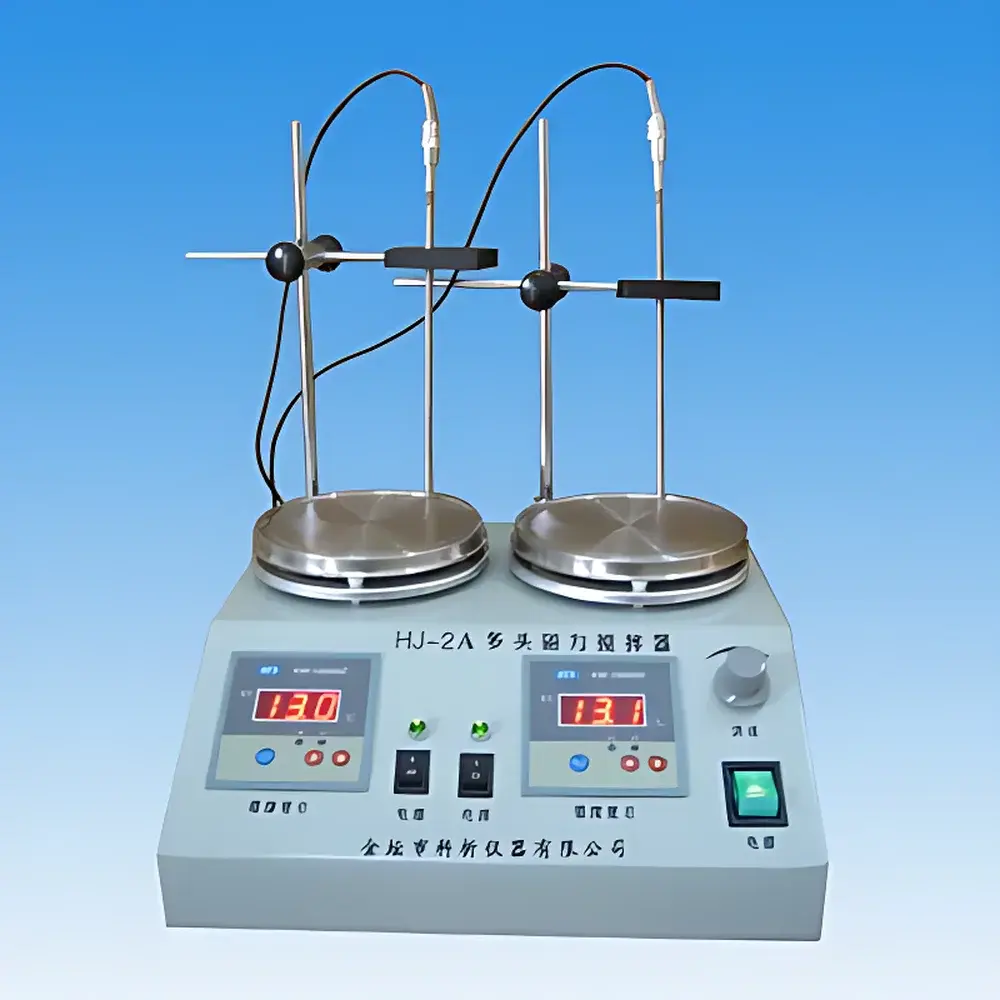
Beifen Sanpu HJ-2A Dual-Station Digital Temperature-Controlled Magnetic Stirrer
| Brand | Beifen Sanpu |
|---|---|
| Model | HJ-2A |
| Type | Dual-Station Magnetic Stirrer with Independent Digital Temperature Control |
| Power Supply | 220 V AC, 50 Hz |
| Motor Speed Range | 0–2400 rpm (infinitely variable) |
| Motor Power | 2 × 20 W |
| Heating Power | 2 × 150 W |
| Temperature Control Range | Ambient to 100 °C (digital LED display) |
| Construction | Cold-rolled steel housing with high-temperature enamel coating |
| Compliance | Designed for general laboratory use under ISO/IEC 17025-aligned environments |
| Safety | Grounded chassis, over-temperature protection circuitry (integrated), non-operational heating interlock |
Overview
The Beifen Sanpu HJ-2A Dual-Station Digital Temperature-Controlled Magnetic Stirrer is an engineered solution for parallel sample processing in analytical, quality control, and research laboratories. It operates on the principle of magnetic coupling—where a rotating permanent magnet beneath the work surface induces synchronous rotation of PTFE-coated stir bars immersed in liquid samples. Each of its two independent stations integrates a brushless DC motor and resistive heating element, enabling simultaneous stirring and precise temperature regulation without mechanical shaft penetration. This architecture eliminates cross-contamination risks, supports sealed-vessel operation, and ensures high reproducibility across batched experiments. The unit is purpose-built for routine applications requiring thermal stability and mixing consistency—such as buffer preparation, reagent dissolution, enzymatic reaction incubation, and standard solution conditioning—under ambient laboratory conditions.
Key Features
- Dual independent stations with fully decoupled speed and temperature controls—enabling asynchronous operation (e.g., one station at 300 rpm/25 °C, the other at 1800 rpm/75 °C)
- Digital LED display for real-time monitoring of both rotational speed (rpm) and setpoint temperature (°C), with ±1 °C accuracy over 25–100 °C range
- Brushless DC motors rated for >10,000 hours continuous operation at no-load; optimized torque delivery across full 0–2400 rpm range
- Two 150 W heating elements with PID-based thermal regulation, minimizing overshoot and ensuring uniform heat distribution across ceramic-coated aluminum plates
- Robust cold-rolled steel chassis with high-temperature epoxy-polyester enamel finish—resistant to common lab solvents, acids, and alkalis
- Safety interlocks: automatic heating cutoff when stirring is disabled; ground-fault protected power input; thermal cutout at ≥110 °C
Sample Compatibility & Compliance
The HJ-2A accommodates standard laboratory glassware up to 1000 mL per station (e.g., beakers, Erlenmeyer flasks, round-bottom flasks). Compatible stir bars include PTFE- or PTFE/glass-coated magnets (6–40 mm length), selected based on vessel geometry and viscosity range (up to ~500 mPa·s). The instrument meets general electrical safety requirements per IEC 61010-1 for laboratory equipment and is suitable for use in GLP-compliant environments where procedural documentation and equipment logbooks are maintained. While not certified to FDA 21 CFR Part 11, its digital interface supports manual audit trails when integrated into validated workflows per ISO/IEC 17025 Clause 6.4.2 (Equipment Management).
Software & Data Management
This analog-digital hybrid instrument does not incorporate embedded firmware, network connectivity, or data logging capabilities. All operational parameters are set manually via front-panel push-button interface and retained only during active power cycle. Users must record setpoints, durations, and observed outcomes externally—consistent with traditional benchtop instrumentation practices in regulated labs where electronic records are managed separately via LIMS or paper-based SOPs. Calibration verification (speed and temperature) is performed using traceable external references—e.g., certified tachometer and NIST-traceable RTD probe—at defined intervals per internal QA schedule.
Applications
- Preparation of homogeneous aqueous and organic solutions for spectroscopy, titration, and chromatography standards
- Controlled-temperature dissolution testing per USP for pharmaceutical excipients and APIs
- Simultaneous multi-sample digestion in environmental water analysis (e.g., EPA Method 3015A)
- Cell culture media equilibration prior to sterile filtration
- Accelerated stability studies requiring constant agitation at elevated temperatures (e.g., polymer solubility screening)
- Calibration of pH and conductivity probes in temperature-controlled buffers
FAQ
What is the maximum recommended operating time at high speed?
Continuous operation at speeds above 1500 rpm is limited to 4 hours per session to maintain motor thermal integrity and bearing longevity.
Can the HJ-2A be used with corrosive solvents such as concentrated HCl or NaOH?
Yes—the enamel-coated steel housing and PTFE stir bars provide resistance to short-term exposure; however, prolonged contact with strong oxidizers or halogenated solvents requires additional containment (e.g., secondary trays) and post-use cleaning per lab SOPs.
Is temperature calibration required before first use?
Yes—users must verify displayed temperature against a calibrated reference thermometer at three points (25 °C, 50 °C, and 75 °C) and adjust offset if deviation exceeds ±1.5 °C.
Why does the heater shut off automatically when stirring stops?
This is a hardware-enforced safety feature to prevent thermal runaway in static liquid; it cannot be disabled.
What maintenance is recommended for long-term reliability?
Monthly inspection of stir bar magnetism, cleaning of heating plate surface with isopropyl alcohol, and verification of grounding continuity using a multimeter.



