
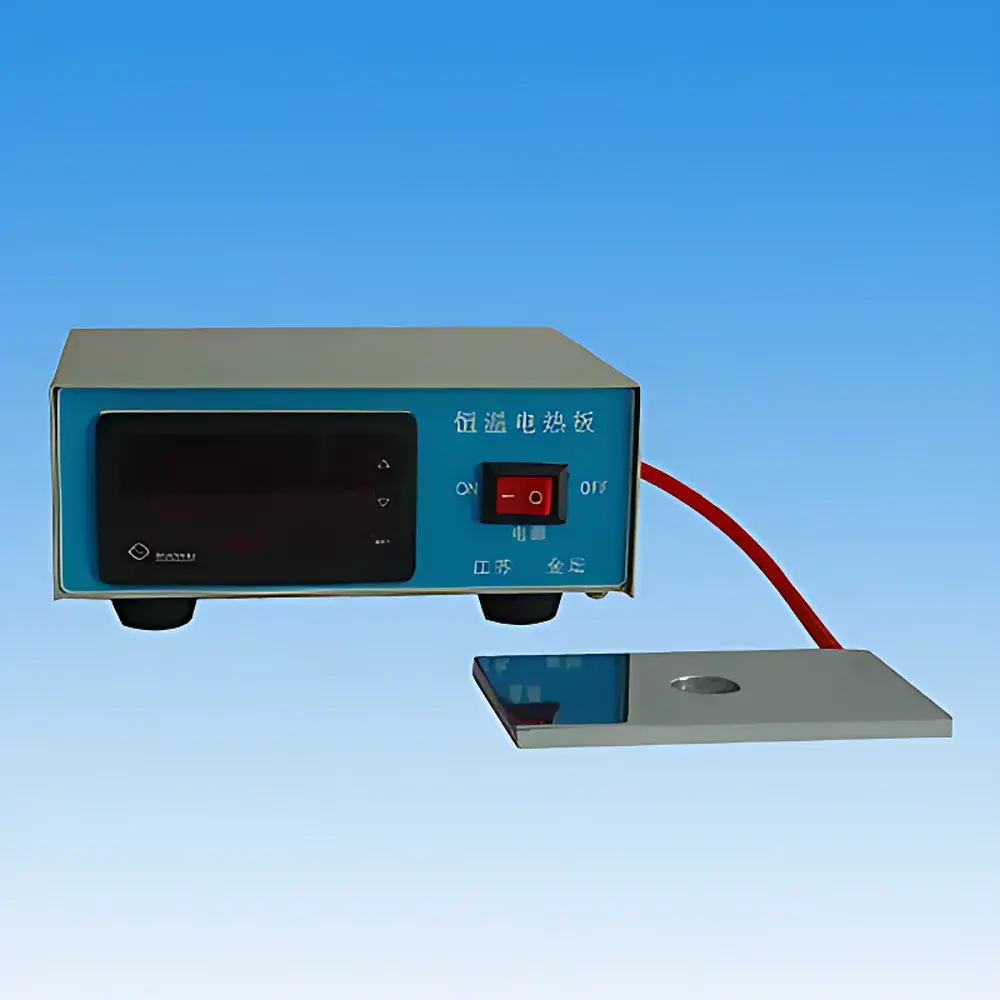
Beifen Sanpu KX-DB Digital Temperature-Controlled Microscope Stage (Heated Stage Plate)
| Brand | Beifen Sanpu |
|---|---|
| Origin | Beijing, China |
| Manufacturer Type | Manufacturer |
| Region of Origin | Domestic (China) |
| Model | KX-DB |
| Price | Upon Request |
| Power Supply | 220 V ±10%, 50 Hz |
| Heating Supply | 12 V ±10%, 50 Hz |
| Heating Power | 8 W |
| Temperature Range | Ambient to 50 °C |
| Temperature Control Accuracy | ±1 °C |
| Stage Dimensions | 98 × 60 × 6 mm |
| Center Aperture Diameter | Φ15 mm |
Overview
The Beifen Sanpu KX-DB Digital Temperature-Controlled Microscope Stage is a precision-engineered heated stage plate designed for integration with upright and inverted optical microscopes in life science, clinical, and reproductive biology laboratories. It operates on resistive heating principles via an embedded aluminum alloy thermal element, delivering uniform surface temperature distribution across the active stage area. Unlike generic hot plates, this device is optimized for microscopic observation under controlled thermal conditions—particularly critical for maintaining physiological viability of temperature-sensitive biological specimens such as mammalian spermatozoa, oocytes, blood smears, and live-cell cultures during real-time imaging. Its operational range (ambient to 50 °C) and tight control tolerance (±1 °C) align with standard requirements for mammalian cell handling protocols, including those specified in ISO 15189–accredited clinical embryology labs and GLP-compliant reproductive toxicology studies.
Key Features
- Aluminum alloy heating element with engineered thermal conductivity ensures rapid, homogeneous heat distribution—minimizing radial and axial thermal gradients across the 98 × 60 mm working surface.
- LED digital temperature display integrated into the stage housing enables real-time, at-a-glance verification of setpoint and actual surface temperature—eliminating reliance on external thermocouples or IR guns.
- Low-voltage (12 V AC) heating circuitry isolates thermal control from mains power, enhancing electrical safety during microscope-integrated operation and reducing electromagnetic interference with sensitive imaging electronics.
- Compact profile (6 mm height) and centered Φ15 mm aperture allow unobstructed optical path alignment with standard microscope objectives (including 10×–40× dry and 60× oil-immersion lenses), supporting Köhler illumination and phase contrast configurations.
- Intelligent proportional–integral (PI) temperature regulation maintains setpoint stability without overshoot—even during repeated sample loading/unloading cycles—ensuring reproducible thermal history for time-lapse microscopy experiments.
Sample Compatibility & Compliance
The KX-DB stage supports standard glass microscope slides (76 × 26 mm), Petri dishes (35 mm and 60 mm), chambered coverslips (e.g., Lab-Tek II), and custom specimen holders used in assisted reproductive technology (ART) workflows. Its 37 °C operating mode meets WHO-recommended incubation conditions for human semen analysis (WHO Laboratory Manual for the Examination and Processing of Human Semen, 6th ed.) and is routinely deployed in artificial insemination (AI) laboratories where sperm motility, morphology, and viability assessments require strict thermal maintenance between 35–37 °C. The unit complies with IEC 61010-1:2010 safety standards for laboratory electrical equipment and incorporates double-insulated construction to satisfy Class II appliance requirements. While not certified to UL or CE for standalone medical device use, its design adheres to functional safety expectations outlined in ISO 13485 quality management systems for in vitro diagnostic support equipment.
Software & Data Management
The KX-DB operates as a stand-alone analog-controlled instrument with no embedded firmware, USB interface, or data logging capability. Temperature setpoint adjustment and status monitoring are performed exclusively via the front-panel LED display and tactile push-button controls—ensuring operational simplicity, electromagnetic compatibility, and long-term reliability in electromagnetically noisy environments (e.g., adjacent to centrifuges, electrophoresis units, or RF-based imaging systems). For laboratories requiring audit trails or electronic records, external validation-grade thermistors (e.g., calibrated PT100 probes traceable to NIST standards) may be mounted adjacent to the stage surface and connected to compliant data acquisition systems satisfying FDA 21 CFR Part 11 requirements. No proprietary software drivers or cloud connectivity are provided or required.
Applications
- Human and veterinary semen analysis—including computer-assisted sperm analysis (CASA) workflows where motility parameters degrade rapidly below 35 °C.
- Live-cell microscopy of thermosensitive primary cultures (e.g., endothelial cells, neurons, and embryonic stem cells) during short-duration imaging sessions.
- Standardization of blood smear preparation and staining procedures under controlled ambient-equivalent thermal conditions.
- Microscopic evaluation of microbial motility, biofilm formation kinetics, and antibiotic susceptibility testing under defined thermal regimes.
- Educational demonstrations of thermal effects on cellular metabolism, enzyme activity, and membrane fluidity in undergraduate and graduate teaching labs.
FAQ
What is the maximum recommended continuous operating temperature?
The stage is rated for sustained operation up to 50 °C; however, for biological specimen integrity—especially sperm and oocytes—37 °C is the validated upper limit per clinical ART guidelines.
Can the KX-DB stage be used with inverted microscopes equipped with motorized Z-focus?
Yes—the low 6 mm profile and rigid aluminum base ensure mechanical stability and compatibility with standard stage adapters for Nikon Eclipse Ti, Zeiss Axio Observer, and Leica DMi8 platforms.
Is calibration documentation included with shipment?
No factory calibration certificate is supplied; users must perform initial verification using a NIST-traceable surface thermometer prior to first use, and re-verify at least quarterly per ISO/IEC 17025 internal quality procedures.
Does the unit support external temperature feedback loops?
No—it operates in open-loop mode with internal thermistor sensing only; no analog voltage output or RS-232 interface is available for integration with building management or central lab control systems.
How should the stage surface be cleaned between uses?
Wipe gently with lint-free wipes moistened with 70% ethanol or isopropyl alcohol; avoid abrasive cleaners, acetone, or ultrasonic cleaning, which may damage the anodized aluminum finish or embedded sensor elements.



