Beifen Sanpu MZ-103A Volumetric Soap Film Flow Calibrator
| Brand | Beifen Sanpu |
|---|---|
| Origin | Beijing, China |
| Manufacturer | Beifen Sanpu Instrument Co., Ltd. |
| Type | Volumetric Flow Calibrator |
| Model | MZ-103A |
| Measurement Principle | Soap Film Transit Time |
| Flow Range | 2 mL/min to 2 L/min |
| Accuracy | ±1% of reading |
| Repeatability | <0.5% |
| Time Resolution | 0.01 s (displayed as 0.1 s) |
| Volume Measurement | Fixed calibrated glass tube |
| Operating Temperature | 0–40 °C |
| Power | Rechargeable 4.8 V / 700 mAh battery (standby >24 h) or external 9 V DC input |
| Dimensions | 90 mm × 150 mm × 280 mm |
| Compliance | Designed for field calibration per ISO 6145-4 and ASTM D6196 Annex A2 |
Overview
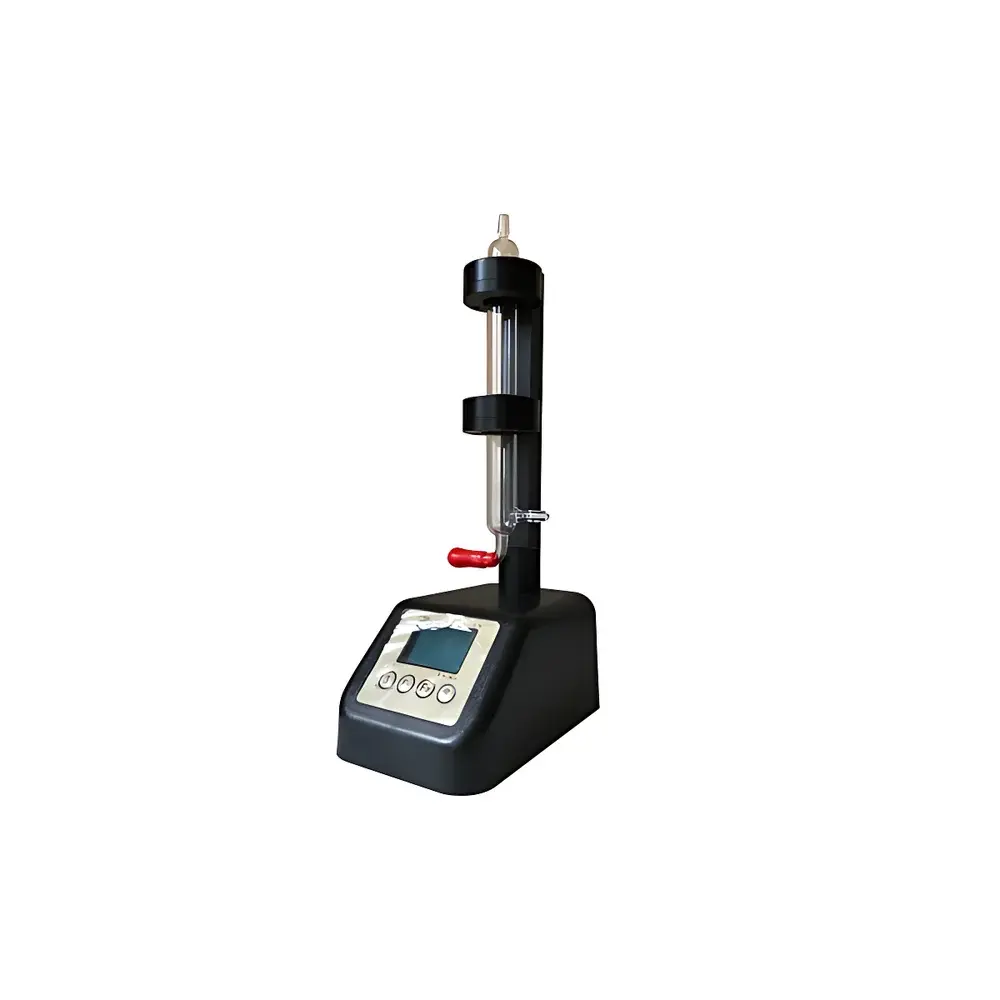
The Beifen Sanpu MZ-103A Volumetric Soap Film Flow Calibrator is a portable, microprocessor-controlled instrument engineered for high-accuracy primary calibration of low-to-medium gas flow rates in environmental monitoring, occupational health, and laboratory air sampling applications. It operates on the volumetric soap film transit time principle: a thin soap film is generated across the inlet port and traverses a precisely calibrated glass tube of known internal volume. The onboard photodetector system detects the film’s passage between two optical sensors; elapsed time is measured with 0.01-second internal resolution and used to compute volumetric flow rate (mL/min or L/min) under real-time ambient temperature and pressure conditions. Unlike thermal mass flow meters or rotameters, this method provides traceable, direct volumetric measurement without dependence on gas composition, density, or viscosity—making it ideal for calibrating personal sampling pumps, active air samplers, and fixed-site atmospheric monitors per EPA Method IO-3A, ISO 6145-4, and ASTM D6196 Annex A2.
Key Features
- Microprocessor-based control with automatic calculation of volumetric flow, mass flow (optional), temperature, pressure, elapsed time, and sensor status—all displayed simultaneously on a backlit LCD screen.
- Dual optical sensor array with self-diagnostic capability: real-time photometric signal monitoring enables user-adjustable sensitivity via internal potentiometer calibration.
- Integrated rechargeable 4.8 V / 700 mAh Ni-MH battery supporting >24 hours of standby operation; external 9 V DC input serves both as backup power and charging source with automatic float-charge management (~8 h full charge).
- Intelligent power management: backlight auto-off after 1 minute of inactivity; full shutdown after 5 minutes of no user input.
- Compact monolithic design (90 × 150 × 280 mm) integrating sensor optics, calibrated glass tube, electronics, and battery—optimized for field deployment and benchtop verification.
- Onboard calibration function allows users to perform traceable zero and span verification using reference volumes or certified flow standards.
- Measurement uncertainty ≤ ±1% of reading with repeatability <0.5%, validated across the full specified range of 2 mL/min to 2 L/min.
Sample Compatibility & Compliance
The MZ-103A is compatible with all non-corrosive, non-condensing gases—including ambient air, nitrogen, oxygen, carbon dioxide, and synthetic calibration mixtures—at temperatures from 0 °C to 40 °C and pressures within standard atmospheric variation (80–106 kPa). Its soap film technique eliminates gas-specific corrections required by thermal or differential-pressure instruments, ensuring consistent performance across diverse sampling media. The device supports compliance workflows aligned with ISO/IEC 17025:2017 (clause 6.5 on equipment verification), US EPA Compendium Method IO-3A for air sampler calibration, and OSHA Technical Manual Section II: Chapter 2 (air sampling pump validation). While not inherently 21 CFR Part 11 compliant, its audit-ready data output (time-stamped flow records with environmental parameters) facilitates integration into GLP/GMP environments when paired with validated data logging protocols.
Software & Data Management
The MZ-103A operates autonomously without PC dependency; all measurements are stored in non-volatile memory with timestamps, environmental readings, and operator-initiated calibration logs. Data export is supported via optional RS-232 or USB-to-serial interface (hardware module sold separately), enabling transfer to spreadsheet or LIMS platforms. Firmware supports firmware-upgradable calibration coefficients and configurable display units (mL/min, L/min, SCFM). No proprietary software is required—raw ASCII-formatted output conforms to ASTM E1447 and ISO 10012-1 for metrological traceability documentation. Audit trails include battery voltage history, sensor activation counts, and last-calibration date—critical for laboratory quality assurance reviews.
Applications
- Primary calibration of personal and area air sampling pumps used in industrial hygiene (e.g., NIOSH methods 0500, 0600).
- Verification of flow accuracy in EPA-compliant ambient air monitoring stations (PM2.5, VOC, ozone analyzers).
- Field validation of low-flow sorbent tube samplers and diffusion badge readers.
- QC/QA checks for environmental laboratories accredited to ISO/IEC 17025.
- Educational use in analytical chemistry and environmental engineering labs for teaching fundamental flow metrology principles.
FAQ
What gases can be calibrated with the MZ-103A?
It is suitable for dry, non-reactive, non-condensing gases including air, N₂, O₂, CO₂, and inert calibration mixtures. Avoid use with corrosive (e.g., Cl₂, NH₃), solvent-saturated, or high-humidity streams.
Does the instrument require periodic recalibration by an accredited lab?
Yes—while field self-calibration is supported, ISO/IEC 17025 recommends annual traceable recalibration against a national standard (e.g., NIST SRM or equivalent) to maintain metrological integrity.
Can the MZ-103A measure mass flow directly?
No—it calculates volumetric flow natively. Mass flow may be derived post-measurement using recorded T/P data and gas-specific compressibility factors, but this requires external computation.
Is the glass tube replaceable or user-serviceable?
The calibrated tube is a precision component sealed during manufacture. Replacement requires factory recalibration and certification; unauthorized disassembly voids metrological validity.
How does temperature and pressure compensation work?
Built-in digital sensors continuously monitor ambient T and P; all flow values are automatically corrected to standard conditions (e.g., 25 °C, 101.325 kPa) unless user-selects actual-condition reporting.