
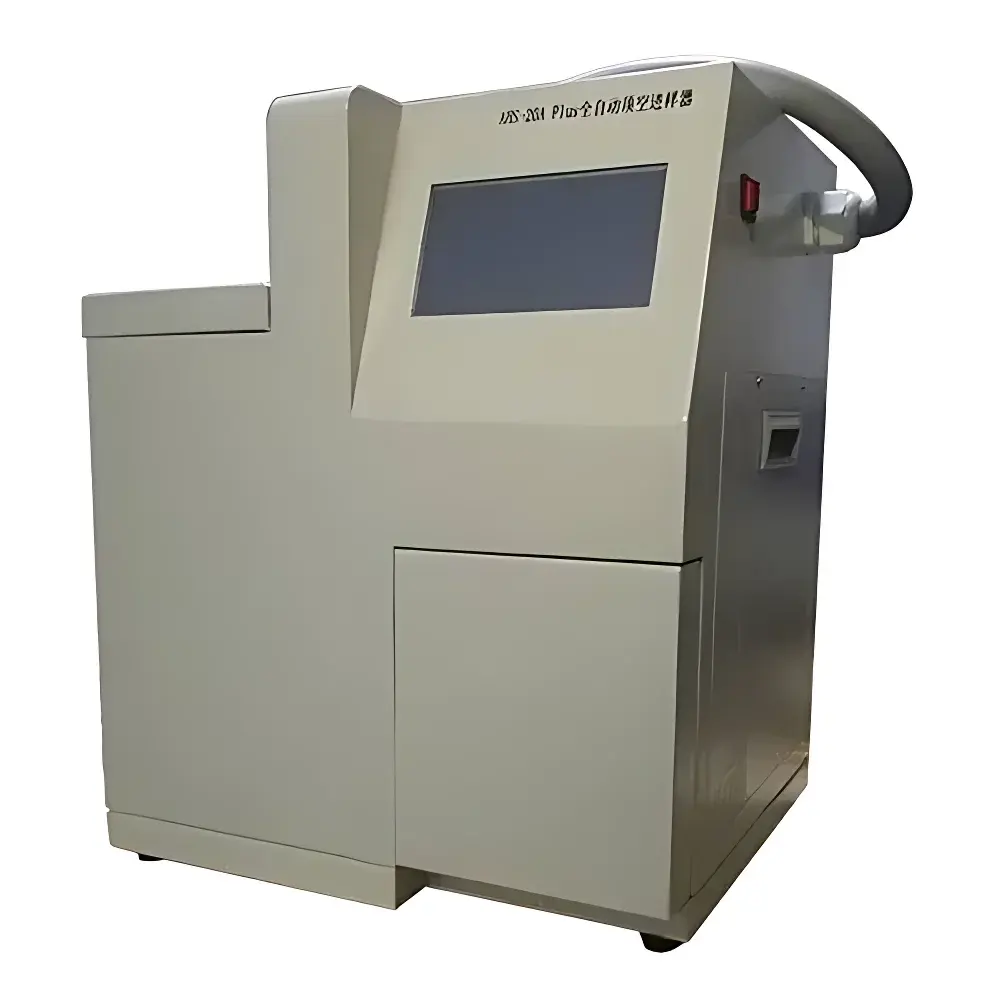
Beifen Sanpu NAHS-20A Plus Fully Automated Headspace Sampler
| Brand | Beifen Sanpu |
|---|---|
| Model | NAHS-20A Plus |
| Origin | Beijing, China |
| Manufacturer Type | Direct Manufacturer |
| Sample Positions | 20 |
| Sample Vial Capacity | 10 mL or 20 mL (customizable up to 100 mL) |
| Quantitative Loop Volume | 1 mL (optional: 0.5 / 2 / 5 mL) |
| Sample Heating Range | 40–220 °C (extendable to 300 °C) |
| Valve & Transfer Line Heating Range | 40–220 °C (extendable to 300 °C) |
| Temperature Accuracy | ±0.5 °C |
| Temperature Stability | < ±0.5 °C |
| Pressurization Time | 0–999 s |
| Sampling Time | 0–30 min |
| Injection Time | 0–999 s |
| Bake-out/Flush Time | 0–30 min |
| Minimum Time Resolution | 1 ms |
| Pressurization Pressure | 0–0.25 MPa (continuously adjustable) |
| Carrier Gas Flow Control | EPC-electronic pressure control (optional) |
| RSD | < 1.0% (for 100 ppm ethanol in water) |
| Purge Flow Rate | 0–100 mL/min (adjustable) |
| Communication Interface | USB |
| Compliance | Compatible with ASTM D6866, ISO 11843-2, USP <467>, and FDA 21 CFR Part 11–compliant data handling when integrated with validated GC software |
Overview
The Beifen Sanpu NAHS-20A Plus Fully Automated Headspace Sampler is a precision-engineered sample introduction system designed for quantitative volatile organic compound (VOC) analysis via gas chromatography (GC). It operates on the principle of equilibrium headspace sampling—where volatile analytes partition from liquid or solid matrices into the vapor phase above the sample at controlled temperature and pressure. This thermodynamic equilibrium enables reproducible, matrix-independent quantification without direct injection of complex or non-volatile residues into the GC column. The NAHS-20A Plus is optimized for laboratories requiring high-throughput, unattended operation across environmental testing, pharmaceutical residual solvent analysis (per USP ), forensic toxicology, food flavor profiling, and polymer off-gassing studies. Its modular thermal architecture ensures uniform heating of sample vials, valve manifold, and transfer lines—eliminating cold spots that cause condensation, adsorption, or fractionation of analytes.
Key Features
- 20-position auto-sampler carousel with automatic vial recognition and collision-avoidance logic; detects empty or misaligned positions and skips them without manual intervention.
- Triple-zone independent temperature control: sample block (40–220 °C, extendable), six-port valve housing, and transfer line—all maintained within ±0.5 °C stability for consistent phase equilibrium and minimal carryover.
- Positive-pressure headspace extraction using inert, de-activated fused-silica or SilcoNert® tubing throughout the entire flow path—including quantitative loop and needle assembly—to ensure negligible adsorption and cross-contamination (RSD < 1.0% demonstrated with 100 ppm ethanol/water).
- Motor-driven actuation system eliminates reliance on external compressed air or nitrogen, reducing infrastructure requirements and enhancing operational safety in regulated environments.
- 7-inch TFT LCD touchscreen interface with animated workflow guidance; supports both local panel programming and full remote configuration via USB-connected PC running compliant chromatography data systems (CDS).
- Configurable injection protocols: single vial/multiple injections, single vial/single injection, or sequential multi-vial analysis—each with independently programmable pressurization, equilibration, sampling, injection, and purge durations (time resolution down to 1 ms).
- Integrated self-diagnostics: power-on system check, positional encoder validation, heater fault detection, and real-time error logging with audible/visual alerts.
Sample Compatibility & Compliance
The NAHS-20A Plus accommodates standard 10 mL and 20 mL crimp-top or screw-cap headspace vials; custom configurations support 50 mL and 100 mL formats for low-concentration or heterogeneous samples. It handles aqueous solutions, suspensions, soils, polymers, pharmaceutical tablets, and packaged foods without modification. All wetted surfaces are chemically inert and certified for compliance with ISO 17025-accredited testing workflows. When paired with validated GC-CDS platforms (e.g., Thermo Fisher Chromeleon, Agilent OpenLab CDS), the system supports audit-trail generation, electronic signatures, and 21 CFR Part 11–compliant data integrity—meeting GLP/GMP documentation requirements for quality control labs. Method parameters are traceable to reference standards including ASTM D6866 (biobased content), ISO 11843-2 (detection capability), and ICH Q2(R2) validation guidelines.
Software & Data Management
Instrument control and method development are executed through either the embedded touchscreen GUI or host PC software via USB 2.0 interface. All timing parameters—equilibration, pressurization, loop fill, injection, and bake-out—are stored as encrypted method files with version timestamps and user attribution. Raw event logs record every mechanical action, temperature reading, pressure setpoint, and fault condition with millisecond precision. Optional EPC (Electronic Pressure Control) module enables closed-loop carrier gas regulation, improving retention time reproducibility and enabling advanced methods such as pressure-programmed headspace analysis. Data export conforms to AIA/ANDI format for seamless import into third-party processing tools (e.g., Chromeleon, Empower, SIMCA).
Applications
- Pharmaceutical residual solvents (USP , EP 2.4.24): acetone, dichloromethane, methanol, toluene, and ethyl acetate in APIs and excipients.
- Environmental VOC monitoring: benzene, toluene, ethylbenzene, xylenes (BTEX), chloroform, and carbon tetrachloride in groundwater and soil extracts.
- Food & beverage authenticity and spoilage assessment: ethanol, acetaldehyde, diacetyl, and ester profiles in wines, dairy products, and fermented beverages.
- Polymer and packaging migration studies: formaldehyde, styrene, and limonene release from plastics, adhesives, and laminates under accelerated aging conditions.
- Clinical toxicology: blood alcohol concentration (BAC), volatile anesthetics (isoflurane, sevoflurane), and illicit drug metabolites (e.g., chloroform from chloral hydrate metabolism).
FAQ
What sample vial sizes does the NAHS-20A Plus support?
Standard configurations include 10 mL and 20 mL headspace vials; optional adapters allow use of 50 mL and 100 mL formats.
Can the system be integrated with third-party gas chromatographs?
Yes—it provides TTL-level trigger outputs and accepts external start signals, ensuring full synchronization with Agilent, Shimadzu, Thermo Fisher, PerkinElmer, and other GC platforms.
Is EPC (Electronic Pressure Control) included by default?
EPC is an optional upgrade; base configuration uses mechanical pressure regulation with analog feedback.
How is method validation supported for regulated laboratories?
The system records all parameter changes, runtime events, and calibration history in tamper-evident logs compatible with 21 CFR Part 11–enabled CDS software.
What maintenance intervals are recommended for routine operation?
Valve seals and septa should be inspected every 500 injections; transfer lines require annual passivation verification per ISO 17025 internal procedure.
Related Products






