
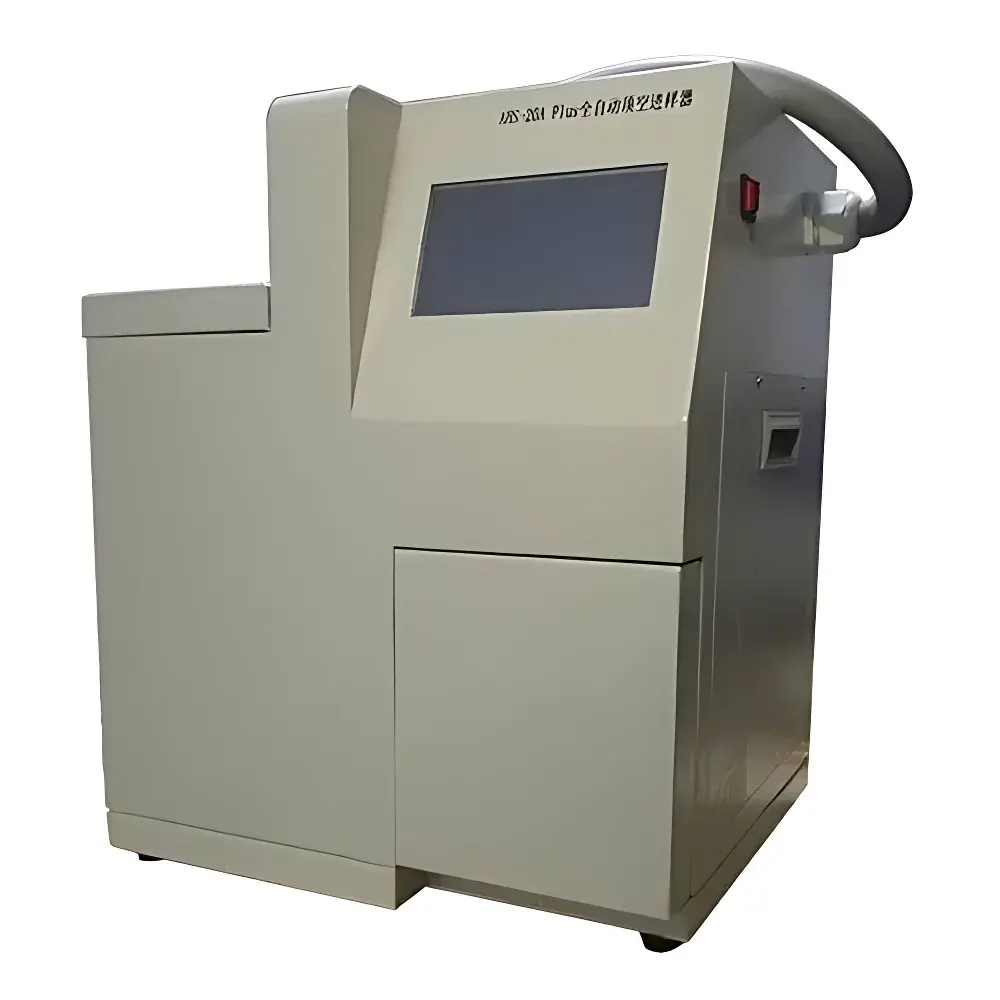
Beifen Sanpu QAHS-20A Plus Fully Automated Headspace Sampler
| Brand | Beifen Sanpu |
|---|---|
| Model | QAHS-20A Plus |
| Origin | Beijing, China |
| Manufacturer Type | Direct Manufacturer |
| Sample Positions | 20 |
| Sample Vial Capacity | 10 mL or 20 mL (customizable up to 100 mL) |
| Quantitative Loop Volume | 1 mL (optional: 0.5 / 2 / 5 mL) |
| Sample Heating Range | 40–220 °C (extendable to 300 °C) |
| Valve & Transfer Line Heating Range | 40–220 °C (extendable to 300 °C) |
| Temperature Accuracy | ±0.5 °C |
| Temperature Stability | < ±0.5 °C |
| Pressurization Time | 0–999 s |
| Sampling Time | 0–30 min |
| Injection Time | 0–999 s |
| Bake-out/Flush Time | 0–30 min |
| Minimum Time Resolution | 1 ms |
| Pressurization Pressure | 0–0.25 MPa (continuously adjustable) |
| Carrier Gas Flow Control | EPC-compatible (optional) |
| RSD | < 1.0% (measured with 100 ppm ethanol in water) |
| Purge Flow Rate | 0–100 mL/min (adjustable) |
| Communication Interface | USB |
| Automation | Full sequence control with GC synchronization, self-diagnostic routines, and fault-tolerant sample positioning |
Overview
The Beifen Sanpu QAHS-20A Plus Fully Automated Headspace Sampler is an engineered solution for precise, reproducible, and unattended volatile compound extraction from solid and liquid matrices prior to gas chromatographic analysis. Based on the principle of equilibrium headspace sampling—where analytes partition between a sealed sample phase and its overlying vapor phase—the instrument thermally equilibrates samples under controlled temperature and pressure conditions, then introduces the vapor phase quantitatively into the GC inlet via a pressurized, heated transfer path. Designed for laboratories requiring high-throughput routine analysis without operator dependency, the QAHS-20A Plus integrates robust mechanical architecture, inert flow path materials, and deterministic timing resolution down to 1 millisecond. Its modular thermal zones—sample incubation, six-port valve, and transfer line—are independently regulated to eliminate cold spots and ensure analyte integrity throughout the entire sampling cycle.
Key Features
- 20-position rotary sample carousel with automatic vial detection and collision-avoidance logic—skips empty positions and halts motion upon mechanical anomaly detection.
- Triple-zone independent heating system: sample block (40–220 °C, optional to 300 °C), valve oven (40–220 °C), and transfer line (40–220 °C), all with ±0.5 °C accuracy and < ±0.5 °C stability over time.
- High-inertness fluidic path: de-activated fused silica capillaries and stainless-steel components minimize adsorption, carryover, and cross-contamination; validated RSD < 1.0% for 100 ppm ethanol in aqueous matrix.
- Positive-pressure sampling mechanism eliminates baseline drift associated with vacuum-based systems and supports direct compatibility with both split/splitless and PTV inlets.
- Integrated EPC-ready electronic pressure control (optional) enables precise, programmable pressurization (0–0.25 MPa) and purge flow regulation (0–100 mL/min).
- 7-inch graphical LCD interface with animated workflow guidance; full parameter configuration possible either locally or remotely via USB-connected PC running vendor-neutral control software.
- Comprehensive self-diagnostics: power-on hardware verification, positional encoder validation, thermal sensor redundancy checks, and real-time fault logging with audible/visual alerts.
Sample Compatibility & Compliance
The QAHS-20A Plus accommodates standard 10 mL and 20 mL crimp-top headspace vials, with engineering support available for custom configurations (e.g., 50 mL or 100 mL formats). It accepts liquid, semi-solid, and solid samples—including pharmaceutical tablets, polymer pellets, food homogenates, environmental soils, and clinical biofluids—provided they remain physically stable under prescribed incubation conditions. All wetted surfaces comply with ASTM D6866 and ISO 17025 traceability frameworks when operated within validated method parameters. The system supports audit-ready operation under GLP and GMP environments through timestamped event logging, user-access-controlled parameter locking, and firmware-level write protection for calibration records. While not inherently 21 CFR Part 11 compliant, it interfaces seamlessly with chromatography data systems (CDS) that provide electronic signature, audit trail, and role-based access management layers.
Software & Data Management
Instrument control and method development are executed via a Windows-based application accessible through USB 2.0. The software permits creation of multi-step sequences—including variable incubation durations, staggered pressurization profiles, iterative sampling from a single vial, and synchronized GC start triggers. All runtime events—including temperature ramp logs, valve actuation timestamps, pressure transducer readings, and error codes—are stored in structured CSV format with ISO 8601-compliant timestamps. Raw metadata exports integrate directly into LIMS platforms using ODBC drivers. Firmware updates are delivered as signed binary packages with SHA-256 checksum verification, ensuring integrity during field deployment. Remote monitoring via TCP/IP is supported through optional Ethernet module integration (not included standard).
Applications
- Residual solvent analysis in pharmaceutical active ingredients and excipients per USP <467> and ICH Q3C guidelines.
- Volatile organic compound (VOC) profiling in drinking water, wastewater, and soil extracts per EPA Methods 502.2, 524.4, and 8260D.
- Flavor and fragrance release kinetics in food packaging and beverage formulations.
- Monomer migration testing in plastic food-contact materials per EU Regulation 10/2011.
- Pyrolysis product screening in polymer degradation studies and forensic accelerant detection.
- Quality control of ethanol content in disinfectants, hand sanitizers, and alcoholic beverages.
FAQ
What vial sizes does the QAHS-20A Plus support?
Standard configurations accommodate 10 mL and 20 mL crimp-top headspace vials. Custom carriers for 50 mL and 100 mL formats are available upon request and require mechanical revalidation.
Can the system be integrated with third-party GC instruments?
Yes—it provides TTL-level trigger outputs and accepts external start signals, enabling bidirectional synchronization with Agilent, Thermo Fisher, Shimadzu, PerkinElmer, and other major GC platforms.
Is EPC functionality standard or optional?
Electronic pressure control is an optional add-on module. Base configuration uses precision mechanical regulators with manual adjustment; EPC enables dynamic, software-defined pressure ramping and closed-loop stability.
How is carryover mitigated between samples?
The system performs programmable bake-out cycles with heated purge gas flow (0–100 mL/min) across the quantitative loop, valve rotor seal, and transfer line. All internal surfaces utilize Siltek®-treated stainless steel or fused silica to reduce surface activity.
Does the instrument support unattended overnight operation?
Yes—full 20-vial batch processing with auto-recovery after power interruption is supported. Internal non-volatile memory retains method settings and position state even during complete power loss.





