
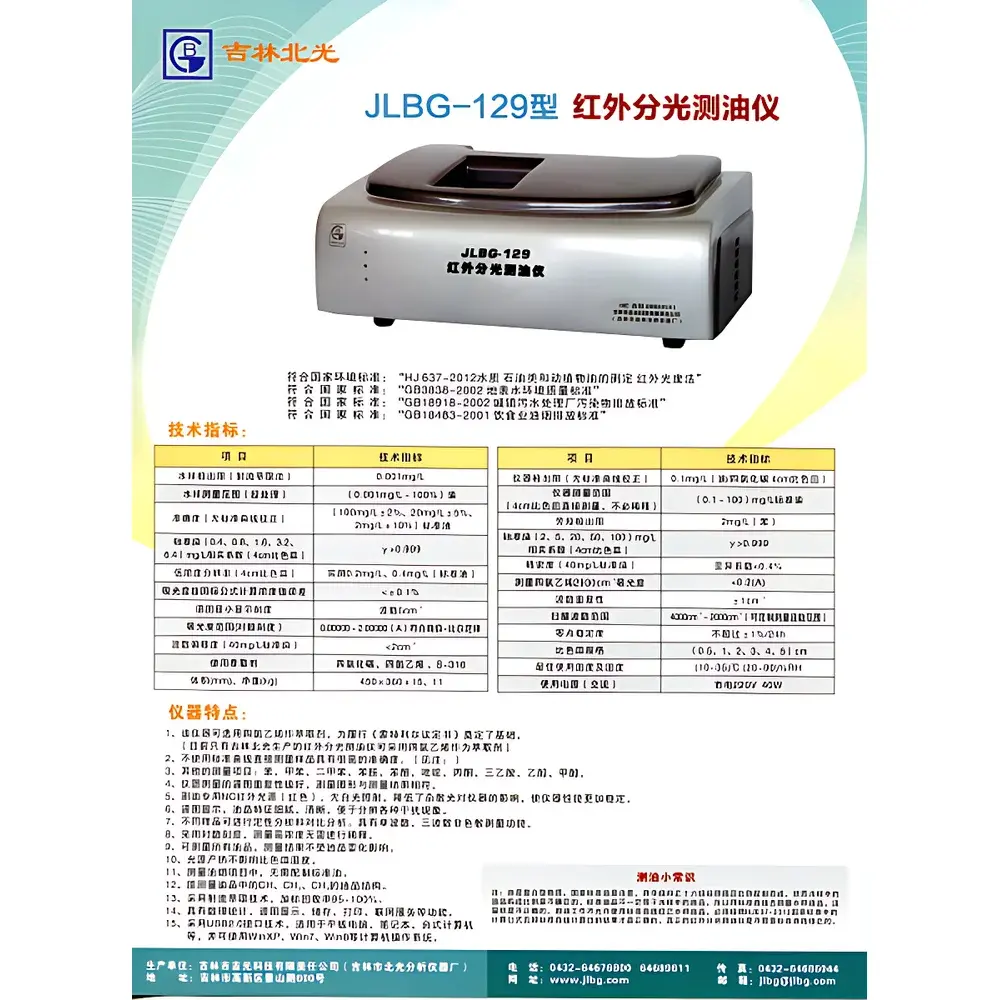
Beiguang JLBG-129 Infrared Spectrophotometric Oil Content Analyzer
| Brand | Beiguang |
|---|---|
| Origin | Jilin, China |
| Manufacturer Type | Authorized Distributor |
| Country of Origin | China |
| Model | JLBG-129 |
| Instrument Type | Laboratory Benchtop Analyzer |
| Measurement Principle | Infrared Absorption Spectrophotometry (at 2930 cm⁻¹, 2960 cm⁻¹, and 3030 cm⁻¹) |
| Measurement Range | 0.001 mg/L to 100% oil (post-extraction) |
| Detection Limit | 0.1 mg/L (oil in CCl₄, 4 cm pathlength) |
| Accuracy | ±2% at 100 mg/L |
| Resolution | 0.1 ppm (as oil) |
| Measurement Frequency | 2 samples/min |
| Wavenumber Range | 4000–2000 cm⁻¹ (customizable) |
| Wavenumber Repeatability | ±1 cm⁻¹ |
| Absorbance Range (log scale) | 0.00000–2.00000 A |
| Correlation Coefficient (r) | >0.999 (for standard oil series) |
| Compliant Standards | HJ 637–2012, GB 3838–2002, GB 18918–2002, GB 18483–2001 |
Overview
The Beiguang JLBG-129 Infrared Spectrophotometric Oil Content Analyzer is a laboratory-grade benchtop instrument engineered for precise quantification of petroleum hydrocarbons and animal/vegetable oils in aqueous and semi-aqueous matrices. It operates on the principle of infrared absorption spectrophotometry, measuring characteristic C–H stretching vibrations at three key wavenumbers—2930 cm⁻¹ (CH₂ asymmetric), 2960 cm⁻¹ (CH₃ asymmetric), and 3030 cm⁻¹ (aromatic C–H)—in accordance with the Chinese national standard HJ 637–2012. Unlike dispersive UV-Vis systems, the JLBG-129 employs a proprietary NC-type narrowband infrared source with pulse modulation, eliminating broadband visible emission and minimizing stray light interference. This design ensures high photometric stability, low thermal drift (<±1%/24 h zero stability), and reproducible spectral acquisition across extended operational cycles. The instrument supports direct analysis without mandatory calibration curve interpolation for routine samples, enabling rapid screening while maintaining traceability to reference standards. Its optical architecture is optimized for use with environmentally compliant extraction solvents—including tetrachloroethylene (C₂Cl₄), carbon tetrachloride (CCl₄), and S-316—aligning with Montreal Protocol obligations regarding ozone-depleting substance phase-out.
Key Features
- Triple-wavenumber non-dispersive measurement mode (2930, 2960, 3030 cm⁻¹) with automatic peak integration and baseline correction
- Dedicated NC infrared source emitting only in the mid-IR region (no visible bleed), reducing stray light and enhancing signal-to-noise ratio
- Logarithmic absorbance scale (0.00000–2.00000 A) enabling linear dynamic range extension without manual dilution or range switching
- High-fidelity spectral display (5 cm⁻¹ resolution) supporting qualitative comparison, interference identification, and spectral library referencing
- Integrated USB 2.0 interface compatible with Windows XP through Windows 10 operating systems; no proprietary drivers required
- Support for multiple cell pathlengths (0.5–5 cm) to accommodate variable concentration ranges and matrix turbidity
- Onboard statistical functions including coefficient of variation (CV <0.4% at 40 mg/L standard oil), correlation analysis, and batch reporting
- Direct analysis of油烟 (cooking fume condensates) following standardized collection protocols per GB 18483–2001
- Jet-stream extraction compatibility yielding 95–100% spike recovery for method validation
Sample Compatibility & Compliance
The JLBG-129 is validated for use with environmental water matrices including surface water, groundwater, municipal wastewater, industrial effluents, cooling tower recirculation water, and marine samples. It accommodates solid-phase extraction (SPE) and liquid–liquid extraction (LLE) workflows using CCl₄, C₂Cl₄, or S-316 as extractants—fully compliant with HJ 637–2012’s solvent flexibility clause. The system meets regulatory requirements for reporting under GB 3838–2002 (surface water quality), GB 18918–2002 (municipal wastewater discharge limits), and GB 18483–2001 (catering industry fume emissions). While not inherently 21 CFR Part 11–compliant, its audit-trail-capable software architecture supports GLP/GMP-aligned data integrity practices when deployed with controlled access, electronic signatures, and version-controlled method files. All spectral data are stored in vendor-neutral formats (CSV, PNG) for third-party review and archival.
Software & Data Management
The embedded control software provides real-time spectral acquisition, quantitative calculation via the HJ 637–2012 algorithm (including compensation for C–H bond type distribution), and automated report generation. Raw interferograms and processed absorbance spectra are timestamped and saved with full metadata: operator ID, sample ID, cell pathlength, solvent lot, calibration date, and environmental conditions (ambient temperature/humidity). Data export supports CSV for Excel-based QA/QC review and PNG for publication-ready figures. Network connectivity enables remote monitoring and centralized data aggregation in multi-instrument labs. Software updates are delivered via signed firmware packages to ensure integrity and version consistency across installations.
Applications
- Quantitative determination of total petroleum hydrocarbons (TPH) and total recoverable oil & grease (ROG) in environmental monitoring programs
- Compliance testing for wastewater discharge permits under national and provincial environmental regulations
- Source identification and trend analysis in oil spill forensic investigations
- Process water monitoring in petrochemical, metallurgical, power generation, and food processing facilities
- Research applications in hydrocarbon biodegradation kinetics, soil–water partitioning studies, and sorption isotherm modeling
- Multi-analyte screening for aromatic compounds (benzene, toluene, xylene), ketones (acetone), amines (triethylamine), and alcohols (methanol, ethanol) using spectral fingerprint matching
FAQ
Does the JLBG-129 require daily recalibration?
No. The instrument maintains zero stability within ±1%/24 h and exhibits wavenumber repeatability of ±1 cm⁻¹. A single calibration verification using a certified mineral oil standard is recommended before each analytical batch.
Can it measure oil in highly turbid or colored samples?
Yes—when paired with appropriate extraction (e.g., jet-stream LLE) and background subtraction algorithms, the JLBG-129 compensates for matrix interferences. For extreme cases, 2–4 cm pathlength cells improve sensitivity without dilution.
Is tetrachloroethylene (C₂Cl₄) validated as an extraction solvent?
Yes. Beiguang is the sole manufacturer whose JLBG-129 configuration has undergone formal verification for C₂Cl₄ use under HJ 637–2012 Annex B, satisfying Montreal Protocol compliance requirements.
What spectral resolution is achieved during scanning?
The system delivers 5 cm⁻¹ nominal resolution across the 4000–2000 cm⁻¹ range, sufficient to resolve adjacent C–H vibrational bands and distinguish petroleum-derived hydrocarbons from biogenic interferents.
How is data integrity ensured for regulatory submissions?
All measurements are time-stamped, operator-logged, and stored with immutable metadata. When integrated into a validated IT infrastructure, the system supports ALCOA+ principles (Attributable, Legible, Contemporaneous, Original, Accurate, Complete, Consistent, Enduring, Available) for audit readiness.
Related Products







