
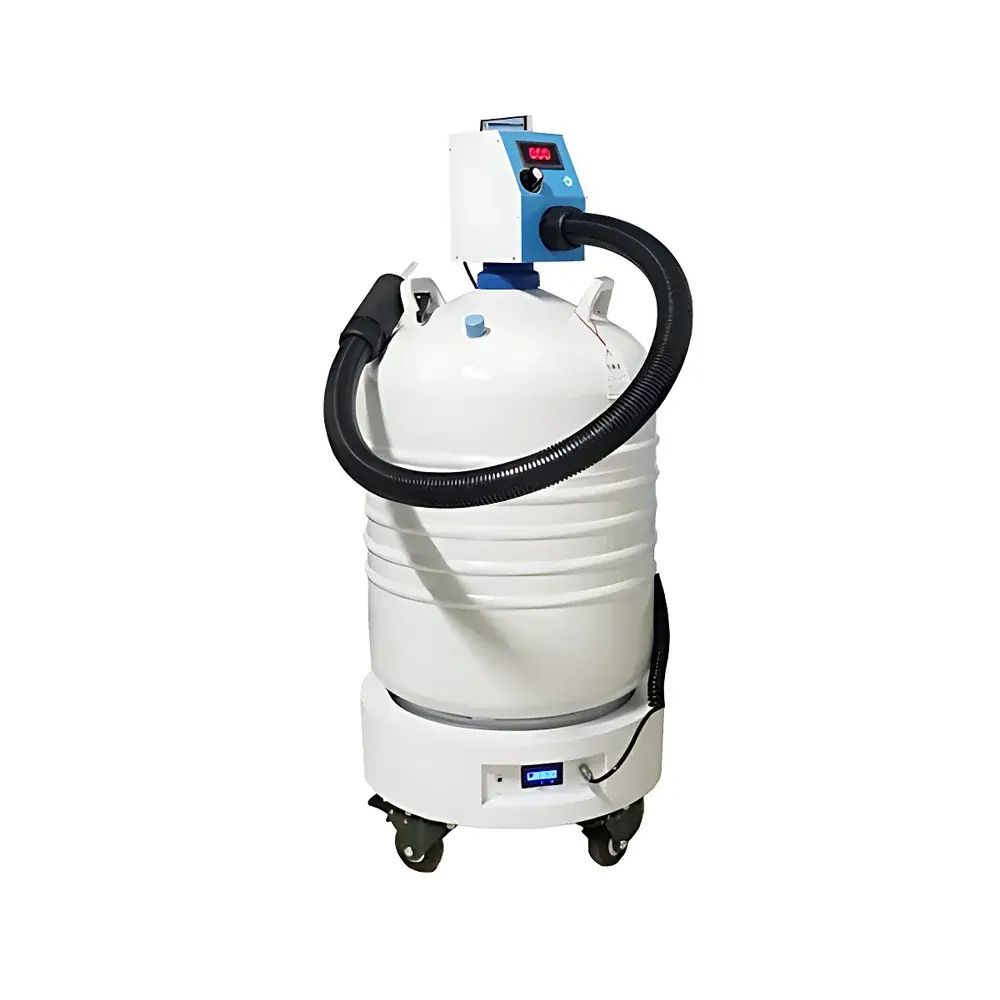
Beishide BSD-LNL Fully Automated Liquid Nitrogen Level Stabilization System
| Brand | Beishide Instrument |
|---|---|
| Origin | Beijing, China |
| Manufacturer Type | Direct Manufacturer |
| Region of Origin | Domestic (China) |
| Model | BSD-LNL |
| Pricing | Upon Request |
Overview
The Beishide BSD-LNL Fully Automated Liquid Nitrogen Level Stabilization System is an engineered solution designed to maintain a precisely controlled liquid nitrogen (LN₂) level within cryogenic sample chambers—primarily for physical adsorption analyzers (e.g., surface area and porosity analyzers), electron microscopes (SEM/TEM cryo-stages), and other low-temperature analytical platforms requiring stable thermal environments. Operating on the principle of real-time ultrasonic or capacitive liquid-level feedback coupled with closed-loop motorized pumping control, the BSD-LNL system eliminates thermal drift caused by LN₂ evaporation-induced level fluctuations. This stabilization directly mitigates temperature gradient variations across the sample zone—critical for high-accuracy BET surface area, t-plot micropore volume, and DFT pore size distribution measurements per ISO 9277, ASTM D3663, and IUPAC recommendations. Unlike pressure-driven or gravity-fed LN₂ top-up systems, the BSD-LNL employs a non-pressurized, electrically driven turbine pump, ensuring consistent flow without introducing mechanical vibration or gas-phase contamination into the cryostat.
Key Features
- Automated LN₂ level regulation with ±2 mm positional accuracy over extended operation cycles (up to 72+ hours unattended)
- Adjustable volumetric delivery rate: 0–2 L/min, programmable via front-panel interface or remote command protocol
- Modular integration architecture—designed for seamless retrofitting onto existing physical adsorption instruments (e.g., volumetric gas sorption analyzers) and cryo-electron microscopy stages
- Turbine-based LN₂ transfer pump operating without pressurized gas sources; eliminates risk of over-pressurization or sudden boil-off events
- Cryogenically rated flexible tubing and multi-layer vacuum-jacketed insulation—maintains mechanical compliance and thermal integrity at 77 K
- Fail-safe anti-freeze obstruction design: integrated thermal monitoring and dynamic flow reversal logic prevent ice accumulation in delivery lines
- Tool-free quick-mount/dismount mechanism—enables field installation or removal without modifying host instrument calibration or vacuum integrity
Sample Compatibility & Compliance
The BSD-LNL system supports standard 100–500 mL Dewar configurations used in commercial gas sorption analyzers and custom-designed cryogenic sample holders. It is compatible with liquid nitrogen, liquid helium (4.2 K), and liquid oxygen (90 K) when configured with appropriate material-grade components (e.g., OFHC copper lines, PTFE-reinforced elastomers). The system complies with general laboratory safety requirements under ISO 13850 (emergency stop functionality) and incorporates electrical isolation per IEC 61010-1 for Class I equipment. While not a medical or regulated GMP device, its logging-capable control module supports audit-ready operation under GLP-compliant laboratories—particularly where traceability of cryogen supply duration and level stability is required for method validation (e.g., USP , Ph. Eur. 2.9.32).
Software & Data Management
The embedded controller provides local LED display with real-time level position, cumulative LN₂ consumption, and pump runtime statistics. Optional RS-232 or Ethernet interface enables integration with host instrument software (e.g., Beishide’s ConFlow™ or third-party acquisition suites) for synchronized data logging. All level setpoints, flow profiles, and alarm thresholds are configurable and retained in non-volatile memory. Event logs—including level deviation alerts, pump activation cycles, and thermal fault triggers—are timestamped and exportable as CSV for QA documentation. The system does not require FDA 21 CFR Part 11-compliant electronic signatures but supports manual verification logs aligned with internal SOPs for regulated research environments.
Applications
- Stabilizing thermal boundary conditions during nitrogen physisorption isotherm acquisition (77 K) for accurate surface area (BET), pore volume, and pore size distribution analysis
- Maintaining constant cryo-stage temperature in SEM/TEM for beam-sensitive biological or polymeric specimens
- Supporting low-temperature catalytic reaction studies requiring reproducible adsorbate–surface interaction kinetics
- Enabling long-duration thermal desorption spectroscopy (TDS) experiments with minimized baseline drift
- Facilitating inter-laboratory method harmonization where LN₂ level consistency directly impacts repeatability across ISO/IEC 17025-accredited facilities
FAQ
Can the BSD-LNL system be retrofitted to non-Beishide adsorption analyzers?
Yes—mechanical and electrical interface specifications are documented for third-party integration; custom flange adapters and signal mapping guides are available upon request.
Does the system support liquid helium operation out-of-the-box?
No—LN₂-rated components are standard; helium compatibility requires upgraded materials (e.g., stainless steel 316L tubing, specialized seals) and must be specified at time of order.
What maintenance intervals are recommended for the turbine pump?
Annual inspection of rotor bearings and tubing integrity is advised; no routine lubrication is required due to cryogenic dry-running design.
Is remote monitoring possible without proprietary software?
Yes—ASCII-based serial commands allow integration with LabVIEW, Python (PySerial), or SCADA platforms using documented protocol syntax.
How does the system handle power interruption during operation?
The controller retains last-set parameters and resumes level regulation upon power restoration; LN₂ flow halts immediately during outage to prevent overflow or thermal shock.



