
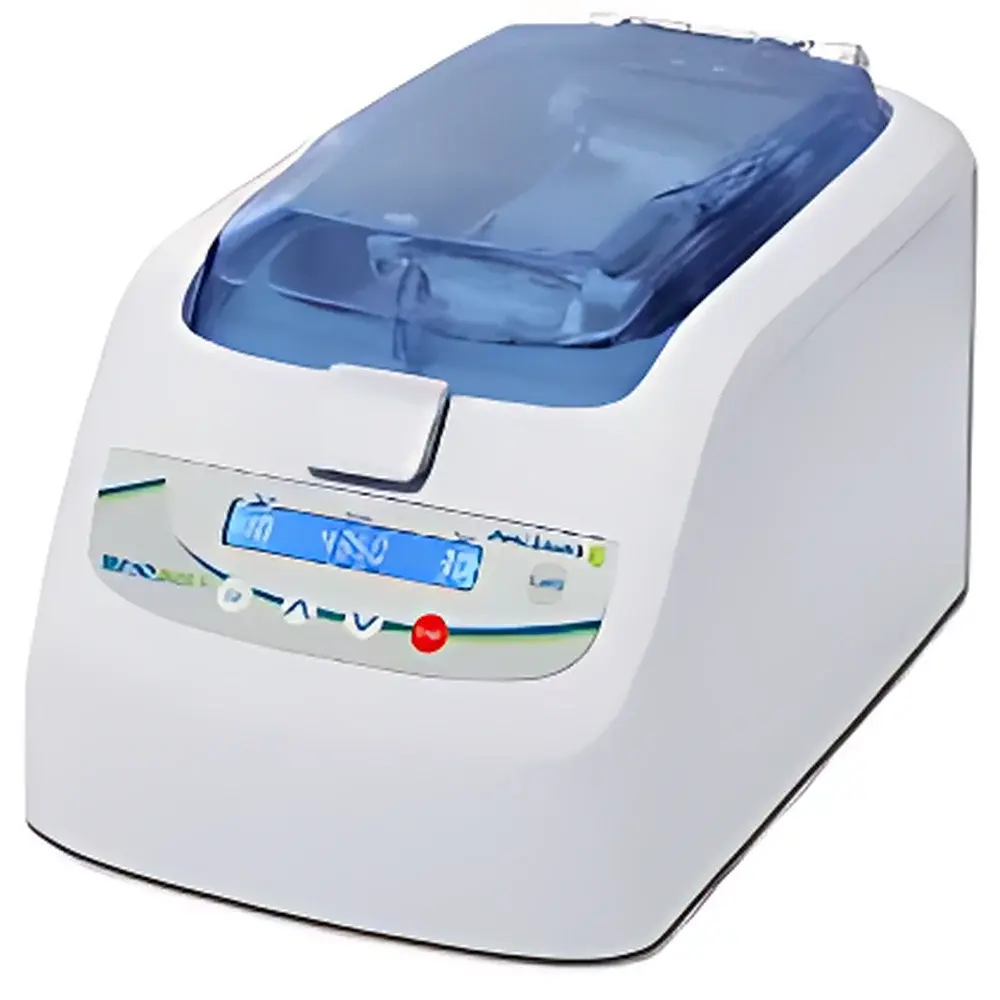
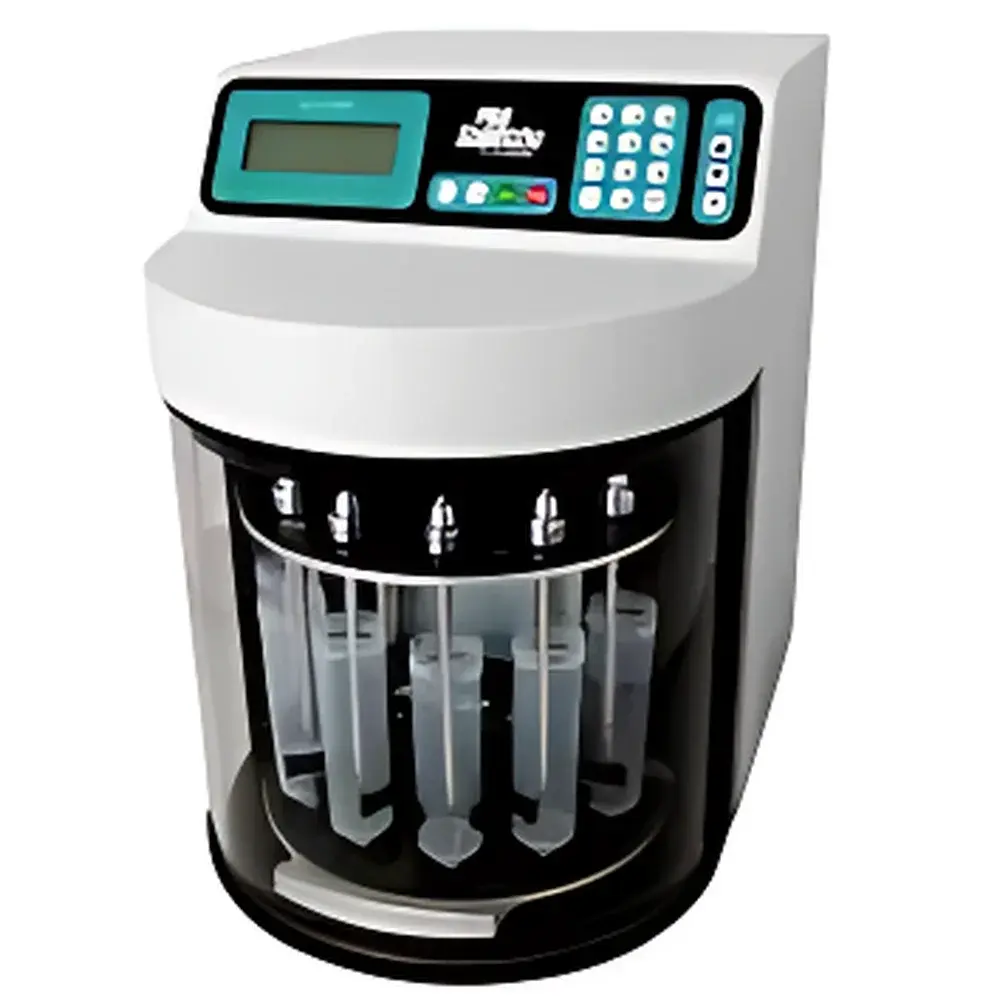
Benchmark BeadBug6 Multi-Sample Bead Mill Homogenizer
| Brand | Benchmark |
|---|---|
| Origin | USA |
| Manufacturer Type | Authorized Distributor |
| Product Category | Imported Instrument |
| Instrument Type | Bead Mill Homogenizer |
| Dimensions (W×D×H) | 22 × 35.5 × 20.5 cm (8.6 × 14 × 8 in) |
| Sample Capacity | 6 × 2.0 mL tubes or 2 × 5.0 mL tubes |
| Velocity Range | 4.00–7.00 m/s (increment: 0.05 m/s) |
| Cycle Time | 0–90 s (increment: 1 s) |
| Inter-Cycle Pause | 0–90 s (increment: 1 s) |
| Cycles | 1–10 |
| Acceleration/Deceleration Time | ≤2 s |
| Noise Level | <65 dB(A) |
| Operating Temperature | +4 °C to +45 °C |
| Weight | 9 kg (20 lbs) |
| Power Supply | 100–240 V, 50–60 Hz |
Overview
The Benchmark BeadBug6 Multi-Sample Bead Mill Homogenizer is an engineered solution for high-throughput, reproducible mechanical lysis of biological samples in research and quality control laboratories. It operates on the principle of high-frequency 3D orbital motion—generating controlled kinetic energy transfer from inert grinding beads to sample matrices housed in sealed microcentrifuge tubes. This bead-based impact mechanism enables rapid disruption of diverse sample types—including cultured cells, soft tissues, fibrous plant material, bone fragments, and microbial pellets—without thermal degradation or enzymatic bias. Unlike rotor-stator or ultrasonic homogenizers, the BeadBug6 delivers consistent shear forces across all six positions simultaneously, eliminating inter-sample variability caused by sequential processing. Its compact footprint and closed-tube operation support walkaway automation in biosafety level 2 (BSL-2) environments and align with GLP-compliant workflows requiring minimal operator intervention and contamination control.
Key Features
- Simultaneous homogenization of up to six 2.0 mL microcentrifuge tubes—or two 5.0 mL tubes using optional adapters—ensuring parallel processing without cross-contamination.
- Precisely programmable velocity (4.00–7.00 m/s, 0.05 m/s increments), cycle duration (0–90 s), inter-cycle pause (0–90 s), and repeat cycles (1–10), enabling method standardization across users and shifts.
- Integrated acceleration/deceleration control (≤2 s) minimizes mechanical stress on tube seals and prevents bead sedimentation during transitions between motion phases.
- Acoustically damped housing maintains noise levels below 65 dB(A) at 1 m distance—suitable for shared laboratory spaces and continuous operation in temperature-controlled rooms (+4 °C to +45 °C).
- Sealed-tube protocol eliminates aerosol generation and preserves sample integrity for downstream applications including RNA extraction, proteomics, and metagenomic DNA isolation.
- Universal power input (100–240 V, 50–60 Hz) ensures compatibility with global electrical infrastructure without external transformers or voltage regulators.
Sample Compatibility & Compliance
The BeadBug6 accommodates a broad spectrum of biological matrices, validated for use with mammalian cell suspensions, bacterial cultures, yeast pellets, frozen plant tissue, rodent liver/kidney, and decalcified bone specimens. Compatibility extends to common lysis buffers (e.g., RLT, QIAzol, TRIzol-compatible formulations) and cryopreserved samples processed directly from −80 °C storage. All protocols are compatible with ISO 17025-accredited testing environments when paired with traceable calibration procedures. The instrument’s sealed-tube architecture satisfies containment requirements outlined in CDC/NIH Biosafety in Microbiological and Biomedical Laboratories (BMBL) 6th Edition and supports adherence to FDA 21 CFR Part 11 when integrated with compliant LIMS or ELN platforms that log parameter changes and run histories.
Software & Data Management
The BeadBug6 features a front-panel LCD interface with intuitive rotary encoder navigation—no external PC or proprietary software required for routine operation. All active parameters (velocity, time, cycles, pause) are retained in non-volatile memory after power-down, supporting immediate method recall and replication. For laboratories requiring audit trails, optional RS-232 or USB-to-serial interfaces enable integration with third-party data acquisition systems. When used in conjunction with electronic lab notebooks (ELNs) compliant with ALCOA+ principles, the device supports full traceability of homogenization conditions—including timestamped start/stop events and user-defined method IDs—facilitating regulatory submissions under ICH M7, USP , or ISO/IEC 17025 Clause 7.7.
Applications
- Routine nucleic acid extraction from difficult-to-lyse Gram-positive bacteria and fungal spores.
- High-yield protein solubilization from membrane-rich tissues such as brain, heart, and tumor biopsies.
- Preparation of single-cell suspensions from solid tumors prior to flow cytometry or scRNA-seq library construction.
- Homogenization of environmental soil or sediment samples for metagenomic DNA recovery and qPCR-based pathogen detection.
- Fragmentation of calcified or keratinized tissues (e.g., teeth, hooves, feathers) in forensic and veterinary diagnostics.
- Standardized lysis for QC release testing of biopharmaceutical intermediates under GMP Annex 1 guidelines.
FAQ
Can the BeadBug6 be operated inside a cold room?
Yes—the instrument is rated for continuous operation between +4 °C and +45 °C, making it suitable for use in refrigerated laboratories or adjacent to −20 °C freezers without condensation-related failure.
Is validation documentation available for IQ/OQ/PQ protocols?
Benchmark provides a comprehensive User Requirements Specification (URS) template and factory test reports; site-specific IQ/OQ execution is supported via calibrated tachometers and acoustic meters per ISO 13485 and ASTM E2500 standards.
What grinding bead options are compatible with the BeadBug6?
Glass, ceramic (zirconium oxide), stainless steel, and silica beads ranging from 0.1 mm to 2.0 mm diameter are validated; pre-filled lysing matrix tubes (e.g., MP Biomedicals Lysing Matrix A–D) are fully supported.
Does the BeadBug6 require preventive maintenance?
No scheduled maintenance is required beyond periodic visual inspection of the rubber isolation feet and cleaning of the chamber cavity with 70% ethanol; the brushless DC motor has a rated service life exceeding 20,000 hours.
How does the BeadBug6 compare to vortex-based or rotor-stator homogenizers for RNA integrity?
Independent studies demonstrate superior RNA Integrity Number (RIN) scores (≥9.2) versus vortex homogenization (RIN ~7.5) and comparable performance to optimized rotor-stator methods—without the need for post-lysis centrifugation or probe sterilization between runs.



