
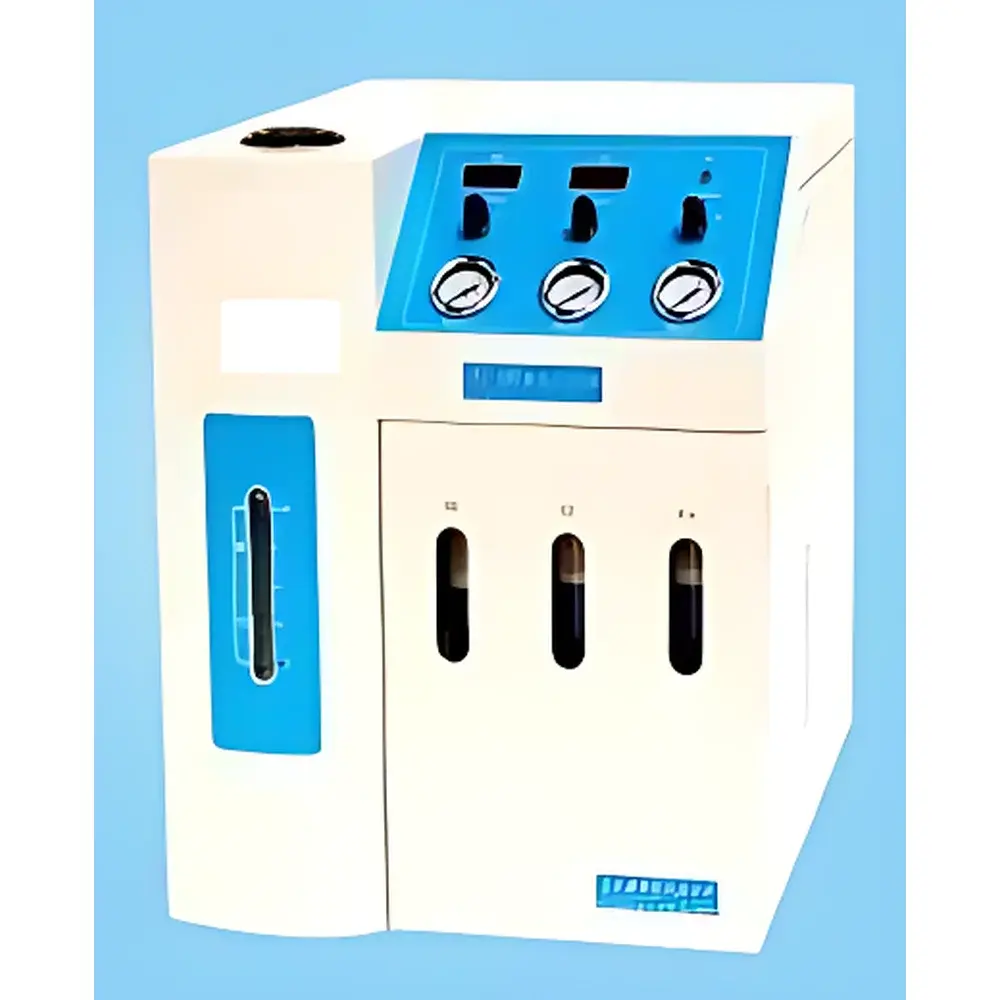
BF-300 Nitrogen-Hydrogen-Air Integrated Gas Generator
| Brand | Beifen Sanpu |
|---|---|
| Origin | Beijing, China |
| Manufacturer Type | Direct Manufacturer |
| Region of Origin | Domestic (China) |
| Model | BF-300 |
| Pricing | Available Upon Request |
| Nitrogen Purity | ≥99.999% (O₂ ≤1 ppm) |
| Hydrogen Purity | ≥99.999% (O₂ ≤1 ppm) |
| Air Purity | Oil-free, Class 3 filtration |
| Nitrogen Output Pressure | 0.4 MPa |
| Hydrogen Output Pressure | 0.3 MPa |
| Air Output Pressure | 0.4 MPa |
| Nitrogen Flow Rate | 0–300 mL/min |
| Hydrogen Flow Rate | 0–300 mL/min |
| Air Flow Rate | 0–2 L/min |
| Power Supply | AC 220 V, 50 Hz |
| Max. Power Consumption | 350 W |
| Operating Temperature | 0–40 °C |
| Relative Humidity | <85% RH |
| Dimensions (L×W×H) | 500 × 400 × 360 mm |
| Net Weight | 40 kg |
| Safety Features | Multi-stage pressure regulation, non-return liquid design, over-pressure/over-temperature protection, electrolyte level monitoring |
| Cooling | Passive convection |
| Electrolyte Requirement | Deionized or distilled water only |
| Compliance | Designed for GLP-compliant laboratory environments |
Overview
The BF-300 Nitrogen-Hydrogen-Air Integrated Gas Generator is an engineered solution for laboratories requiring on-demand, high-purity carrier, fuel, and combustion gases—primarily for gas chromatography (GC), GC–MS, and related analytical instrumentation. Unlike conventional high-pressure cylinder systems, the BF-300 eliminates logistical constraints, safety hazards associated with compressed gas storage, and purity degradation over time. It operates on the principle of membrane-based nitrogen separation (PSA or hollow-fiber diffusion), alkaline electrolysis for hydrogen generation, and multi-stage oil-free compression with integrated filtration for synthetic air production. All three gas streams are independently regulated, pressure-stabilized, and continuously monitored to ensure long-term reproducibility under varying load conditions. The system is designed for uninterrupted 24/7 operation in ambient laboratory environments (0–40 °C, <85% RH), meeting the baseline infrastructure requirements for modern analytical labs pursuing ISO/IEC 17025 accreditation or routine GLP compliance.
Key Features
- Triple-gas output from a single compact chassis: nitrogen (≤1 ppm O₂), hydrogen (≤1 ppm O₂), and oil-free synthetic air (Class 3 filtration per ISO 8573-1)
- Dual-mode operational flexibility: supports simultaneous or independent use of any gas stream without cross-contamination or performance compromise
- Electrolytic hydrogen module with high-efficiency tubular electrolysis cell—optimized for low operating temperature, high surface-area-to-volume ratio, and stable H₂ yield at rated flow
- Nitrogen subsystem incorporating advanced multi-stage purification architecture, eliminating the “two-gas-in-one-cylinder” dependency common in legacy setups
- Integrated non-return liquid (NRL) design across both N₂ and H₂ circuits prevents backflow into electrolyte reservoirs or separation membranes
- Real-time digital LED display for nitrogen and hydrogen flow rates and pressure status—enabling immediate verification of delivery parameters
- Multi-layer safety architecture: pressure relief valves, thermal cutoffs, automatic electrolyte level sensing, and fail-safe shutdown logic compliant with IEC 61010-1
- Energy-efficient switch-mode power supply reduces standby losses and improves overall electrolysis efficiency versus linear transformer-based designs
Sample Compatibility & Compliance
The BF-300 is validated for continuous feeding of analytical instruments requiring ultra-high-purity gases—including flame ionization detectors (FID), thermal conductivity detectors (TCD), electron capture detectors (ECD), and plasma-based elemental analyzers. Its nitrogen output meets ASTM D6299 specifications for GC carrier gas purity; hydrogen output satisfies USP requirements for fuel gas in detector applications; and its oil-free air stream complies with ISO 8573-1:2010 Class 3 for particulate, moisture, and oil aerosol content. The unit’s mechanical and electrical design adheres to CE marking directives (2014/30/EU EMC, 2014/35/EU LVD) and supports audit-ready documentation for FDA 21 CFR Part 11–aligned environments when paired with validated instrument control software.
Software & Data Management
While the BF-300 operates as a standalone hardware platform with no embedded firmware or network interface, its analog output signals (0–5 V or 4–20 mA optional upon request) are compatible with third-party lab information management systems (LIMS) and building automation controllers. All operational parameters—including pressure setpoints, flow stability logs, and maintenance alerts—are accessible via front-panel indicators and user-accessible service menus. For laboratories implementing electronic recordkeeping, manual logging templates aligned with ISO/IEC 17025 clause 7.5.2 (control of records) are available upon request. No proprietary software installation is required; system diagnostics rely solely on physical indicator status and calibrated pressure gauges traceable to national standards.
Applications
- Carrier gas supply for capillary GC columns (nitrogen, hydrogen)
- Fuel gas for FID, NPD, and FPD detectors (hydrogen)
- Make-up and combustion gas for FID and TCD (air)
- Blank gas for zero-air calibration in environmental air monitoring systems
- Shielding gas in inert-atmosphere sample preparation workstations
- Gas source for portable GC field deployments where cylinder logistics are prohibitive
- Support gas for hyphenated techniques including GC–FTIR and GC–AED
FAQ
What is the expected service life of the electrolysis cell under continuous operation?
With proper deionized water replenishment and adherence to ambient operating conditions, the tubular electrolyzer is rated for ≥15,000 hours of cumulative runtime before scheduled refurbishment.
Does the BF-300 require external cooling or ventilation?
No forced-air cooling is needed; the unit relies on passive convection and has been thermally characterized to remain within safe operating limits at 40 °C ambient with full-load output.
Can the nitrogen and hydrogen outputs be used simultaneously with different flow demands?
Yes—the BF-300 features fully decoupled gas generation modules, enabling independent pressure and flow control without interference between streams.
Is validation documentation provided for IQ/OQ/PQ protocols?
Factory test reports, pressure calibration certificates, and material compliance declarations (RoHS, REACH) are included; site-specific qualification support is available through authorized service partners.
How often must distilled water be added to the hydrogen generator?
Under typical usage (200 mL/min H₂, 8 hrs/day), electrolyte top-up is required approximately every 7–10 days; a low-level visual indicator alerts users prior to depletion.



