
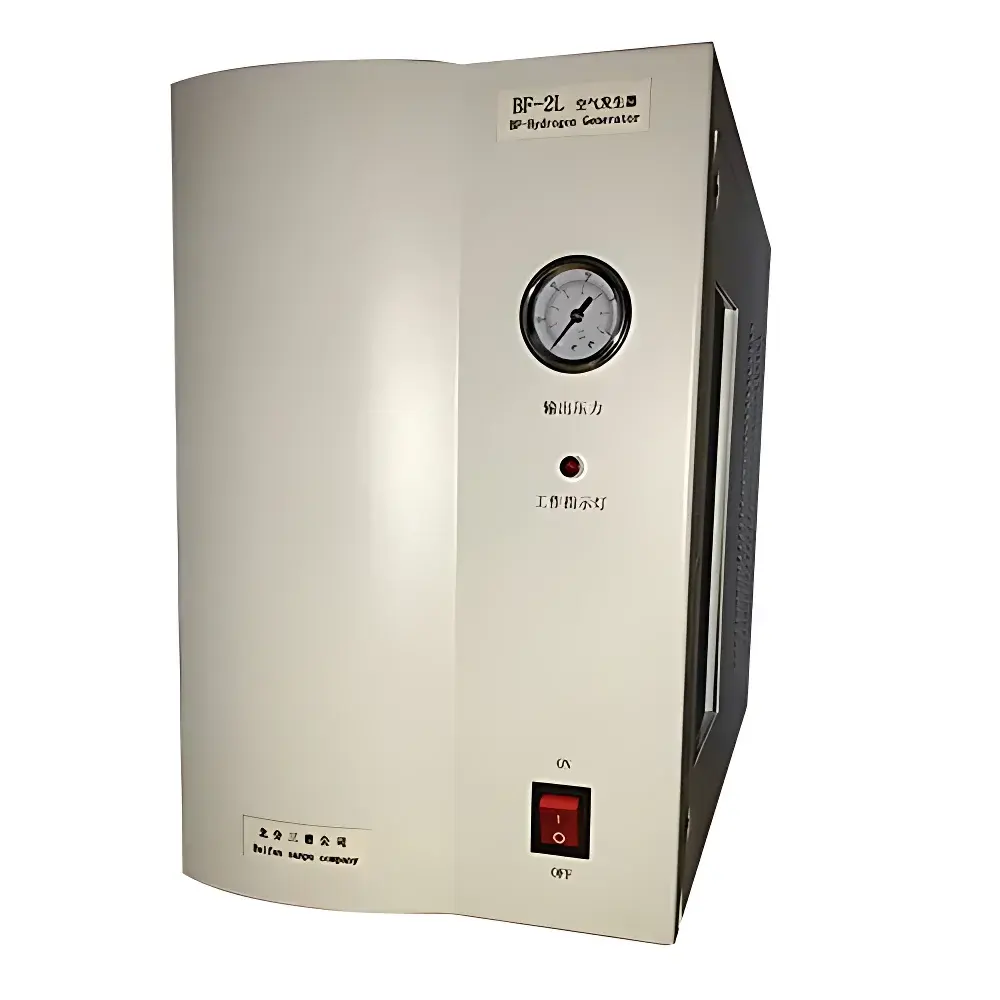
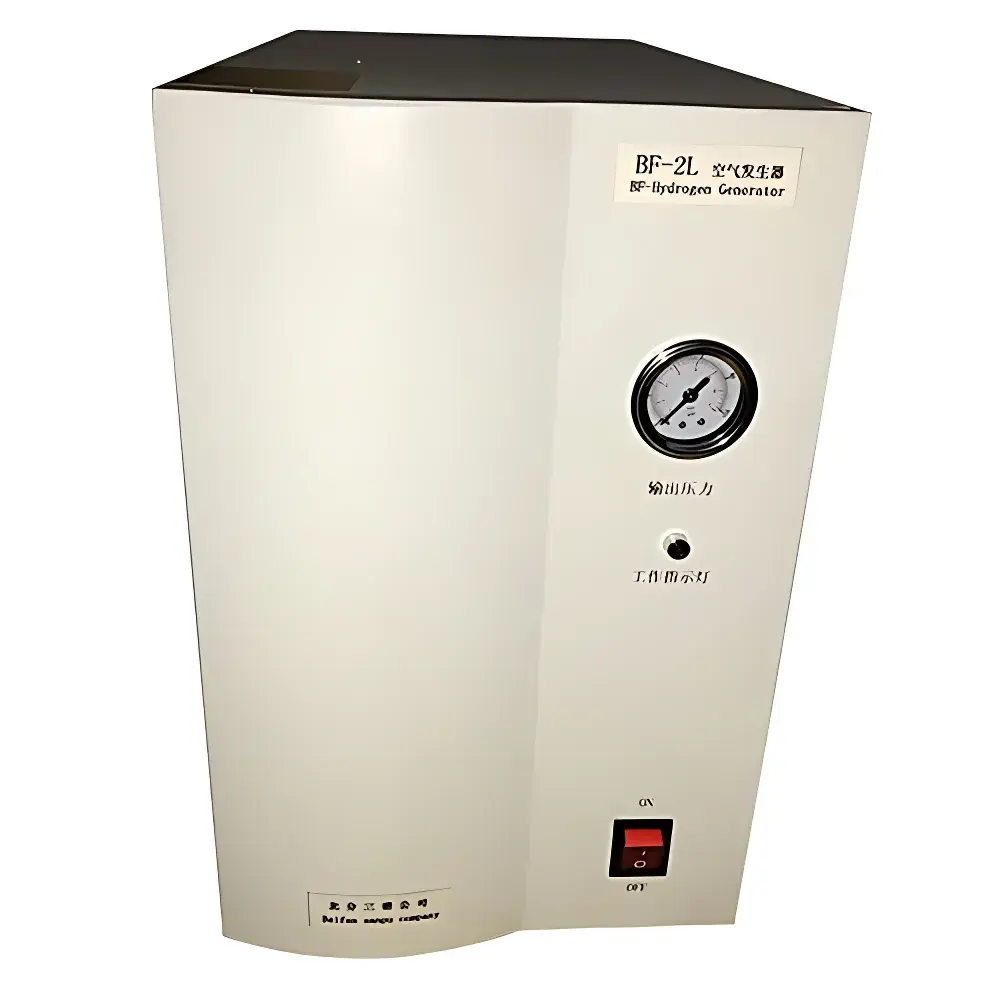
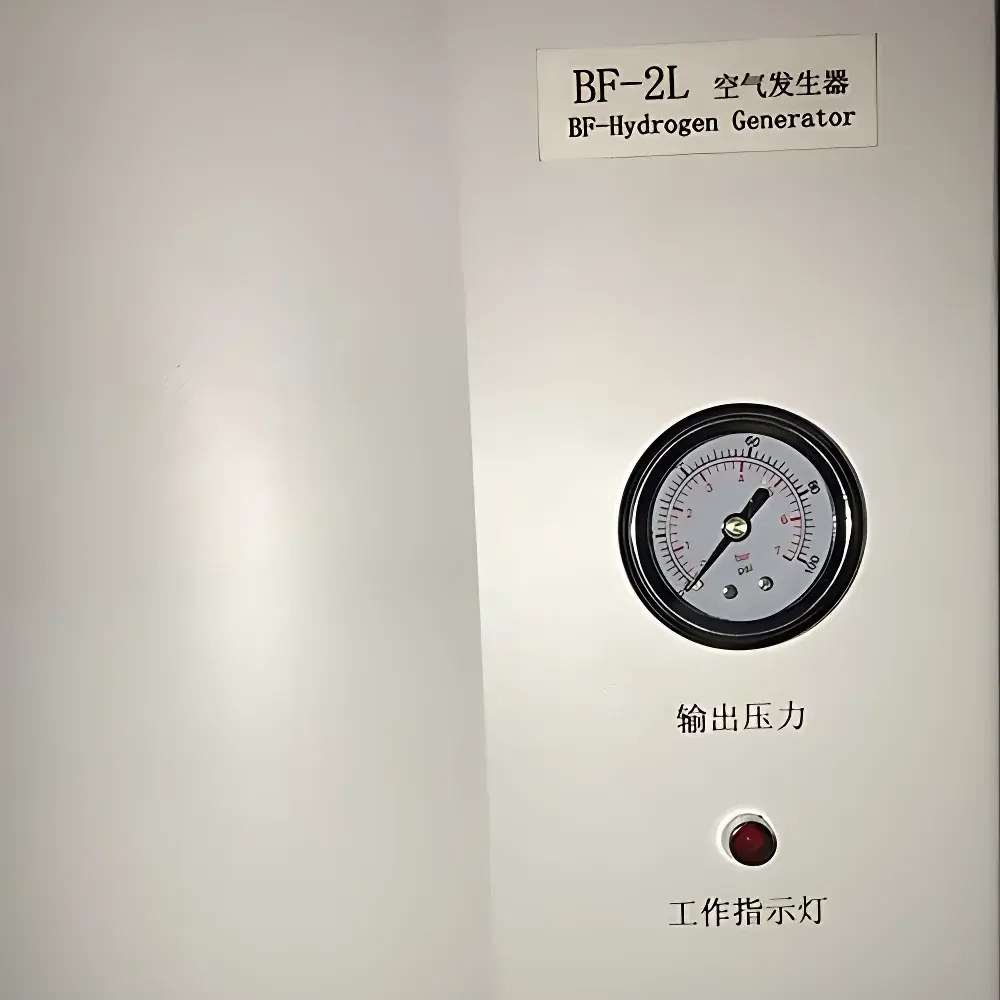
BF-5L Air Generator by Beifen Sanpu
| Brand | Beifen Sanpu |
|---|---|
| Origin | Beijing, China |
| Manufacturer Type | Direct Manufacturer |
| Model | BF-5L |
| Hydrocarbon Removal Principle | High-Temperature Catalytic Cracking |
| Output Flow Rate | 0–5 L/min |
| Output Pressure | 0.5 MPa |
| Total Hydrocarbon (HC) Content | < 0.1 ppm |
| Dew Point | –40 °C |
| Air Purity | Oil-Free, Triple-Stage Purification |
| Pressure Regulation | Dual-Stage Stabilization |
| Safety Features | Overpressure Protection, Manual Drain Valve |
| Noise Level | ≤ 42 dB(A) |
| Input Power | AC 220 V, 50 Hz |
| Rated Power Consumption | 180 W |
| Operating Temperature Range | 15–40 °C |
| Relative Humidity Limit | < 70 % RH |
| Dimensions (L×W×H) | 490 × 240 × 380 mm |
| Net Weight | 24 kg |
Overview
The BF-5L Air Generator by Beifen Sanpu is an engineered solution for laboratories requiring a continuous, on-demand supply of high-purity, oil-free compressed air—specifically optimized for analytical instrumentation including gas chromatographs (GC), GC–MS systems, flame ionization detectors (FID), nitrogen–phosphorus detectors (NPD), and other air-dependent laboratory equipment. Unlike conventional high-pressure cylinder-based air sources, the BF-5L eliminates handling hazards, logistical constraints, and purity variability associated with bulk gas delivery. Its core air generation principle relies on ambient air compression followed by integrated multi-stage purification: particulate filtration, desiccant-based moisture removal, and high-temperature catalytic cracking (>300 °C) to decompose residual hydrocarbons into CO₂ and H₂O. This process ensures compliance with stringent instrumental air specifications defined in ASTM D6299 and ISO 8573-1 Class 1.4.1 (for particles, water, and oil), making it suitable for regulated environments operating under GLP or GMP frameworks.
Key Features
- Triple-stage air purification system: pre-filter (5 µm), activated carbon adsorption, and high-efficiency desiccant dryer—ensuring oil-free, particle-free, and low-moisture output.
- Dual-stage pressure regulation architecture delivering stable output pressure at 0.5 MPa (±0.02 MPa), minimizing flow fluctuations during instrument duty cycling.
- High-temperature catalytic hydrocarbon destruction module reduces total hydrocarbon content to < 0.1 ppm (as methane equivalent), meeting detector-grade air requirements for FID and ECD operation.
- Integrated dew point control achieves –40 °C at 0.5 MPa, preventing condensation in pneumatic lines and detector housings—even under variable ambient humidity conditions.
- Comprehensive safety subsystems include automatic overpressure cutoff (set at 0.65 MPa), thermal overload protection, and manual condensate drain valve for routine maintenance.
- Compact footprint (490 × 240 × 380 mm) and low acoustic signature (≤ 42 dB[A]) enable seamless integration into densely configured analytical labs without compromising ergonomic workflow.
Sample Compatibility & Compliance
The BF-5L is validated for continuous operation with air-dependent analytical platforms requiring Class 1.4.1 compressed air per ISO 8573-1:2010. It supports standard GC inlet configurations (split/splitless), pneumatic actuators in autosamplers, and auxiliary air supplies for mass spectrometer ion sources. All internal wetted materials—including stainless steel regulators, fluoropolymer tubing, and ceramic catalyst substrates—are inert and non-outgassing, ensuring no interference with trace-level volatile organic compound (VOC) analysis. The unit complies with IEC 61010-1 for electrical safety and meets EMC directive 2014/30/EU. Optional documentation packages support 21 CFR Part 11–aligned audit trails when paired with compatible lab data management software.
Software & Data Management
While the BF-5L operates as a standalone hardware unit with analog controls (power switch, pressure gauge, drain valve), its operational parameters are inherently traceable via built-in mechanical indicators and scheduled maintenance logs. For laboratories implementing electronic recordkeeping, the generator’s consistent performance profile—verified through quarterly calibration checks using certified gas analyzers (e.g., photoacoustic HC meters and chilled-mirror hygrometers)—enables integration into broader instrument qualification protocols (IQ/OQ/PQ). Maintenance history, filter replacement dates, and pressure stability records can be archived within LIMS or ELN systems to satisfy GLP audit requirements.
Applications
- Primary air supply for gas chromatography flame ionization detectors (GC-FID), where hydrocarbon-free air is critical to baseline stability and detection limit integrity.
- Carrier gas makeup air in GC–MS systems requiring low-particulate, low-humidity auxiliary flow.
- Pneumatic power source for automated liquid handlers, valve actuators, and sample introduction modules in high-throughput QC labs.
- Replacement for high-pressure air cylinders in ISO/IEC 17025-accredited testing facilities seeking improved gas consistency and reduced cylinder change frequency.
- Supporting environmental monitoring labs performing EPA Method 8260/8270 analyses, where air purity directly impacts method reproducibility.
FAQ
What is the expected service life of the catalytic converter?
Under normal operating conditions (24/7 use, ambient temperature ≤ 35 °C), the high-temperature catalytic module maintains efficacy for ≥ 12,000 hours; recommended replacement interval is every 24 months or after 18,000 hours—whichever occurs first.
Can the BF-5L be used with oxygen-sensitive instruments?
No—it generates ambient-air-derived compressed air (≈ 78% N₂, 21% O₂); it is not designed for inert or oxygen-scrubbed applications. For oxygen-sensitive workflows, pairing with a dedicated nitrogen generator is advised.
Is remote monitoring or digital interface available?
The standard BF-5L model features analog operation only. Digital output (4–20 mA pressure signal or RS-485 Modbus RTU) is available upon request as a factory-configured option.
How often should the desiccant and particulate filters be replaced?
Pre-filters require replacement every 6 months; desiccant cartridges every 12 months—frequency may increase in high-dust or high-humidity environments. Filter status is tracked via included maintenance log sheet.
Does the unit comply with ISO 8573-1:2010 Class 1.4.1?
Yes—validated output meets Class 1 (particles ≤ 0.1 µm), Class 4 (dew point ≤ –40 °C), and Class 1 (total oil ≤ 0.01 mg/m³, hydrocarbons < 0.1 ppm) under rated flow and pressure conditions.



