
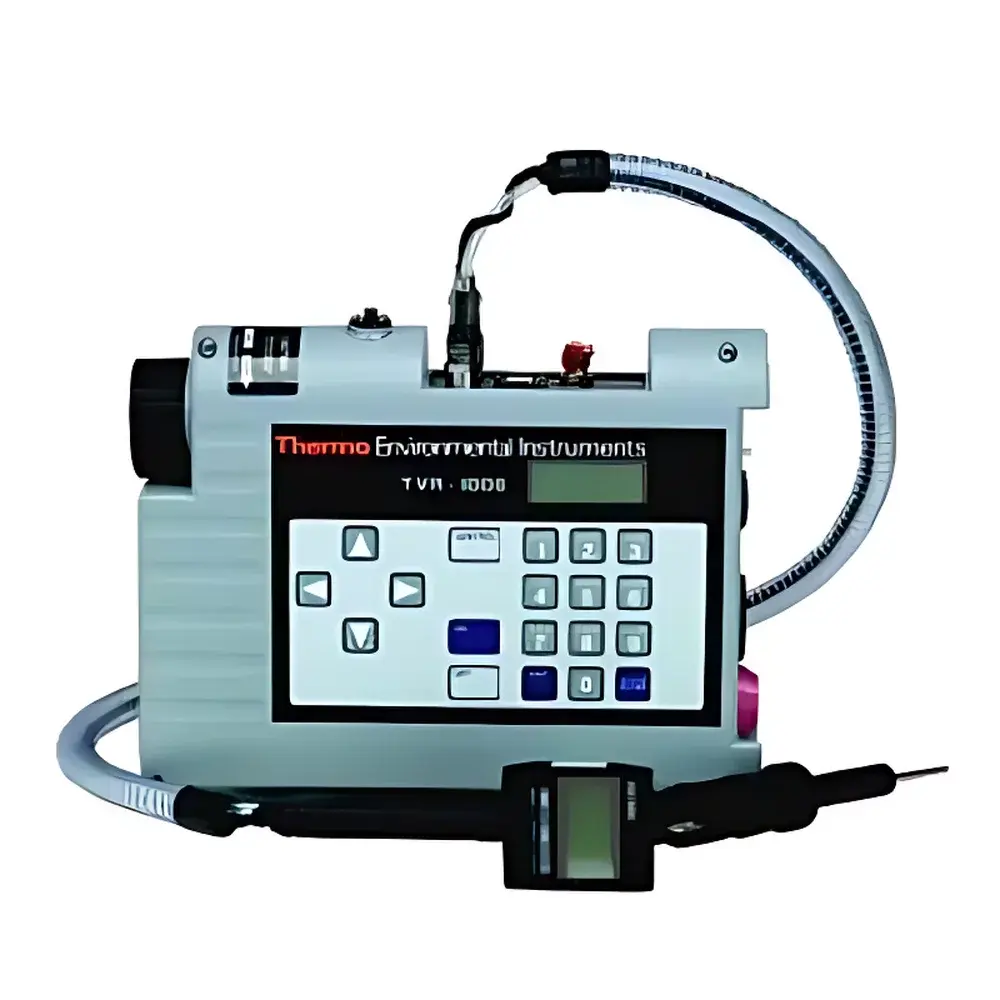
Thermo Fisher Scientific TVA Series Portable Toxic Volatile Organic Compound (VOC) Analyzer
| Brand | Thermo Fisher Scientific |
|---|---|
| Origin | USA |
| Manufacturer Type | Original Equipment Manufacturer (OEM) |
| Product Category | Imported Instrument |
| Model | TVA Series |
| Instrument Type | Portable Real-Time Gas Analyzer |
| Typical Configuration | Dual FID & PID Detector |
| Detection Range (FID) | 1–50,000 ppm (methane equivalent) |
| Detection Range (PID) | 0.5–2,000 ppm (isobutylene equivalent) |
| Resolution | <100 ppb (PID), <300 ppb (FID) |
| Accuracy | ±25% of reading or ±2.5 ppm (whichever is greater), per EPA Method 21 calibration protocols |
| Response Time (T90) | ≤3.5 s (both detectors) |
| Operating Temperature | 0–40 °C |
| Weight | ~5 kg |
| Certifications | FM Class I, Division 1 |
Overview
The Thermo Fisher Scientific TVA Series Portable Toxic Volatile Organic Compound (VOC) Analyzer is an intrinsically safe, field-deployable instrument engineered for real-time, quantitative detection of volatile organic compounds and select inorganic gases in industrial, environmental, and emergency response settings. It operates on two complementary detection principles: Flame Ionization Detection (FID) and Photoionization Detection (PID), enabling broad-spectrum analyte coverage while maintaining regulatory compliance with U.S. Environmental Protection Agency (EPA) Method 21 — the benchmark standard for Leak Detection and Repair (LDAR) programs. The FID module employs a hydrogen-air flame to ionize carbon-containing species, delivering high sensitivity across saturated and unsaturated hydrocarbons (e.g., methane, propane, benzene) with a dynamic range spanning 1–50,000 ppm. The PID module utilizes a 10.6 eV ultraviolet lamp to ionize molecules with ionization potentials below 10.6 eV, including aromatics, ketones, amines, sulfur compounds (e.g., H2S, NH3), and phosphines (e.g., PH3). Unlike single-detector systems, the TVA’s dual-channel architecture allows simultaneous, independent signal acquisition — eliminating cross-interference and enabling compound-class differentiation through response factor correlation.
Key Features
- Intrinsically safe design certified to FM Class I, Division 1 (and CENELEC ATEX Zone 1 for TVA1000B), permitting use in hazardous classified locations without explosion risk.
- Dual FID/PID detection system with independent sample flow paths, signal amplification, and digital signal processing — ensuring measurement integrity under variable humidity, temperature, and matrix conditions.
- Real-time concentration display with auto-scaling and user-adjustable response factors for over 100 common VOCs and inorganics, supporting EPA Method 21-compliant reporting.
- Onboard data logging with configurable sampling intervals (1/sec to 1/999 min in auto mode; 2–30 sec in manual mode) and timestamped GPS-tagged location metadata (when integrated with optional LDAR software).
- Robust mechanical architecture: lightweight (~5 kg), shoulder-strap compatible housing with IP54-rated ingress protection; operational at 0–40 °C and up to 95% RH non-condensing.
- Extended service life: PID lamp rated for >2,000 hours (with routine cleaning); FID burner assembly rated for >2,000 hours; hydrogen cylinder (15.3 MPa initial pressure) supports ≥8 hours of continuous operation.
Sample Compatibility & Compliance
The TVA Series is validated for direct sampling of ambient air, process vent streams, fugitive emissions from flanges, valves, pumps, and connectors, and headspace vapors above contaminated soils or groundwater. Its dual-detector configuration ensures compatibility with EPA Method 21 target analytes (e.g., methylene chloride, toluene, xylene, vinyl chloride), as well as non-EPA-listed compounds such as formaldehyde (via PID), hydrogen sulfide (PID), and ammonia (PID). All instruments undergo factory calibration using certified NIST-traceable gas standards and include full traceability documentation. The system meets requirements for GLP-compliant field data collection, supports 21 CFR Part 11–ready audit trails when paired with Thermo Fisher’s LDAR Manager software, and conforms to ISO 16000-22 (indoor air — VOC measurement) and ASTM D6196 (selection of sorbents for VOC monitoring) reference frameworks.
Software & Data Management
When interfaced with Thermo Fisher’s proprietary LDAR Manager software suite, the TVA Series enables fully auditable workflow execution — from route planning and site mapping to leak quantification, repair scheduling, and regulatory report generation (e.g., EPA Form 7520-1). Raw analog detector outputs are digitized at 10 Hz, time-stamped, and stored with instrument status flags (battery level, flow rate, temperature, calibration due date). Data export supports CSV, XML, and .ldar file formats compatible with third-party enterprise EHS platforms. Firmware updates are delivered via USB or Bluetooth, and all calibration events, zero/span checks, and maintenance logs are retained onboard with immutable timestamps — satisfying internal QA/QC and external regulatory inspection requirements.
Applications
- Leak Detection and Repair (LDAR): Primary deployment for EPA-regulated petrochemical, refining, and chemical manufacturing facilities — performing Method 21 screening surveys, quantification of emission rates, and verification of repair effectiveness.
- Uncontrolled Emission Monitoring: Quantitative assessment of fugitive emissions from storage tanks, transfer operations, wastewater treatment units, and vapor recovery systems.
- Indoor Air Quality (IAQ) Assessment: Identification and semi-quantitative profiling of VOC sources in laboratories, cleanrooms, and occupational environments per ASHRAE Standard 62.1.
- Underground Storage Tank (UST) Investigations: Soil vapor intrusion screening and plume delineation at remediation sites.
- Hazardous Waste Site Characterization: Rapid on-site screening of landfill gas, drum headspace, and contaminated sediment vapors.
- Emergency Response: First-responder deployment for chemical release incidents involving toxic VOCs or reactive inorganics (e.g., chlorine, phosphine), supported by built-in alarm thresholds and audible/visual alerts.
FAQ
What regulatory standards does the TVA Series comply with?
The instrument is designed and verified to meet EPA Method 21 for LDAR applications, and carries FM Class I, Division 1 certification for use in hazardous locations. The TVA1000B model additionally holds CENELEC ATEX Zone 1 approval.
Can the TVA distinguish between different VOCs?
It does not perform compound-specific identification like GC-MS, but enables class-level differentiation via response factor libraries and dual-detector ratio analysis (e.g., PID/FID signal ratio helps differentiate aromatic vs. aliphatic compounds).
Is hydrogen supply required for FID operation?
Yes — the FID requires ultra-high-purity hydrogen (≥99.999%) supplied from a portable cylinder (15.3 MPa initial pressure); integrated pressure regulation and flow control ensure stable combustion across ambient conditions.
How is calibration performed in the field?
Zero and span calibration is executed using certified span gases (e.g., 100 ppm isobutylene for PID, 10,000 ppm methane for FID) and ambient air or zero air; all calibrations are logged with operator ID, date/time, and gas lot traceability.
Does the TVA support data integration with enterprise EHS platforms?
Yes — via standardized CSV/XML exports and API-enabled connectivity with Thermo Fisher LDAR Manager, which supports integration into SAP EHS, Intelex, and Sphera platforms through documented middleware protocols.
Related Products







