
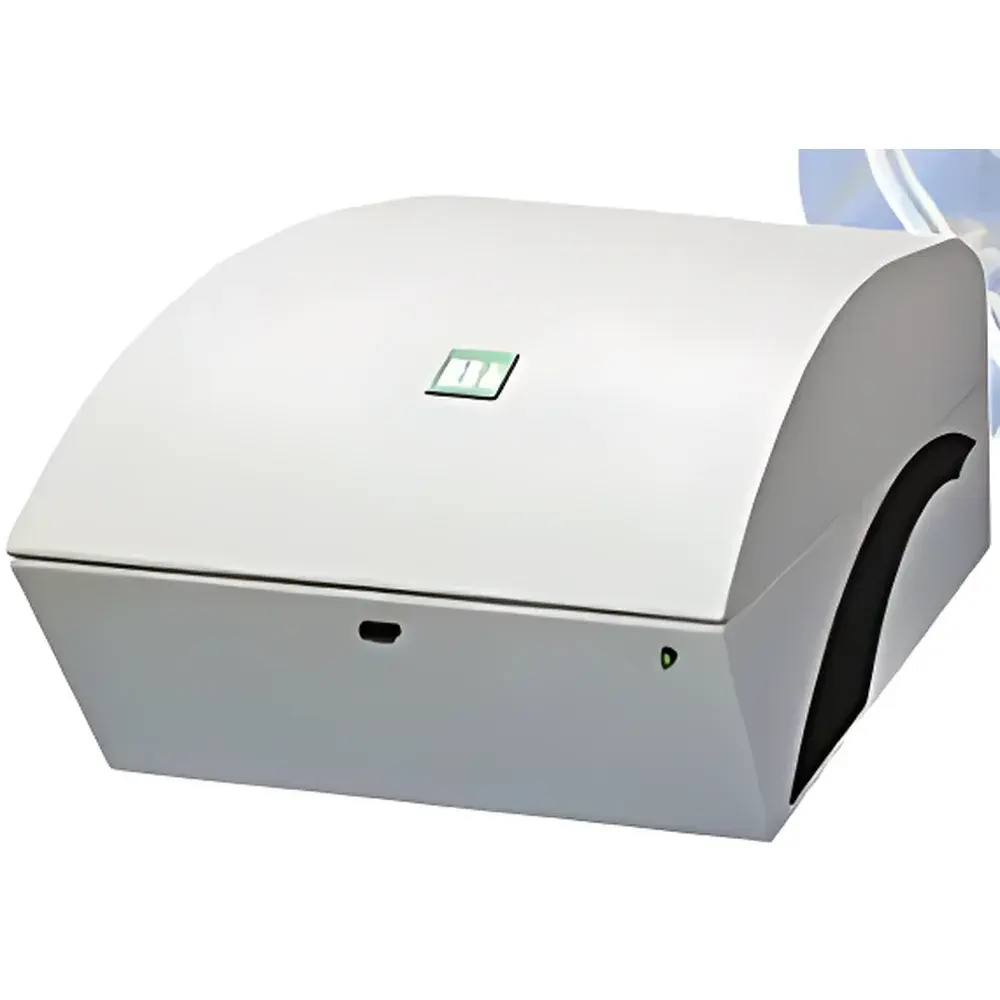
BI-2500 Desktop Surface Plasmon Resonance Instrument
| Origin | USA |
|---|---|
| Manufacturer Type | Authorized Distributor |
| Origin Category | Imported |
| Model | BI-2500 |
| Detection Range | <100 Da, KD = 10⁻³ M (1 mM) to 10⁻¹² M (1 pM), angular resolution <10⁻⁴° |
| Sample Channels | 3 |
| Injection Volume | >50 µL |
| Analysis Time Scale | milliseconds to hours (kinetically resolved) |
| Temperature Control | Ambient only |
Overview
The BI-2500 Desktop Surface Plasmon Resonance (SPR) Instrument is a compact, benchtop-grade optical biosensor engineered for label-free, real-time monitoring of molecular interactions at solid–liquid interfaces. Based on the Kretschmann configuration of angular interrogation, the system detects minute changes in the refractive index within ~200 nm of a gold-coated sensor surface—enabling quantitative measurement of binding kinetics (ka, kd) and equilibrium dissociation constants (KD) across a broad dynamic range. Its core optical architecture integrates a high-stability LED light source, precision angular scanning mechanism, and low-noise photodetector array, delivering sub-millidegree angular resolution (<10⁻⁴°) critical for resolving weak-affinity or fast-dissociating interactions involving small molecules (<100 Da) and proteins. Designed for academic labs, biopharma QC/QA units, and early-stage assay development teams, the BI-2500 operates without requiring dedicated optical tables or climate-controlled rooms—making SPR accessible in standard laboratory environments.
Key Features
- Triple-channel flow cell design enabling parallel sample analysis, reference subtraction, and internal calibration—increasing throughput by up to 100% compared to dual-channel systems
- Sub-picomolar sensitivity (KD down to 10⁻¹² M) validated with standard IgG–antigen and small-molecule–target protein pairs per ISO 20776-1 guidelines
- Modular platform supporting optional add-ons: electrochemical SPR (EC-SPR) with bipotentiostatic control, gas-phase SPR for volatile analyte detection, and dual-flow electrochemical modules for redox-coupled conformational studies
- Real-time kinetic acquisition from millisecond-scale association events to hour-long equilibrium phases—compatible with both rapid-onset ligand screening and slow off-rate characterization
- Robust mechanical architecture with passive thermal stabilization; no active temperature regulation required—optimized for ambient lab operation (18–25°C)
Sample Compatibility & Compliance
The BI-2500 supports a wide range of biomolecular interaction studies—including protein–protein, protein–peptide, protein–small molecule, antibody–epitope, and nucleic acid–ligand binding. Sensor chips are compatible with standard Au-coated glass slides (e.g., BI-CORE, CM5, NTA, SA, and custom functionalized surfaces). The system meets essential requirements for GLP-compliant workflows: audit-trail-enabled software logging, user-access controls, electronic signatures (per FDA 21 CFR Part 11 when paired with compliant LIMS integration), and traceable calibration protocols aligned with ASTM E2577 and ISO/IEC 17025 principles. All fluidic components comply with USP Class VI biocompatibility standards; wetted materials include PEEK, fused silica, and 316 stainless steel.
Software & Data Management
Instrument control, data acquisition, and kinetic modeling are performed via Biosensing Instrument’s proprietary BI-Analyzer software (v5.2+), which runs natively on Windows 10/11 platforms. The software provides real-time sensorgram visualization, global fitting of multi-cycle kinetics using 1:1 Langmuir, bivalent analyte, or heterogeneous ligand models, and batch processing for high-throughput screening datasets. Raw data are stored in vendor-neutral HDF5 format with embedded metadata (timestamp, flow rate, temperature, chip ID, user ID). Export options include CSV, Excel, and GraphPad Prism-compatible files. For enterprise deployment, the software supports LDAP authentication and can interface with laboratory information management systems (LIMS) via RESTful API endpoints.
Applications
- High-sensitivity affinity ranking of fragment libraries against therapeutic targets
- Characterization of allosteric modulation and redox-induced conformational dynamics using EC-SPR modules
- Development and validation of novel biosensor surfaces for point-of-care diagnostics
- Binding stoichiometry and thermodynamic profiling under varied buffer conditions (pH, ionic strength, co-solvents)
- Gas-phase detection of VOCs and environmental contaminants via functionalized SPR chips
FAQ
Does the BI-2500 support temperature-controlled measurements?
No—the system is designed for ambient-temperature operation only. Active thermal regulation is not integrated; users must maintain stable lab conditions (±1°C) for optimal reproducibility.
Can I use third-party sensor chips with the BI-2500?
Yes—standard 12.5 × 12.5 mm Au-coated chips from major suppliers (e.g., Cytiva, XanTec, SensiQ) are mechanically and optically compatible.
Is the BI-2500 suitable for GMP-regulated environments?
It supports key GMP elements (audit trail, user roles, electronic signatures) when deployed with validated software configurations and documented SOPs—but final qualification remains the responsibility of the end-user per ICH Q5E and Annex 11 requirements.
What is the minimum injection volume required for reliable kinetics?
A minimum of 50 µL is recommended per cycle to ensure full channel saturation and laminar flow stability; lower volumes may compromise mass transport correction accuracy.
How does the 3-channel architecture improve data quality beyond throughput?
It enables simultaneous reference subtraction (channel 2), blank correction (channel 3), and active measurement (channel 1), reducing systematic drift and enhancing signal-to-noise ratio in low-response scenarios such as small-molecule binding.
Related Products





