
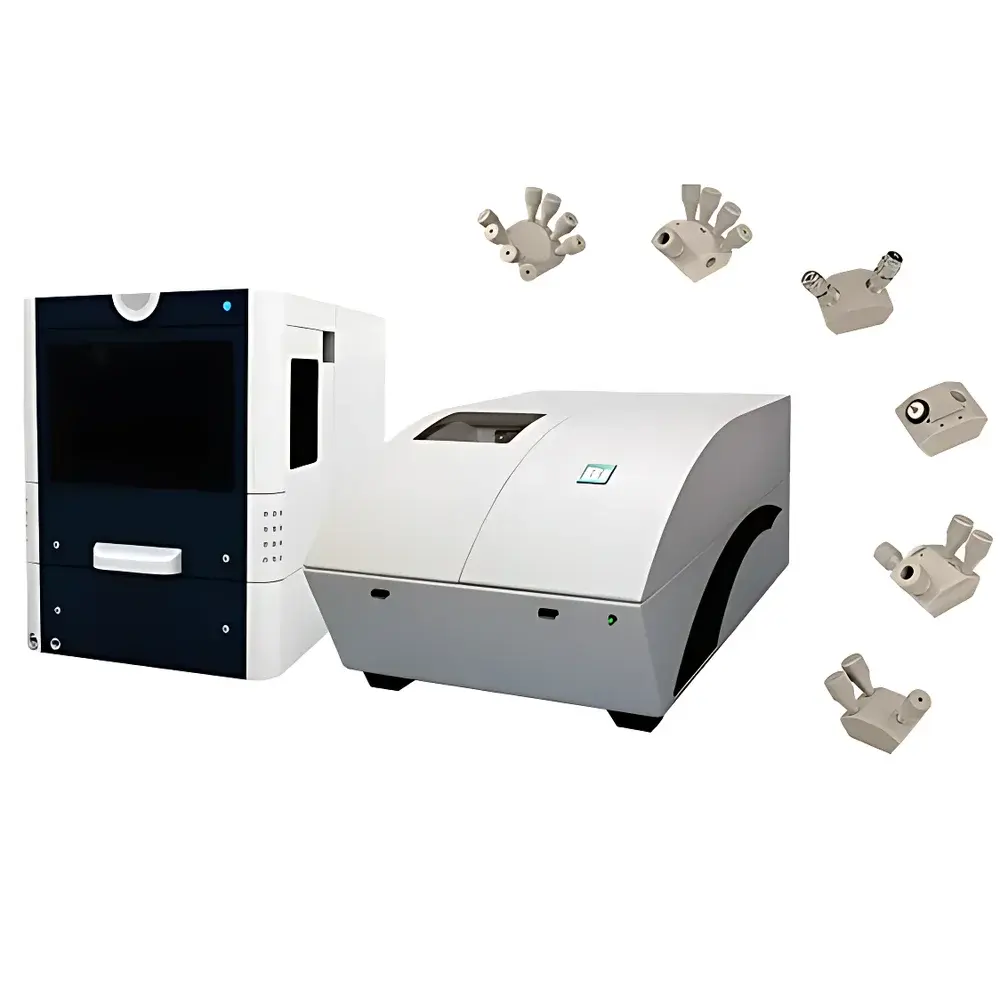
BI-Biosensing Instrument BI-4500 High-Throughput Automated Surface Plasmon Resonance Analyzer
| Brand | BI/Biosensing Instrument |
|---|---|
| Origin | USA |
| Model | BI-4500 |
| Detection Principle | Surface Plasmon Resonance (SPR) |
| Optical Wavelength | 670 nm |
| Angular Resolution | <0.01 mDeg RMS |
| Sensitivity | <0.06 RU RMS |
| Flow Channels | 5 independent microfluidic channels |
| Flow Rate Range | 1.0–250 µL/min |
| Minimum Analyte MW | 100 Da |
| Injection Volume | >50 µL |
| Injection Time | <0.2 s |
| Liquid-Phase Incident Angle Range | 67–81° |
| Gas-Phase Incident Angle Range (optional) | 40–47° |
| BI-DirectFlow™ Technology | Yes |
| Software Compliance | FDA 21 CFR Part 11 ready (audit trail, electronic signature support), GLP/GMP-compatible data handling |
Overview
The BI-Biosensing Instrument BI-4500 is a high-throughput, fully automated surface plasmon resonance (SPR) analyzer engineered for label-free, real-time monitoring of molecular interactions at solid–liquid and solid–gas interfaces. Based on the Kretschmann configuration, the instrument measures minute changes in the SPR angle induced by mass accumulation or structural rearrangement within the evanescent field (~200 nm depth) above a thin gold sensor surface. This enables quantitative determination of binding kinetics (ka, kd), equilibrium dissociation constants (KD), concentration (C), and stoichiometry without fluorescent or enzymatic labeling—critical for preserving native conformation and function of biomolecules. The BI-4500 integrates five parallel flow channels with precise fluidic control, supporting both high-sensitivity low-MW detection (<100 Da) and multiplexed screening across diverse sample types, including peptides, small-molecule drugs, glycans, nucleic acids, antibodies, viruses, and whole cells.
Key Features
- Five independent microfluidic channels with programmable injection sequencing and regeneration cycles
- BI-DirectFlow™ technology enabling sub-200 ms valve actuation, near-zero dispersion delivery, and reproducible mass transport control—essential for accurate fast-on/fast-off kinetic analysis
- High angular resolution optics with 4 ms data acquisition rate and <0.01 mDeg RMS stability, delivering <0.06 RU RMS baseline noise under continuous flow
- Modular architecture supporting interchangeable analytical configurations: liquid-phase biosensing, gas-phase chemical sensing, and integrated electrochemical SPR (EC-SPR)
- Thermally stabilized flow cell and temperature-controlled sample compartment (±0.1 °C) to minimize thermal drift during long-duration assays
- Gold-coated sensor chips compatible with standard amine coupling, thiol self-assembly, streptavidin-biotin, Ni-NTA, and custom surface chemistries
Sample Compatibility & Compliance
The BI-4500 accommodates a broad range of analytes and matrices without requiring derivatization. It supports direct detection of small molecules (e.g., metabolites, toxins, drug fragments), proteins (including membrane-associated and intrinsically disordered species), nucleic acids (ss/dsDNA, RNA aptamers), carbohydrates, liposomes, exosomes, and intact pathogens. Sensor surfaces are regenerable over ≥50 cycles using mild pH or ionic strength shifts, ensuring assay consistency and cost efficiency. The system meets core regulatory requirements for analytical instrument qualification: full audit-trail logging, user-access controls, electronic signature capability, and data integrity alignment with FDA 21 CFR Part 11, ISO/IEC 17025, and GLP/GMP documentation standards. All firmware and software updates are version-controlled and validated per ICH Q9/Q10 principles.
Software & Data Management
BI-4500 is operated via BI-SCOUT™ software—a Windows-based platform designed for method development, real-time visualization, global fitting, and report generation. The software implements double-referencing (channel + blank subtraction) and zero-time alignment algorithms to correct for bulk refractive index shifts and injection artifacts. Kinetic models (1:1 Langmuir, bivalent analyte, heterogeneous ligand, conformational change) are fitted using Marquardt–Levenberg nonlinear regression with confidence interval estimation. Raw data (.dat), processed sensorgrams (.spr), and analysis reports (.pdf/.xlsx) are stored in a hierarchical project structure with immutable timestamps. Export formats include ASCII, CSV, and FAIR-compliant metadata tags (ISA-Tab). Optional integration with LIMS and ELN systems is supported via RESTful API and ODBC connectivity.
Applications
- Protein–protein & protein–small molecule interaction profiling: Quantification of on-rates (103–107 M−1s−1) and off-rates (10−6–10−1 s−1) for lead optimization and epitope binning
- Antibody affinity maturation: High-resolution ranking of IgG variants under physiological buffer conditions
- Electrochemical SPR (EC-SPR): Simultaneous measurement of interfacial mass change and faradaic current during redox-triggered conformational transitions of immobilized enzymes or receptors
- Gaseous analyte detection: Real-time monitoring of volatile organic compounds (VOCs), NOx, NH3, and H2S using functionalized nanoporous gold or MOF-modified chips
- Food & environmental safety: Rapid screening of mycotoxins, pesticide residues, and pathogen surface antigens in complex food extracts or wastewater filtrates
- Structural dynamics: Detection of sub-angstrom-scale conformational shifts in response to ligand binding, pH variation, or thermal stress
FAQ
What is the minimum molecular weight detectable with the BI-4500?
The system reliably detects analytes as small as 100 Da under optimized immobilization and buffer conditions, leveraging its ultra-low noise floor and high angular resolution.
Can the BI-4500 perform simultaneous electrochemical measurements?
Yes—when equipped with the optional EC-SPR module, it synchronizes potentiostatic/galvanostatic control (±10 V, ±100 mA) with SPR angle acquisition at 4 ms intervals.
Is chip regeneration supported, and how many cycles are typical?
Standard carboxymethyl dextran or bare gold chips tolerate ≥50 regeneration cycles using 10 mM glycine-HCl (pH 2.0) or 50 mM NaOH, verified by post-regeneration baseline stability and reference channel consistency.
Does the software support global fitting of multi-cycle kinetic data?
Yes—BI-SCOUT™ implements global fitting across all concentration series and flow channels, with parameter sharing options and residual heat-map diagnostics.
Are there validation documents available for GMP environments?
Comprehensive IQ/OQ/PQ protocols, traceable calibration certificates, and 21 CFR Part 11 compliance documentation are provided with each installation and updated per release cycle.





