
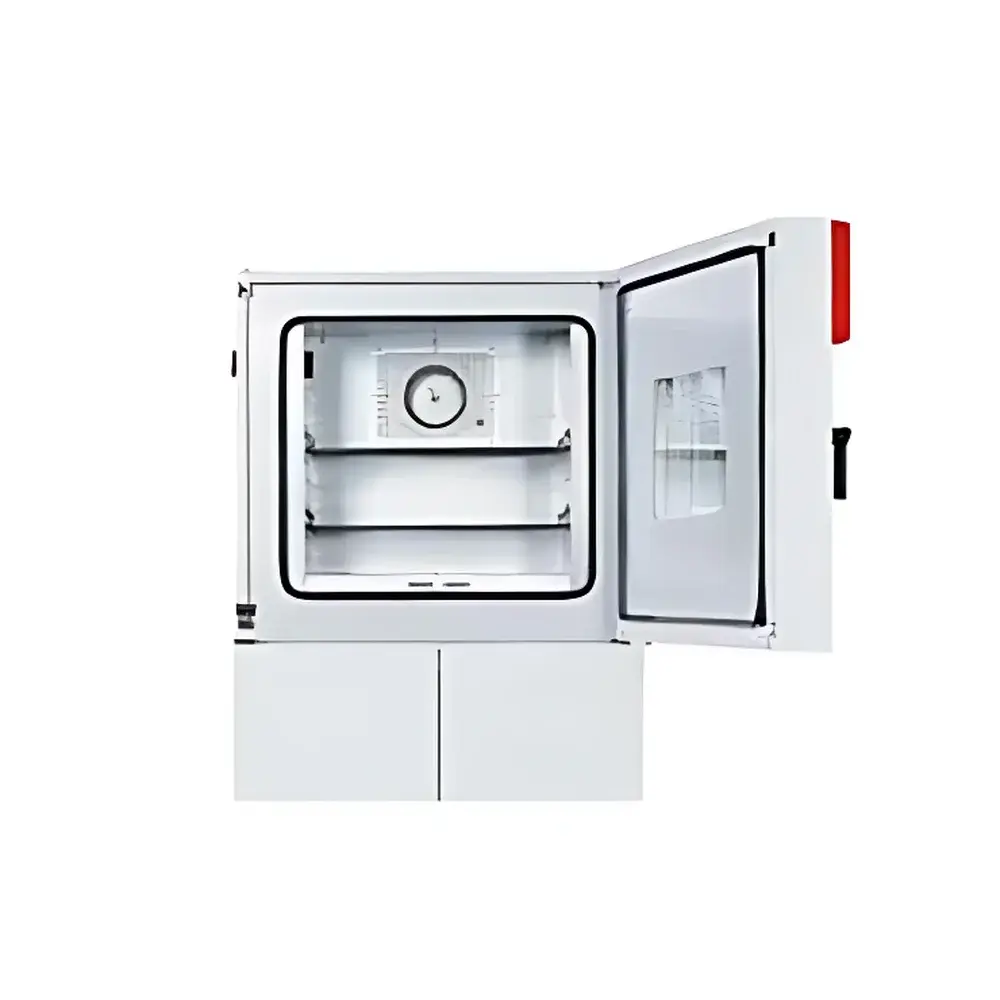
BINDER MKF Series High-Low Temperature Alternating Environmental Test Chamber
| Brand | BINDER |
|---|---|
| Origin | Germany |
| Model | MKF Series |
| Temperature Range | −70 °C to +180 °C (−94 °F to +356 °F) |
| Humidity Range | 10–90 % RH (MKF 240 only) |
| Internal Volume | 228–734 L |
| Temperature Uniformity | ±0.1–±1.0 K |
| Temperature Stability | ±0.1–±0.5 K |
| Heating Rate (−40 °C → 180 °C) | 1.1–5.5 min |
| Cooling Rate (180 °C → −40 °C) | 0.6–5.2 min |
| Refrigerant | R404a |
| Compliance | DIN EN 60068-3-5, IEC 60068-3-6, GLP/GMP, FDA 21 CFR Part 11 (via APT-COM) |
Overview
The BINDER MKF Series High-Low Temperature Alternating Environmental Test Chamber is an engineered solution for precise, reproducible simulation of dynamic thermal and climatic stress conditions in laboratory and industrial quality assurance environments. Designed and manufactured in Germany, the MKF series employs advanced APT.line™ preheating chamber technology, which ensures homogeneous temperature distribution by actively preheating all inner chamber walls—eliminating thermal gradients at critical test surfaces. This architecture enables strict compliance with international environmental testing standards including DIN EN 60068-3-5 (temperature change), IEC 60068-3-6 (humidity control), and ISO 16750-4 (automotive environmental stress). The system supports both static and programmable alternating cycles across a wide operational envelope: −70 °C to +180 °C (with select models extending to −40 °C or −10 °C minimum), and 10–90 % RH (MKF 240 variant). Its robust stainless-steel construction, double-wall insulation, and environmentally responsible R404a refrigerant system reflect BINDER’s commitment to long-term reliability, energy efficiency, and regulatory alignment.
Key Features
- APT.line™ Preheating Chamber Technology: Independently heated inner chamber walls minimize thermal lag and ensure ±0.1 K stability and ±0.1–1.0 K uniformity across the entire working volume—even during rapid ramp transitions.
- MCS Microprocessor Controller: Intuitive 7-inch color LCD interface with 25 stored programs, each supporting up to 100 segments (500 total steps); real-time graphing of temperature, humidity, and time profiles.
- Integrated Humidity System (MKF 240): Capacitive RH sensor coupled with vapor-pressure-controlled humidification and active dehumidification; maintains 10–90 % RH with ±2 % RH accuracy.
- GLP/GMP-Ready Data Integrity: Ethernet-enabled APT-COM software provides full 21 CFR Part 11 compliance—including electronic signatures, audit trails, user access levels, and encrypted raw data export.
- Safety & Redundancy Architecture: Dual-stage temperature safety device (DIN 12880 Class 2), visual/audible alarm, four potential-free relay outputs for external monitoring, and condensation protection logic for sensitive test specimens.
- Ergonomic Design & Serviceability: Heated, anti-fog viewing window; internal LED lighting; removable stainless-steel shelf; front-access water reservoir; castor-mounted base with locking brakes.
Sample Compatibility & Compliance
The MKF series accommodates diverse sample geometries—from PCB assemblies and polymer components to pharmaceutical packaging and automotive ECUs—within standardized internal volumes ranging from 228 L (MKF 240) to 734 L (MK 720). All models meet essential requirements for accelerated aging, thermal shock validation, and climatic stress screening per ASTM D4332, IEC 60068-2-1 (cold), -2-2 (dry heat), -2-14 (change of temperature), and -2-30 (damp heat cyclic). The MKF 240 variant further satisfies ISO 14644-1 cleanroom component testing and USP environmental qualification protocols when operated under controlled humidity conditions. Calibration certificates traceable to DAkkS (German Accreditation Body) are supplied as standard.
Software & Data Management
BINDER’s APT-COM software serves as the central hub for method development, remote supervision, and regulatory documentation. It enables drag-and-drop program creation, live multi-chamber monitoring, and automated report generation in PDF or CSV format. All process data—including setpoints, actual values, alarm events, and controller status—are timestamped and stored with immutable audit trails. Role-based user permissions (Administrator, Operator, Viewer) enforce separation of duties, while digital signature workflows satisfy FDA 21 CFR Part 11 and EU Annex 11 requirements. Data backups can be scheduled to network drives or cloud repositories via secure FTP/SFTP integration.
Applications
- Electronics reliability testing: Thermal cycling of semiconductors, connectors, and conformally coated assemblies.
- Automotive component validation: Climate stress testing of sensors, infotainment modules, and battery management systems per LV 124 and GMW 14872.
- Pharmaceutical stability studies: ICH Q1A(R3) long-term and accelerated storage condition simulation (e.g., 25 °C/60 % RH, 40 °C/75 % RH).
- Polymer & composite aging: Oxidative degradation assessment under elevated temperature and controlled humidity.
- Aerospace material qualification: MIL-STD-810H Method 502.7 (low temperature), 501.7 (high temperature), and 507.6 (humidity).
- Research-grade environmental simulation: Controlled variable-rate ramping for kinetic modeling of phase transitions and chemical degradation pathways.
FAQ
What temperature and humidity standards does the MKF series comply with?
The MKF series conforms to DIN EN 60068-3-5 (temperature change), IEC 60068-3-6 (humidity control), ASTM D4332, and ISO 14644-1. Humidity-capable models (e.g., MKF 240) also support ICH Q1A(R3) and USP environmental qualification.
Is the MKF chamber suitable for GxP-regulated environments?
Yes—when used with APT-COM software and configured with appropriate user roles and audit trail settings, the system meets FDA 21 CFR Part 11 and EU GMP Annex 11 requirements for electronic records and signatures.
How is temperature uniformity validated across the chamber volume?
Uniformity is verified using NIST-traceable PT100 sensors placed at nine defined locations (per DIN 12880). BINDER provides a factory-issued test certificate documenting measured deviations at multiple setpoints.
Can the MKF series perform thermal shock testing?
While not a two-zone thermal shock chamber, the MKF series achieves rapid transitions (e.g., −40 °C ↔ +180 °C in ≤1.1 min on MK 720) suitable for single-chamber thermal cycling per IEC 60068-2-14. For true step-function shock, dedicated TSC chambers are recommended.
What maintenance is required for long-term reliability?
Routine tasks include monthly cleaning of the condensate drain line, quarterly verification of humidity sensor calibration, annual refrigerant leak inspection, and biannual replacement of the activated carbon filter in the air recirculation path.



