
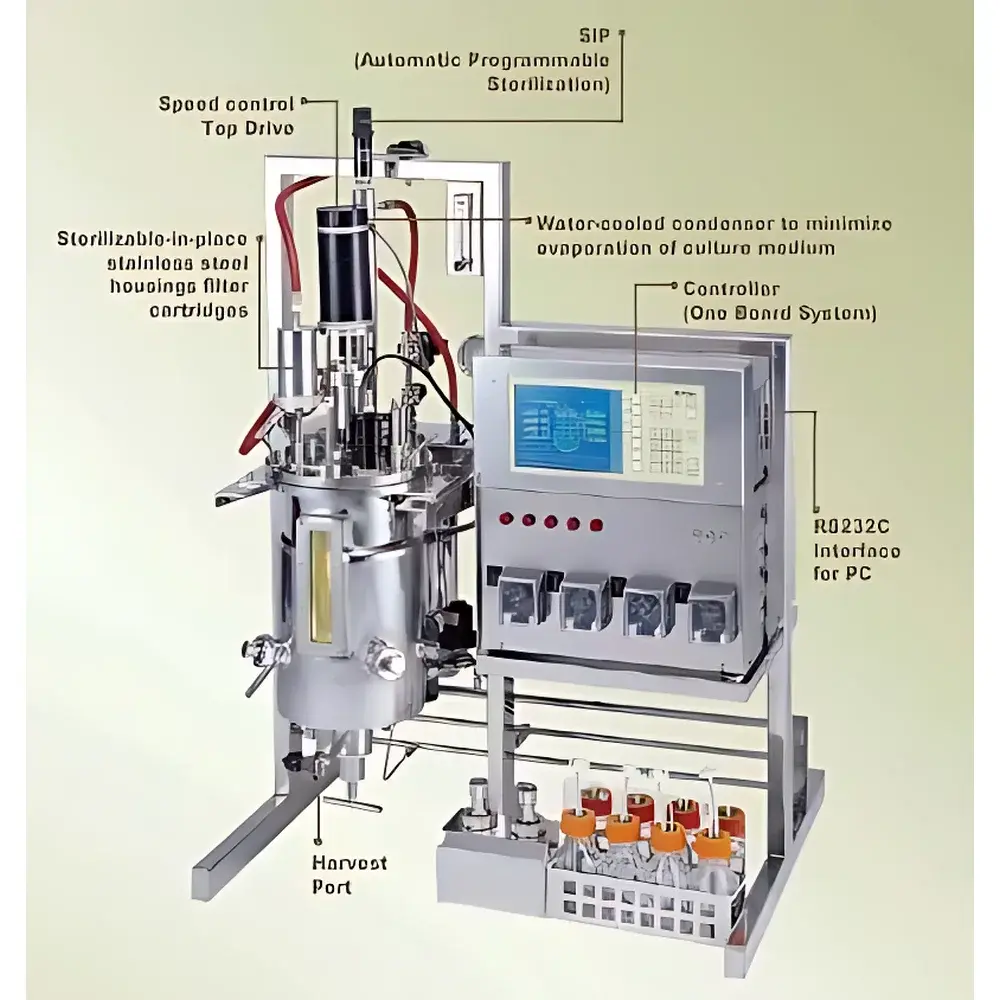
BioLite In-Situ Sterilizable Bioreactor
| Origin | South Korea |
|---|---|
| Manufacturer Type | Distributor |
| Origin Category | Imported |
| Model | BioLite |
| Pricing | Upon Request |
Overview
The BioLite In-Situ Sterilizable Bioreactor is a pilot-scale, fully automated stainless-steel bioreactor engineered for reproducible, scalable microbial and mammalian cell culture under controlled aseptic conditions. Designed around the same architectural and control principles as industrial production systems, it bridges the gap between laboratory benchtop experiments and commercial bioprocess development. Its core operation relies on in-situ steam sterilization (SIP) generated via integrated electric heating elements—eliminating dependency on external autoclaves or steam generators. Temperature is precisely regulated through a double-jacketed 316L stainless-steel vessel coupled with recirculating cooling water and PID-controlled electric heating. The system supports both batch and fed-batch modes and is validated for use in GMP-aligned process development environments where regulatory traceability and operational consistency are critical.
Key Features
- Integrated in-situ sterilization (SIP) capability: Automatic thermal cycle (105–130°C) applied to vessel, headplate, gas lines, and filter housings using built-in electric heaters—no external steam source required.
- Pilot-scale scalability: Designed to support direct scale-up from lab-scale results; compatible with downstream process transfer to larger BioLite-series production bioreactors.
- Robust mechanical agitation: Top-mounted 150 W DC servo motor with tungsten carbide mechanical seal; speed range 50–1500 rpm (±1 rpm accuracy); gear-driven impeller transmission ensures torque stability under viscous load.
- High-integrity fluid path: All wetted parts constructed from electropolished 316L stainless steel; sanitary O-rings (silicone) and gaskets (EPDM) compliant with USP Class VI requirements.
- Dual-mode temperature control: RTD (Pt-100) probe feedback combined with digital PID algorithm; jacketed thermal management enables ±0.1°C setpoint stability across 3°C above coolant temperature to 80°C.
- Gas handling with sterile integrity: Ring-type sparger (316L), dual 0.2 µm absolute-rated sterilizing filters (inlet and exhaust), and pneumatically actuated aseptic diaphragm valves minimize contamination risk and simplify maintenance.
- Modular sensor integration: Multiple standardized ports on vessel sidewall and headplate allow flexible installation of pH, dissolved oxygen (DO), pressure, and off-gas analyzers per application needs.
Sample Compatibility & Compliance
The BioLite bioreactor supports diverse biological systems including prokaryotic (e.g., E. coli, Bacillus spp.), eukaryotic (yeast, filamentous fungi), insect (Sf9, Sf21), and mammalian (CHO, HEK293) cell cultures. With optional add-on modules—including perfusion manifolds, cryo-cooling jackets, and advanced gas blending units—it accommodates suspension, adherent, and microcarrier-based processes. The system conforms to key international standards for bioprocess equipment: ISO 13485 design principles, ASME BPE-2023 surface finish specifications (Ra ≤ 0.4 µm electropolished), and FDA-recommended practices for equipment qualification (IQ/OQ/PQ). All control logic and data logging meet ALCOA+ criteria for data integrity, supporting compliance with 21 CFR Part 11 when configured with BioG-α software and audit-trail-enabled hardware.
Software & Data Management
The bioreactor is operated via an embedded MC68EC020 intelligent microprocessor controller with an 8.5-inch color TFT LCD display and membrane keypad interface. Real-time parameters—including temperature, pH, DO, agitation speed, pressure, and gas flow—are continuously logged and stored internally. Data export is supported via SD card, RS-232C serial interface, USB printer output, and Ethernet-connected PC integration. When paired with BioG-α process control software, users gain access to recipe-based automation, multi-variable cascade control (e.g., DO-stat, pH-stat), electronic batch records, and full audit trail functionality—including user authentication, change history, and electronic signatures—enabling alignment with GLP and GMP documentation workflows.
Applications
- Process development and optimization for recombinant protein expression in microbial and mammalian hosts
- Strain screening and media formulation studies under controlled physiological conditions
- Scale-down modeling for technology transfer to manufacturing-scale bioreactors
- Cell line evaluation and bioprocess characterization (growth kinetics, metabolic profiling, byproduct accumulation)
- Training platform for bioprocess engineers and QC/QA personnel in cGMP-compliant operations
- Regulatory filing support: generation of consistent, auditable process data for IND/IMPD submissions
FAQ
Does the BioLite bioreactor support automated sterilization cycles with validation protocols?
Yes—the SIP cycle is programmable and repeatable, with configurable ramp/soak profiles and real-time temperature monitoring at multiple points (vessel wall, headplate, filter housing). Cycle logs include timestamped temperature curves and alarm events for compliance reporting.
Can third-party sensors (e.g., Hamilton, Mettler Toledo) be integrated into the control system?
Yes—all analog and digital sensor inputs follow standard 4–20 mA, 0–5 V, or Modbus RTU protocols; physical mounting interfaces comply with DIN 11851 and SMS 1142 standards.
Is the system suitable for anaerobic or microaerobic cultivations?
Yes—gas blending capability (via optional mass flow controllers) allows precise regulation of N₂, CO₂, O₂, and air mixtures; exhaust gas analysis can be added for respiratory quotient (RQ) calculation.
What maintenance intervals are recommended for mechanical seals and filters?
Mechanical seals require inspection every 500 operating hours; sterilizable 0.2 µm filters are rated for ≥50 SIP cycles and should be integrity-tested (e.g., bubble point or diffusion test) before each use.
How is cybersecurity addressed in the BioG-α software environment?
BioG-α implements role-based access control (RBAC), TLS 1.2 encrypted communications, and secure boot firmware verification—meeting IEC 62443-3-3 SL2 requirements for industrial control systems.



