
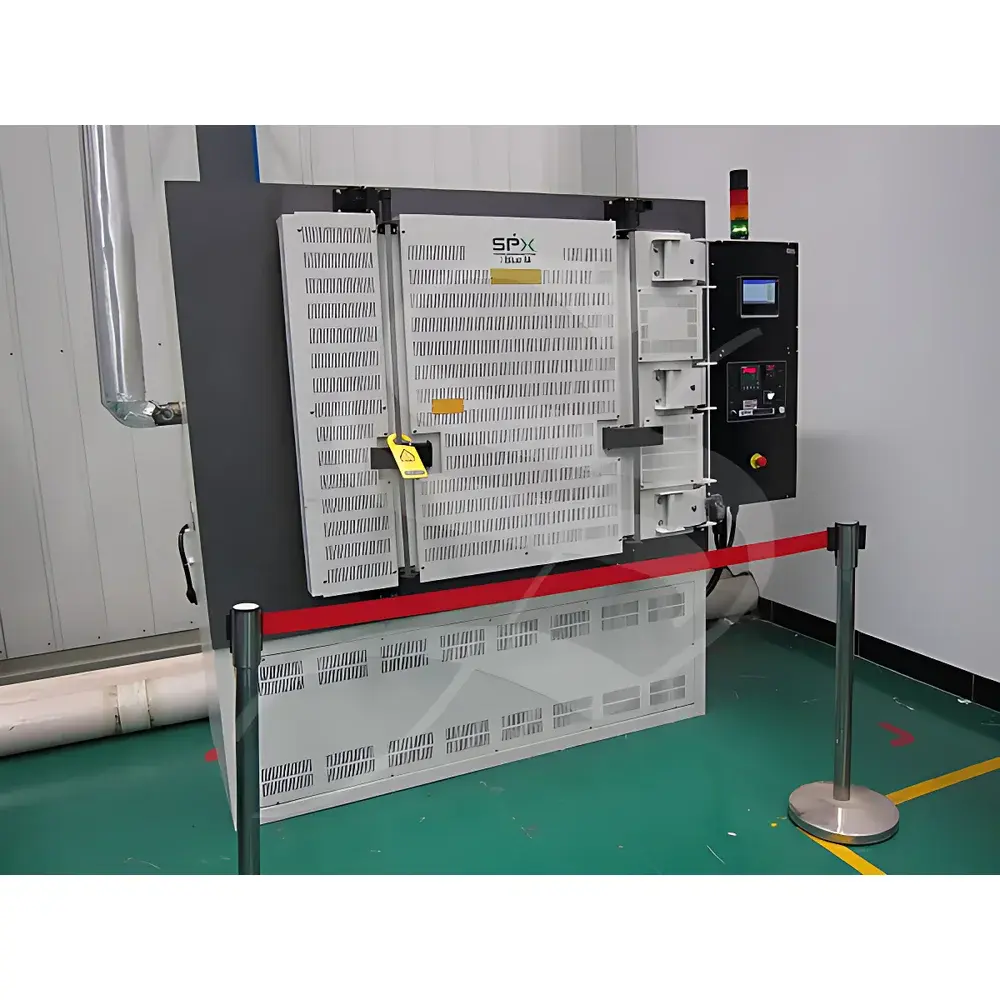
Blue M Inert Atmosphere Oven
| Brand | Blue M |
|---|---|
| Origin | USA |
| Model | Inert Atmosphere Oven |
| Temperature Range | Ambient +15°C to 700°C |
| Temperature Uniformity | ±1% (at ≤316°C), ±2% (at 700°C) |
| Control Accuracy | ±0.5°C |
| Resolution | ±0.1°C |
| Heating Method | Forced Air Convection |
| Internal Dimensions | 20×18×20 in to 48×24×36 in (508×457×508 mm to 1219×610×914 mm) |
| Internal Volume | 1.6–24 cu.ft (0.045–0.679 m³) |
| Max Power | 7500 W |
| Ramp Time to Max Temp | ≤60 min |
| Insulation | 4-inch (102 mm) mineral wool |
| Chamber Material | Fully welded 304 stainless steel |
| Door Seal | Blue M proprietary fiberglass-reinforced gasket |
| Safety | Interlocked door switch, inert gas purge integrity monitoring |
Overview
The Blue M Inert Atmosphere Oven is an engineered laboratory thermal processing system designed for applications requiring precise temperature control under oxygen-free or low-oxygen environments. Built upon Blue M’s legacy of robust industrial oven design, this model integrates forced-air convection heating with a fully welded, gas-tight 304 stainless steel chamber—enabling reliable operation under nitrogen, argon, hydrogen, or other non-reactive atmospheres. Unlike standard convection ovens, its structural integrity and sealing architecture prevent ambient air infiltration and minimize gas migration into insulation layers, making it suitable for moisture-sensitive material drying, oxide-free sintering, catalyst activation, and pre-heat treatment of components prior to vacuum or glovebox transfer. The system operates across a wide thermal range—from ambient +15°C up to 700°C—with distinct uniformity specifications calibrated per temperature zone: ±1% at ≤316°C and ±2% at maximum operating temperature—ensuring process repeatability aligned with ASTM E2203 and ISO 17025-compliant thermal validation protocols.
Key Features
- Heavy-gauge 16-gauge cold-rolled steel outer casing for mechanical durability and long-term dimensional stability
- Fully welded 304 stainless steel interior chamber with seamless construction—eliminating crevices where residual oxygen or contaminants may accumulate
- 4-inch (102 mm) high-density mineral wool insulation layer, minimizing heat loss and improving energy efficiency during extended dwell cycles
- Proprietary Blue M fiberglass-reinforced door gasket, engineered for consistent compression sealing across repeated thermal cycling and multiple inert gas purges
- Interlocked safety door switch that automatically de-energizes heaters when the door is opened—preserving atmosphere integrity and preventing operator exposure to elevated temperatures
- Front-panel digital controller with programmable ramp/soak profiles, real-time data logging capability, and configurable alarm thresholds for overtemperature, gas flow interruption, or door status
- Standard exhaust damper with manual or optional motorized actuation—allowing fine-tuned control of internal pressure differential during purge and hold phases
Sample Compatibility & Compliance
This inert atmosphere oven accommodates diverse sample forms—including powders, thin films, ceramic substrates, metal alloys, battery electrode coatings, and polymer composites—without risk of oxidation, nitridation, or hydrolysis during thermal treatment. Its sealed architecture meets fundamental requirements for GLP and GMP environments where trace oxygen levels must remain below 100 ppm during processing. While not intrinsically rated for Class I Division 1 hazardous locations, the oven is compatible with externally supplied inert gas delivery systems meeting NFPA 56 and CGA G-1 standards. All electrical components conform to UL 61010-1 and CSA C22.2 No. 61010-1 for laboratory equipment safety. Documentation packages support IQ/OQ validation per FDA 21 CFR Part 11 when paired with compliant data acquisition software.
Software & Data Management
The oven’s embedded microprocessor controller supports RS-485 Modbus RTU communication for integration into centralized lab automation platforms. Optional Ethernet-enabled controllers provide secure HTTPS-based remote access, enabling real-time monitoring and parameter adjustment via web browser interfaces. Logged temperature profiles—including setpoint, actual chamber temperature, and door open/close events—are timestamped with millisecond resolution and exportable in CSV format for audit trail generation. When used with validated third-party software (e.g., LabVIEW-based DAQ or DeltaV-compatible modules), the system satisfies ALCOA+ data integrity principles—ensuring attributable, legible, contemporaneous, original, accurate, complete, consistent, enduring, and available records required under ISO/IEC 17025 accreditation.
Applications
- Drying hygroscopic materials (e.g., Li-ion battery cathode precursors, MOFs, zeolites) without decomposition or surface passivation
- Pre-sintering of oxygen-sensitive ceramics (e.g., YBCO superconductors, TiN coatings) under controlled N₂ or Ar flow
- Thermal aging studies of aerospace-grade adhesives and composites under inert conditions to isolate thermal degradation mechanisms
- Post-deposition annealing of thin-film photovoltaic devices (CIGS, perovskites) to optimize crystallinity while suppressing halide volatility
- Moisture removal from analytical standards and reference materials prior to gravimetric analysis or Karl Fischer titration
- Controlled pyrolysis of organic matrices in metallurgical sample preparation workflows
FAQ
What inert gases are compatible with this oven?
Nitrogen (N₂), argon (Ar), helium (He), and forming gas (N₂/H₂ mixtures) are routinely used. Hydrogen requires additional safety interlocks and ventilation verification per local fire codes.
Can the oven be validated for GMP use?
Yes—when equipped with calibrated Class A PT100 sensors, audit-trail-capable controllers, and documented IQ/OQ protocols, it supports qualification under Annex 15 and USP .
Is door-opening during operation safe?
The interlocked door switch cuts power to heaters immediately; however, inert gas flow must be manually or automatically suspended to avoid atmosphere dilution and potential back-drafting.
What maintenance intervals are recommended?
Gasket inspection every 6 months; calibration of temperature sensors annually or per SOP; mineral wool integrity assessment every 3 years under continuous 600°C+ operation.
Related Products



