
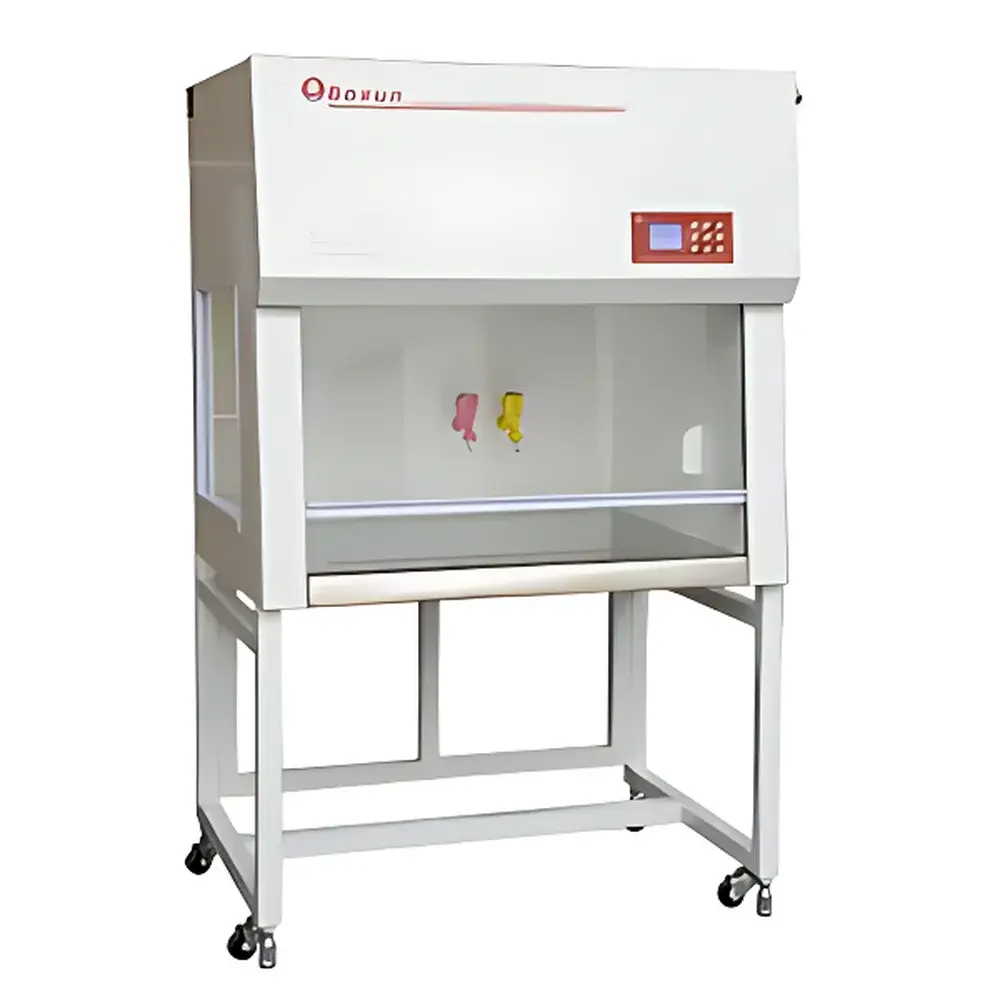
BOXUN BJ-1CD Vertical Laminar Flow Clean Bench
| Brand | BOXUN |
|---|---|
| Origin | Shanghai, China |
| Manufacturer Type | Authorized Distributor |
| Product Category | Domestic |
| Model | BJ-1CD |
| Instrument Type | Vertical Laminar Flow Clean Bench |
| Cleanliness Class | ISO Class 5 (100-level, ≥99.99% filtration efficiency for particles ≥0.5 µm) |
| Noise Level | ≤67 dB(A) |
| User Capacity | Single-user, single-front configuration |
| Airflow Pattern | Vertical unidirectional laminar flow |
| Working Surface Dimensions (W×D×H) | 830 × 700 × 495 mm |
| Overall Dimensions (W×D×H) | 990 × 744 × 1680 mm |
| HEPA Filter Specification | 800 × 604 × 50 mm (1 unit) |
| Pre-filter | Medium-efficiency panel filter |
| Fan Type | High-efficiency centrifugal blower |
| Air Velocity Range | 0.3–0.6 m/s (6-step adjustable, real-time digital display) |
| Illumination | ≥300 lx (30 W fluorescent lamp) |
| UV Germicidal Lamp | 20 W |
| Vibration Amplitude | ≤5 µm (peak-to-peak, X/Y/Z axes) |
| Power Supply | AC 220 V ±10%, 50/60 Hz |
| Power Consumption | 0.2 kW |
| Net Weight | 115 kg |
| Work Surface Material | SUS304 brushed stainless steel |
| Cabinet Material | Cold-rolled steel with epoxy-powder coating |
| Control Interface | LCD display with multi-parameter monitoring |
Overview
The BOXUN BJ-1CD Vertical Laminar Flow Clean Bench is an ISO Class 5 (formerly “100-level”) personnel-protective and product-protective workstation engineered for controlled environments requiring localized airborne particulate control. It operates on the principle of vertical unidirectional laminar airflow: ambient air is drawn through a pre-filter to remove coarse particulates, then pressurized into a plenum chamber and passed through a certified HEPA filter (EN 1822 H14 or equivalent, ≥99.99% efficiency at 0.5 µm), delivering uniform, low-turbulence airflow vertically downward across the work surface. This airflow pattern minimizes cross-contamination between operator and sample while preventing recirculation of aerosols within the workspace—critical for aseptic handling in microbiological culture, sterile pharmaceutical compounding, cell line maintenance, and sensitive analytical preparation.
Key Features
- Real-time multi-parameter LCD interface displaying face velocity (0.3–0.6 m/s, six-step adjustable with numeric readout), differential pressure across HEPA filter, cumulative operating hours, system clock, and HEPA operational status.
- Integrated safety interlocks: UV germicidal lamp and main lighting are electrically interlocked—UV activation automatically disables illumination, and vice versa—to prevent accidental UV exposure.
- Counterbalanced vertical sliding sash with frictionless linear motion, enabling precise, tool-free positioning within its travel range for ergonomic access and containment integrity.
- Dual-stage filtration architecture: a washable medium-efficiency pre-filter extends HEPA service life by capturing >90% of coarse dust and lint before air reaches the final barrier.
- Robust mechanical design: SUS304 brushed stainless steel work surface resists corrosion, facilitates decontamination, and complies with ISO 14644-1 surface cleanliness requirements; cold-rolled steel cabinet with epoxy-powder finish ensures structural rigidity and chemical resistance.
- Acoustically optimized centrifugal blower delivers stable airflow at ≤67 dB(A) under typical operating conditions—suitable for shared laboratory environments where noise mitigation is required.
- Integrated utility provisions: recessed splash-proof power outlets (IEC 60320 C13), optional gas and liquid inlet ports (threaded NPT or Swagelok-compatible), and 5° forward-sloped front panel aligned with ergonomic best practices (ISO 11228-1).
Sample Compatibility & Compliance
The BJ-1CD is designed for non-hazardous biological and non-volatile chemical operations where personnel protection is not mandated (e.g., no toxic, radioactive, or pathogenic aerosol generation). It meets core performance criteria outlined in ISO 14644-1 (Cleanrooms and associated controlled environments – Part 1: Classification of air cleanliness), JIS B 9920 (Japanese standard for clean benches), and GB/T 25220–2010 (Chinese national standard for laminar flow clean benches). While not a biosafety cabinet (BSC), its validated airflow uniformity and HEPA retention efficiency support GLP-compliant sample preparation workflows in QC labs, academic research cores, and pilot-scale bioprocessing facilities. Routine certification per ISO 14644-3 Annex B (airflow visualization, particle counting, and velocity mapping) is recommended every 6–12 months.
Software & Data Management
The BJ-1CD features embedded firmware with non-volatile memory for logging cumulative runtime, filter usage duration, and alarm history (HEPA breach, pre-filter clogging, door position fault). All parameters are displayed locally via the integrated LCD; no external PC connection or proprietary software is required for basic operation. For laboratories implementing electronic record-keeping under FDA 21 CFR Part 11 or EU Annex 11, optional RS-485 or Modbus RTU interfaces (available upon request) enable integration into centralized facility monitoring systems for audit-trail-capable data capture—including timestamped velocity setpoints, alarm events, and maintenance alerts.
Applications
- Aseptic transfer of microbial cultures, plant tissue explants, and mammalian cell lines in academic and industrial life science labs.
- Preparation of media, reagents, and standards in pharmaceutical quality control (QC) environments compliant with USP and .
- Assembly and inspection of microelectronics components where electrostatic discharge (ESD)-safe surfaces and particulate-free air are prerequisites.
- Environmental microbiology workflows including water and soil sample processing prior to membrane filtration or plate inoculation.
- Calibration and handling of reference standards in metrology and analytical chemistry laboratories requiring ISO Class 5 background conditions.
FAQ
What ISO cleanliness class does the BJ-1CD achieve?
It is certified to ISO Class 5 (equivalent to Federal Standard 209E Class 100), with ≥99.99% removal efficiency for particles ≥0.5 µm.
Can this unit be used for handling hazardous biological agents?
No—it provides product protection only, not personnel or environmental protection. Biosafety Level 2+ work requires a certified Class II Biological Safety Cabinet.
How often should the HEPA filter be replaced?
Typical service life is 3–5 years under normal use; replacement is triggered when differential pressure exceeds manufacturer-specified thresholds or particle challenge testing fails.
Is the unit compatible with GMP/GLP documentation requirements?
Yes—its built-in runtime logging, alarm history, and optional digital output support traceability and audit readiness when paired with appropriate SOPs.
Does the BJ-1CD include validation documentation?
Factory-installed units ship with a Certificate of Conformance and initial airflow uniformity test report; IQ/OQ protocols are available separately for qualification under GxP frameworks.



