
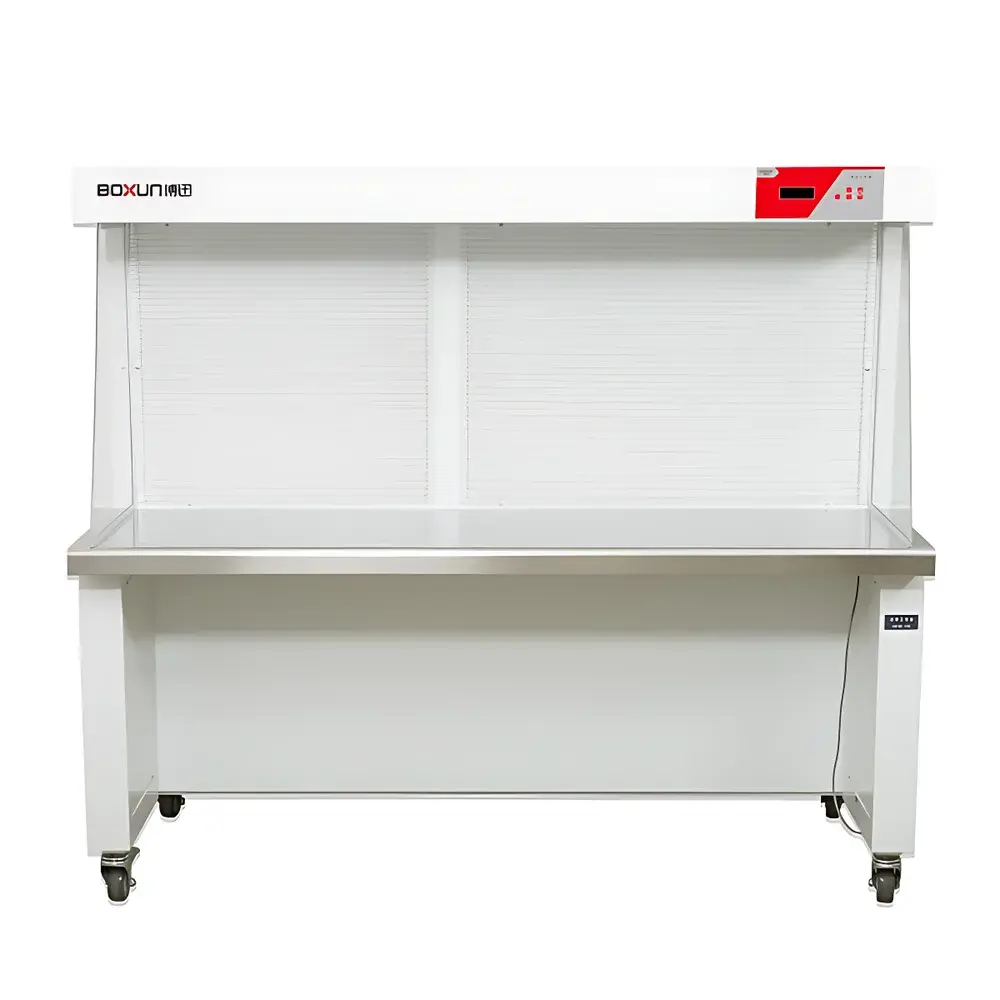
BOXUN SW-CJ-1CU Horizontal Laminar Flow Clean Bench
| Brand | BOXUN |
|---|---|
| Origin | Shanghai, China |
| Manufacturer Type | Direct Manufacturer |
| Product Category | Domestic |
| Model | SW-CJ-1CU |
| Instrument Type | Horizontal Laminar Flow Clean Bench |
| Cleanliness Class | ISO Class 5 (100 @ ≥0.5 µm, ≥99.99% filter efficiency) |
| Noise Level | ≤67 dB(A) |
| User Capacity | Dual-user, single-front configuration |
| Airflow Pattern | Horizontal laminar flow |
| Working Surface Wind Speed | 0.3–0.6 m/s (adjustable in six steps) |
| Vibration Peak-to-Peak | ≤5 µm (X/Y/Z axes) |
| Illumination | ≥300 lx |
| Work Area Dimensions (W×D×H) | 1570 × 480 × 570 mm |
| Overall Dimensions (W×D×H) | 1570 × 790 × 1380 mm |
| HEPA Filter Specifications | 600 × 575 × 50 mm (1 pc) + 815 × 575 × 50 mm (1 pc) |
| UV Lamp & Fluorescent Lamp | 40 W × 1 each |
| Net Weight | 200 kg |
| Power Consumption | 0.3 kW |
| Electrical Supply | AC 220 V ±10%, 50/60 Hz |
Overview
The BOXUN SW-CJ-1CU Horizontal Laminar Flow Clean Bench is an ISO Class 5-certified local containment workstation engineered for applications requiring particle-free, unidirectional airflow across the work surface. It operates on the principle of horizontal laminar flow—where pre-filtered ambient air is drawn through a dual-stage filtration system (medium-efficiency pre-filter followed by two certified HEPA filters), accelerated by a brushless centrifugal blower, and delivered uniformly across the work area at a controlled velocity (0.3–0.6 m/s). This airflow profile creates a sterile barrier that sweeps contaminants away from the operator and sample zone, minimizing cross-contamination risks during aseptic handling of cell cultures, microbial inoculations, pharmaceutical preparations, or precision instrumentation assembly. Unlike vertical flow hoods, the horizontal design directs filtered air parallel to the work surface—ideal for open-vessel procedures where turbulence or backflow must be avoided. The unit complies with ISO 14644-1 for cleanroom classification and meets foundational requirements for GLP-compliant laboratories conducting routine microbiological testing, environmental monitoring, and bioprocess support.
Key Features
- Robust structural architecture: Cold-rolled steel housing with electrostatic epoxy powder coating; work surface and splash guard constructed from brushed SUS304 stainless steel for corrosion resistance and ease of decontamination.
- Dual HEPA filtration system: Two independently rated HEPA filters (600 × 575 × 50 mm and 815 × 575 × 50 mm) ensure ≥99.99% retention efficiency for particles ≥0.5 µm—validated per EN 1822-1 and IEST-RP-CC001.7 standards.
- Precision airflow control: Six-step adjustable fan speed via micro-touch interface with LCD status display; real-time wind speed feedback supports procedural repeatability and SOP alignment.
- Integrated lighting and sterilization: Separate switching controls for 40 W fluorescent lamp (≥300 lx uniform illumination) and 40 W UV-C germicidal lamp (254 nm); UV timer range: 0–999 minutes with automatic cutoff and interlock safety circuitry.
- Ergonomic access design: Full-width horizontal sliding sash with tempered organic glass side panels—optically transparent, impact-resistant, and non-shattering—to maintain laminar integrity while enabling lateral visibility and physical stability.
- Low-noise operation: Centrifugal blower with dynamically balanced impeller achieves ≤67 dB(A) sound pressure level at 1 m distance, supporting prolonged use in shared laboratory environments without acoustic fatigue.
Sample Compatibility & Compliance
The SW-CJ-1CU accommodates standard Petri dishes, flasks, pipette racks, and small-scale bioreactors within its 1570 × 480 mm working area. Its horizontal airflow geometry is particularly suited for handling open containers, agar plates, and sensitive optical components where vertical downflow could induce convective disturbance or static charge accumulation. The unit conforms to national and international regulatory expectations for non-sterile ancillary equipment: it satisfies GB/T 25225–2010 (Chinese standard for laminar flow clean benches), aligns with ISO 14644-1:2015 Class 5 performance criteria, and supports compliance pathways for ISO/IEC 17025-accredited testing labs. While not classified as a biosafety cabinet (BSC), its design excludes recirculation and exhaust ducting—making it appropriate for low-risk biological work under CLSI M29-A4 guidelines and USP Annex A supplemental environments.
Software & Data Management
This model operates via embedded firmware with no external software dependency. All operational parameters—including fan speed stage, UV runtime, illumination status, and error codes—are displayed and logged locally on the LCD interface. The system records cumulative UV exposure time (non-resettable) and retains last-set fan speed upon power cycle. Though not equipped with Ethernet or USB data export, its control logic supports integration into centralized lab monitoring systems via optional dry-contact relay outputs (available upon request). Audit trails are maintained internally for GLP documentation: UV activation timestamps and duration logs can be manually transcribed for batch record inclusion. For FDA 21 CFR Part 11 readiness, third-party validation packages—including IQ/OQ protocols and filter integrity test templates—are available through BOXUN’s Technical Support Division.
Applications
- Aseptic transfer of mammalian and insect cell lines in academic and contract research laboratories.
- Preparation of culture media, reagent aliquoting, and sterility testing in QC/QA departments of biopharmaceutical manufacturers.
- Environmental sampling plate incubation and colony isolation in public health and food safety laboratories.
- Assembly and calibration of high-precision optical sensors and semiconductor prototypes where airborne particulates compromise yield.
- Supporting ISO 13485-certified medical device manufacturing processes requiring Class 5 background environments for component handling.
FAQ
Is the SW-CJ-1CU suitable for handling pathogenic agents?
No. This is a clean bench—not a biosafety cabinet—and provides personnel and product protection only. It does not protect the user from aerosolized biohazards. Use only for non-infectious, low-risk materials.
What maintenance intervals are recommended for HEPA filters?
Pre-filters should be replaced every 3–6 months depending on ambient dust load; HEPA filters require integrity testing annually and replacement every 5–7 years—or sooner if differential pressure exceeds 250 Pa or airflow drops below 0.3 m/s.
Can the unit be installed in a room without dedicated HVAC?
Yes, but ambient air quality must meet ISO 14644-1 Class 8 (100,000) or better. High particulate loads will reduce HEPA service life and increase maintenance frequency.
Does the UV lamp require periodic intensity verification?
Yes. Radiometric validation using a calibrated UV-C meter is recommended before each shift when used for critical decontamination—per CLSI M29-A4 Section 5.3.2.
Is electrical certification provided for North American markets?
Standard units ship with CE and CCC marks. UL/cUL listing and NRTL certification are available as factory-installed options—contact BOXUN Export Engineering for regional compliance documentation.



