
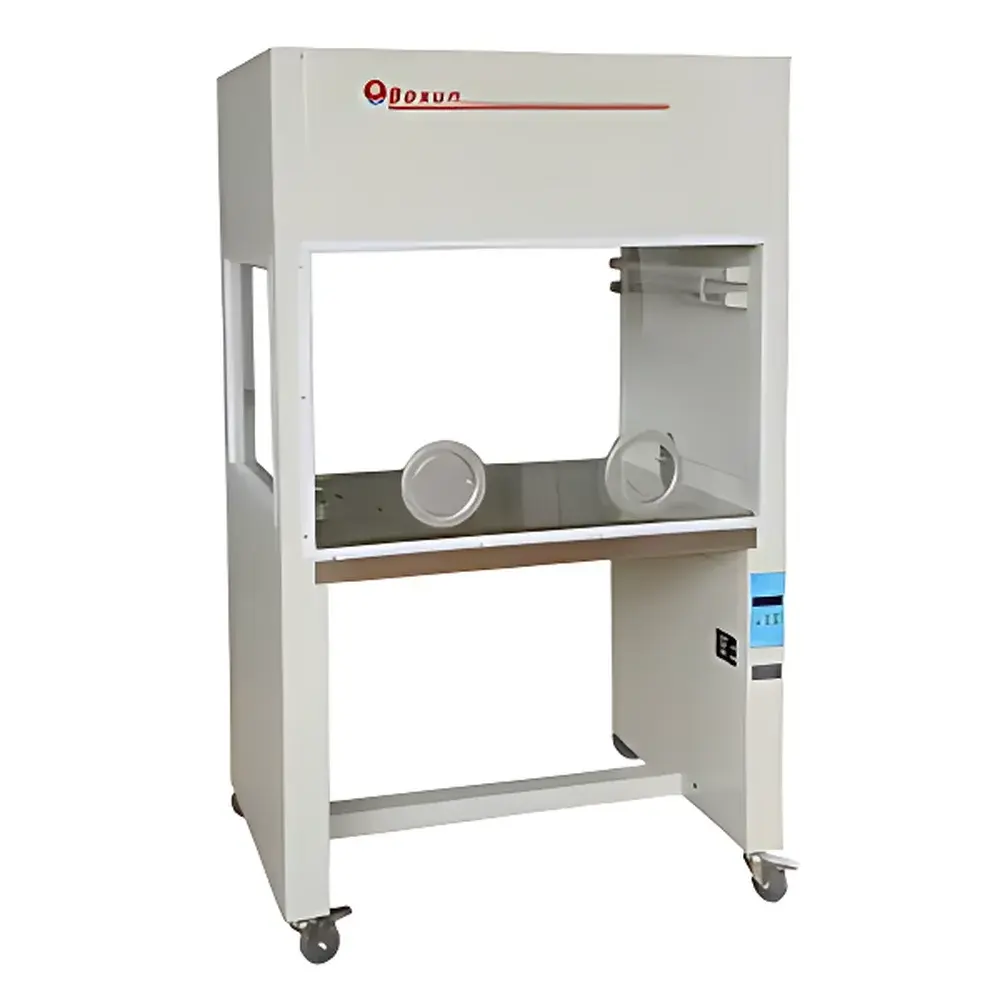
BOXUN SW-CJ-1F Vertical Laminar Flow Clean Bench
| Brand | BOXUN |
|---|---|
| Origin | Shanghai, China |
| Manufacturer Type | Authorized Distributor |
| Product Category | Domestic |
| Model | SW-CJ-1F |
| Instrument Type | Vertical Laminar Flow Clean Bench |
| Cleanliness Class | ISO Class 5 (100-level, ≥99.99% filtration efficiency for particles ≥0.5 µm) |
| Noise Level | ≤67 dB(A) |
| User Capacity | Single-user, dual-front access |
| Airflow Pattern | Vertical downward laminar flow |
| Working Surface Velocity Range | 0.3–0.6 m/s (adjustable in six steps) |
| Vibration Amplitude (peak-to-peak) | ≤5 µm (X/Y/Z axes) |
| Illumination | ≥300 lux |
| Work Area Dimensions (W×D×H) | 870 × 700 × 520 mm |
| Overall Dimensions (W×D×H) | 990 × 724 × 1650 mm |
| HEPA Filter Specification | 820 × 615 × 50 mm (1 unit) |
| Pre-filter | Medium-efficiency panel filter |
| Lighting | 20 W fluorescent lamp (1 unit) |
| UV Germicidal Lamp | 20 W (1 unit, timer-controlled: 0–999 min) |
| Weight | 110 kg |
| Power Consumption | 0.15 kW |
| Electrical Supply | AC 220 V ±10%, 50/60 Hz |
Overview
The BOXUN SW-CJ-1F Vertical Laminar Flow Clean Bench is an ISO Class 5-certified local containment workstation engineered to deliver unidirectional, particle-free airflow across the work surface via vertical downward laminar flow. It operates on the principle of high-efficiency particulate air (HEPA) filtration—specifically, a single 820 × 615 × 50 mm H14-grade HEPA filter (EN 1822-1:2019 compliant), delivering ≥99.99% removal efficiency for airborne particles ≥0.5 µm. A pre-installed medium-efficiency pre-filter extends HEPA service life by capturing coarse particulates and extending maintenance intervals. The unit maintains a stable working face velocity between 0.3 and 0.6 m/s, adjustable across six discrete fan-speed settings, ensuring consistent aerodynamic shielding of the work zone against ambient contamination. Designed for non-hazardous applications requiring sterile or low-particulate environments—including microbial handling, cell culture setup, reagent preparation, and precision instrumentation assembly—the SW-CJ-1F does not provide personnel or environmental protection against biohazards or volatile chemicals; it is strictly a product-protection device per ISO 14644-1 and NSF/ANSI 49 classifications.
Key Features
- Robust structural architecture: Cold-rolled steel housing with electrostatic epoxy powder coating; work surface and interior chamber fabricated from brushed AISI 304 stainless steel for corrosion resistance and ease of decontamination.
- Low-noise centrifugal blower system: Engineered for stable rotational speed and acoustic performance ≤67 dB(A) at 1 m distance—critical for extended operator comfort in shared laboratory spaces.
- Intuitive LCD control interface: Integrated micro-touch keypad enables precise, repeatable adjustment of airflow velocity, UV sterilization duration (0–999 min), and independent on/off control of fluorescent illumination and germicidal UV lamps.
- Vertical laminar flow design with aerodynamic curtain: A vertically oriented, quasi-enclosed work chamber establishes a continuous downward air curtain that isolates the work area from lateral cross-contamination and minimizes turbulence-induced particle resuspension.
- Ergonomic dual-front access configuration: Sliding sash with auxiliary small access door reduces operator exposure to volatile compounds or odors during routine manipulation, while maintaining laminar integrity across the full work surface.
Sample Compatibility & Compliance
The SW-CJ-1F is suitable for handling non-pathogenic biological materials (e.g., primary mammalian cells, bacterial cultures, plant tissue explants), sterile pharmaceutical intermediates, and sensitive optical or electronic components. It complies with ISO 14644-1:2015 (Class 5), GB/T 25225-2010 (Chinese national standard for clean benches), and aligns with general laboratory infrastructure requirements under GLP (Good Laboratory Practice) and GMP Annex 1 (for non-aseptic processing support zones). While not certified to NSF/ANSI 49 for biosafety, its airflow pattern and filtration meet foundational criteria for ISO Class 5 environments used in QC labs, R&D cleanrooms, and analytical prep areas. UV lamp output conforms to IEC 62471 photobiological safety guidelines for germicidal UVC (254 nm).
Software & Data Management
This analog-digital hybrid system features embedded firmware with no external software dependency. All operational parameters—including fan speed setting, UV timer status, and lamp activation—are retained in non-volatile memory and displayed in real time on the backlit LCD. No data logging, remote monitoring, or audit trail functionality is included; however, the unit supports integration into facility-wide environmental monitoring systems via optional analog voltage output modules (not supplied standard). For regulated environments requiring 21 CFR Part 11 compliance, third-party validation documentation (IQ/OQ/PQ protocols) and calibration records must be generated independently by the end user or qualified service provider.
Applications
- Preparation of sterile culture media, dilution series, and inoculation plates in microbiology and molecular biology laboratories.
- Assembly and handling of sensitive optical sensors, MEMS devices, and semiconductor prototypes in cleanroom-adjacent fabrication support zones.
- Standardized weighing and dispensing of reference standards and certified reference materials (CRMs) in analytical chemistry labs.
- Non-sterile but particle-sensitive tasks such as lens cleaning, microscope slide mounting, and precision pipette calibration.
- Supporting ISO/IEC 17025-accredited testing workflows where sample integrity depends on particulate-free handling prior to instrumental analysis (e.g., ICP-MS, HPLC sample introduction).
FAQ
What ISO cleanliness class does the SW-CJ-1F achieve?
It meets ISO Class 5 (formerly “100-level”) under dynamic operating conditions, verified per ISO 14644-1:2015 using light-scattering airborne particle counters.
Can this unit be used for handling BSL-2 organisms?
No—it provides product protection only and lacks inward airflow, negative pressure containment, or exhaust ducting required for biosafety level 2 agents.
How often should the HEPA filter be replaced?
Filter replacement interval depends on ambient air quality and usage frequency; typical service life ranges from 18 to 36 months. Pre-filter inspection and replacement every 3–6 months is recommended to preserve HEPA integrity.
Is UV lamp intensity validated upon installation?
UV irradiance is factory-set but not individually certified; users must perform initial and periodic radiometric verification (e.g., with a calibrated UVC meter) to ensure ≥100 µW/cm² at the work surface for effective microbial inactivation.
Does the unit include certification documentation for regulatory audits?
A manufacturer’s Declaration of Conformity (DoC) and basic technical file are provided; full GxP-compliant validation packages (IQ/OQ/PQ) require site-specific execution by qualified personnel.



