
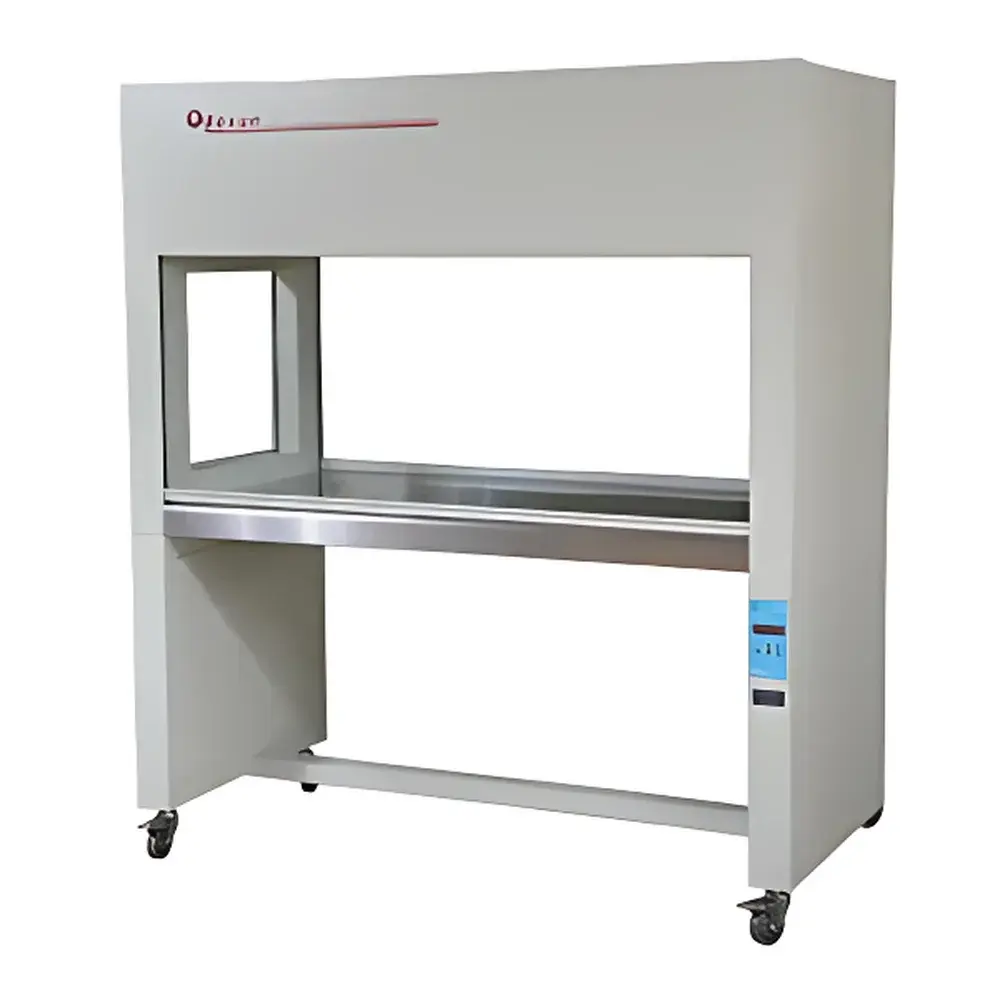
BOXUN SW-CJ-2FD Vertical Laminar Flow Clean Bench
| Brand | BOXUN |
|---|---|
| Origin | Shanghai, China |
| Manufacturer Type | Authorized Distributor |
| Product Category | Domestic |
| Model | SW-CJ-2FD |
| Instrument Type | Vertical Laminar Flow Clean Bench |
| Cleanliness Class | ISO Class 5 (100-level, ≥99.99% filtration efficiency for particles ≥0.5 µm) |
| Noise Level | ≤67 dB(A) |
| User Capacity | Dual-operator, single-front configuration |
| Airflow Pattern | Vertical downward laminar flow |
| Working Surface Air Velocity Range | 0.3–0.6 m/s (adjustable in six discrete steps) |
| Vibration Peak-to-Peak Amplitude | ≤5 µm (X/Y/Z axes) |
| Illumination | ≥300 lux |
| Work Area Dimensions (W×D×H) | 1300 × 650 × 520 mm |
| Overall Dimensions (W×D×H) | 1460 × 700 × 1650 mm |
| HEPA Filter Specification | 1250 × 560 × 50 mm (single unit) |
| Pre-filter | Medium-efficiency panel filter |
| Lighting | 40 W fluorescent lamp (1 unit) |
| UV Germicidal Lamp | 20 W (1 unit, timer-controlled: 0–999 min) |
| Construction Materials | Cold-rolled steel housing with epoxy powder coating |
| Control System | LCD display with tactile membrane switches |
| Counterweight-balanced sash | Adjustable vertical positioning within operational range |
| Power Supply | AC 220 V ±10%, 50/60 Hz |
| Rated Power Consumption | 0.3 kW |
| Net Weight | 200 kg |
Overview
The BOXUN SW-CJ-2FD Vertical Laminar Flow Clean Bench is an ISO Class 5-certified local containment system engineered to deliver unidirectional, particle-free airflow across the work surface via a vertically oriented laminar flow architecture. Operating on the principle of downward laminar air displacement—generated by a precision-controlled centrifugal blower and conditioned through a dual-stage filtration system—the unit maintains a sterile microenvironment suitable for non-hazardous microbiological manipulations, aseptic sample handling, and sensitive instrumentation setup. Unlike biological safety cabinets, this clean bench does not provide personnel or environmental protection against biohazards; rather, it is purpose-built to safeguard samples from ambient airborne contamination in laboratories where sterility assurance is critical but containment of hazardous agents is not required. Its design conforms to core principles outlined in ISO 14644-1 for cleanroom performance verification and aligns with general laboratory infrastructure expectations under GLP-compliant facility planning.
Key Features
- Vertical laminar airflow with adjustable velocity (0.3–0.6 m/s) across the full work surface, ensuring consistent particle removal and low-turbulence operation.
- Dual-stage air filtration: a pre-filter (medium-efficiency panel type) extends service life of the primary HEPA filter (1250 × 560 × 50 mm), rated at ≥99.99% efficiency for particles ≥0.5 µm—meeting ISO 14644-1 Class 5 requirements.
- SUS304 brushed stainless steel work surface resistant to corrosion, chemical exposure, and repeated disinfection cycles; housing constructed from cold-rolled steel with electrostatic epoxy powder coating for durability and cleanability.
- Integrated LCD control panel with tactile membrane switches enabling six-step fan speed selection, independent on/off control for UV germicidal and fluorescent lighting, and programmable UV exposure timing (0–999 minutes).
- Counterweight-balanced front sash allows smooth, tool-free vertical positioning within the designated operational range, enhancing ergonomic access while preserving laminar integrity.
- Acoustically optimized centrifugal blower system achieving ≤67 dB(A) noise emission at 1 m distance—supporting sustained operator comfort during extended procedures.
Sample Compatibility & Compliance
The SW-CJ-2FD supports routine aseptic operations involving cell culture media preparation, microbial inoculation, reagent dispensing, and electronics assembly where particulate exclusion is essential. It is routinely deployed in pharmaceutical QC labs, academic research facilities, biotechnology R&D centers, and environmental testing laboratories. While not certified to NSF/ANSI 49 or EN 12469 (as it lacks inward airflow and negative pressure containment), the unit complies with general electrical safety standards (IEC 61010-1) and mechanical stability criteria per ISO 14644-3. Its construction materials and surface finish meet standard cleaning validation protocols under cGMP Annex 1 (2022) for non-sterile manufacturing support environments. Documentation includes CE-marked components, factory calibration records for airflow uniformity, and HEPA filter certification reports traceable to EN 1822-1.
Software & Data Management
This clean bench operates as a standalone hardware platform without embedded software or network connectivity. All operational parameters—including fan speed setting, UV timer status, and lighting state—are managed locally via the integrated LCD interface. No data logging, remote monitoring, or audit trail functionality is provided. For laboratories requiring electronic recordkeeping or 21 CFR Part 11 compliance, external environmental monitoring systems (e.g., calibrated anemometers, particle counters, or building management interfaces) must be deployed independently. The unit’s mechanical and electrical architecture supports integration into facility-wide preventive maintenance schedules, including scheduled HEPA filter replacement intervals (typically 12–24 months depending on usage and ambient air quality).
Applications
- Aseptic preparation of culture media, buffers, and diluents in microbiology and cell biology laboratories.
- Handling of non-pathogenic microbial strains during isolation, subculturing, and colony picking.
- Assembly and inspection of high-precision optical or electronic components sensitive to particulate deposition.
- Preparation of standard reference materials and calibration standards in analytical chemistry workflows.
- Support function in cleanroom-adjacent areas where full ISO Class 5 room construction is cost-prohibitive but localized particle control remains necessary.
FAQ
Does the SW-CJ-2FD protect the operator from hazardous aerosols or biological agents?
No. This is a clean bench—not a biological safety cabinet—and provides no personnel or environmental protection. It is intended solely for product protection in non-hazardous applications.
What is the recommended frequency for HEPA filter replacement?
Under typical laboratory conditions (8 hrs/day, ISO Class 7 ambient air), replacement is advised every 18–24 months. Actual interval depends on pre-filter maintenance, particulate load, and upstream air quality.
Can the unit be validated for ISO Class 5 compliance?
Yes. Qualification requires third-party testing per ISO 14644-3, including airflow velocity mapping, particle count testing (≥0.5 µm), and filter integrity scanning (e.g., DOP/PAO leak test). BOXUN provides filter certification documentation to support this process.
Is the UV lamp intensity monitored or calibrated?
The unit does not include built-in UV radiometry. Users must perform periodic verification using a NIST-traceable UV-C radiometer, especially before critical sterilization tasks.
What electrical infrastructure is required for installation?
A dedicated 220 V ±10%, 50/60 Hz circuit with minimum 16 A rating and proper grounding is mandatory. Voltage fluctuations exceeding tolerance may affect blower stability and control system reliability.
Related Products



