
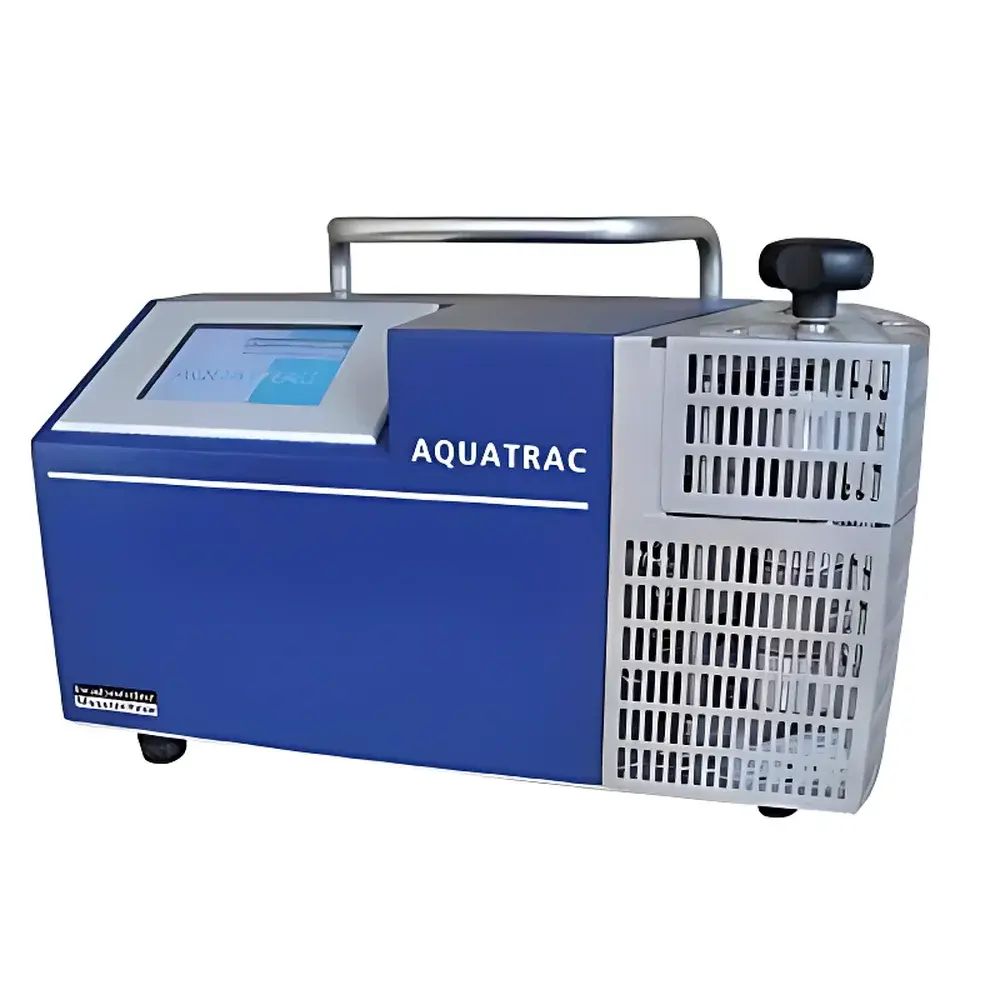
Brabender AQUATRAC-3E Plastic Pellet Moisture Analyzer
| Brand | Brabender |
|---|---|
| Origin | Germany |
| Model | AQUATRAC-3E |
| Measurement Principle | Calcium Hydride (CaH₂) Reaction Method |
| Moisture Range | Three selectable ranges — <0.1%, 0.1–0.5%, >0.5% (w/w) |
| Sample Weight | 0.1–100 g (range-dependent) |
| Test Duration | 10–30 min (sample-dependent) |
| Temperature Control | 60–200 °C, adjustable in 1 °C increments |
| Output Units | % H₂O or ppm |
| Accuracy | ±2% of reading or ±1% of range |
| Repeatability | ±1% of range |
| CaH₂ Cartridge Capacity | ≥1,000 tests per standard cartridge |
Overview
The Brabender AQUATRAC-3E Plastic Pellet Moisture Analyzer is a benchtop-to-floor portable instrument engineered for precise, rapid quantification of trace moisture content in thermoplastic granules, engineering resins, and hygroscopic polymer feedstocks. It operates on the well-established calcium hydride (CaH₂) reaction principle: water in the sample reacts stoichiometrically with CaH₂ to produce hydrogen gas; the evolved gas volume—measured volumetrically under controlled temperature and pressure—is directly proportional to the mass of water present. This method delivers high specificity for free and bound water without interference from solvents, volatiles, or polymer matrix components—making it particularly robust for quality control in polyamide (PA6, PA66), polycarbonate (PC), polybutylene terephthalate (PBT), and polyethylene terephthalate (PET) processing environments.
Key Features
- Three user-selectable moisture ranges (0.5% w/w) enable optimal sensitivity and dynamic response across diverse resin types and drying conditions.
- Programmable temperature control (60–200 °C, 1 °C resolution) allows optimization of reaction kinetics for challenging matrices—including crystalline nylons and reinforced composites—without thermal degradation.
- Integrated volumetric gas measurement system with temperature-compensated transducer ensures stable calibration over extended operational cycles.
- Compact, ruggedized housing with ergonomic carry handle and optional battery pack supports true at-line deployment: from warehouse receiving bays to extruder hoppers and injection molding cells.
- Self-contained CaH₂ reagent cartridges (≥1,000 determinations per unit) minimize handling risk, reduce operator exposure, and eliminate daily reagent weighing or titration setup.
- Non-destructive sample recovery option available for post-test material verification or further analysis (e.g., FTIR, DSC).
Sample Compatibility & Compliance
The AQUATRAC-3E accommodates solid granular, flake, and pelletized samples ranging from 0.1 g (for ultra-low-moisture engineering plastics) to 100 g (for heterogeneous blends or low-sensitivity screening). It complies with ASTM D6980–22 (“Standard Test Method for Determination of Moisture in Plastics by Calcium Hydride Method”) and aligns with ISO 15512:2019 requirements for moisture determination in plastics. Its design supports GLP-compliant workflows through manual logbook integration and meets foundational traceability criteria for GMP-regulated polymer manufacturing (e.g., medical-grade tubing, automotive interior components). While not inherently 21 CFR Part 11 compliant, its output data can be imported into validated LIMS or ELN systems supporting audit trail generation.
Software & Data Management
The AQUATRAC-3E operates via intuitive front-panel controls with real-time display of gas evolution curve, temperature profile, and final %H₂O or ppm result. No proprietary software is required for basic operation; however, optional RS-232/USB interface enables direct data export to CSV or Excel-compatible formats for statistical process control (SPC) charting, batch reporting, and trend analysis. All measurements are timestamped and associated with user-defined sample IDs—supporting documentation integrity during internal audits or supplier qualification reviews.
Applications
- Receiving inspection of inbound plastic pellets to verify compliance with supplier moisture specifications (e.g., ≤0.02% for PA6 before injection molding).
- In-process monitoring of desiccant dryer efficiency—correlating residual moisture with dew point, airflow, and residence time.
- Validation of drying protocols prior to extrusion or compounding, especially for moisture-sensitive polymers requiring <50 ppm pre-processing.
- Blending homogeneity assessment: quantifying moisture distribution across multi-component formulations (e.g., PC/ABS blends, glass-filled PBT).
- Root-cause analysis of surface defects (splay, silver streaking) and mechanical property deviations linked to undetected moisture ingress.
- Supporting ISO 9001:2015 Clause 8.5.1 (Control of production and service provision) and IATF 16949:2016 requirements for process validation in automotive polymer supply chains.
FAQ
What types of plastics are compatible with the AQUATRAC-3E?
The analyzer is validated for all major thermoplastics—including polyamides, polyesters, polycarbonates, acrylics, and polyolefins—as well as filled and reinforced grades. It is not intended for thermosets, elastomers, or solvent-based slurries.
Does the instrument require routine calibration with certified standards?
Yes. Annual verification using NIST-traceable moisture standards (e.g., potassium tartrate monohydrate) is recommended. The built-in zero-check function and CaH₂ blank subtraction mitigate drift between calibrations.
Can test results be integrated into our existing MES or ERP system?
Direct integration is achievable via ASCII data streaming over serial/USB; custom API development is supported through Brabender’s OEM partner program for enterprise-level deployment.
How does the CaH₂ method compare to Karl Fischer titration for plastic analysis?
Unlike KF—which may overestimate moisture due to side reactions with aldehydes or acidic additives—the CaH₂ method measures only chemically reactive water, offering superior selectivity and reproducibility for polymer granules without sample dissolution or solvent handling.
Is operator training required for regulatory compliance?
Basic operation requires ≤2 hours of instruction. For GLP/GMP environments, documented competency assessment and SOP adherence (per ASTM D6980 Annex A1) are mandatory prior to routine use.





