
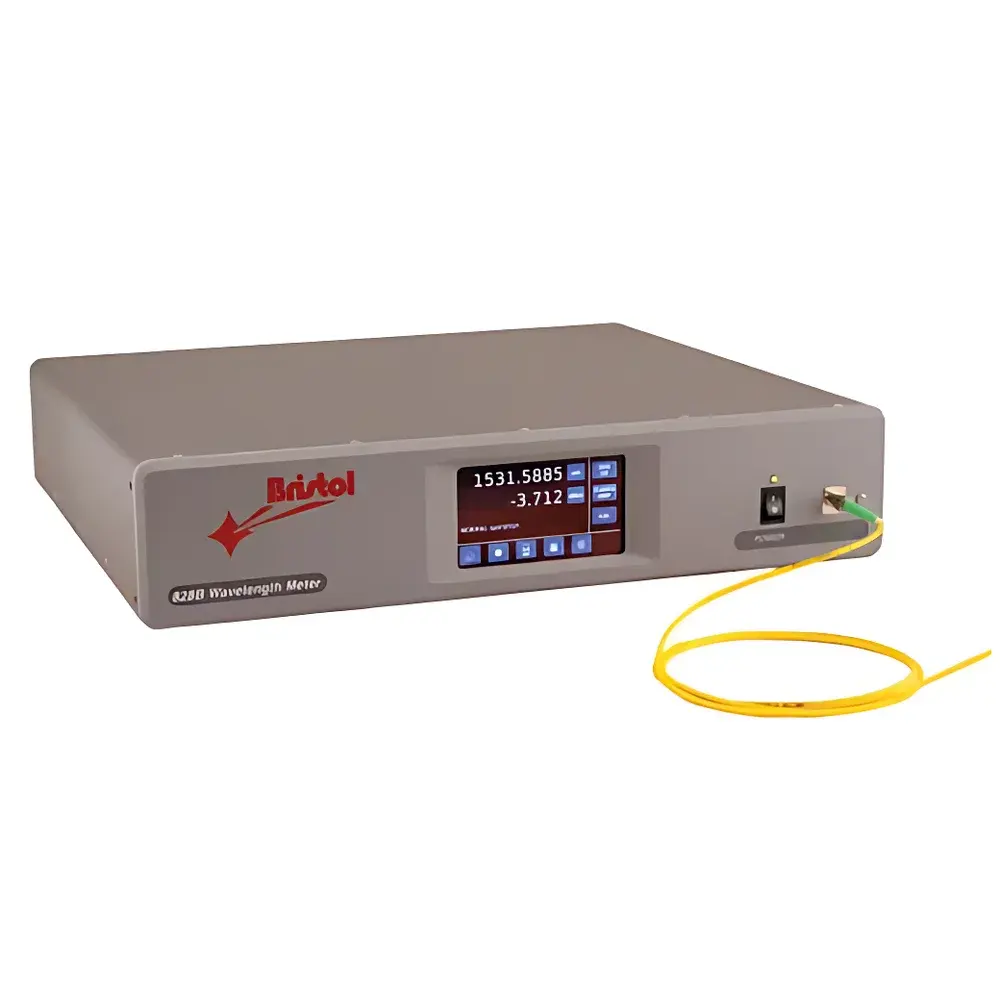
Bristol 828B High-Speed Optical Wavelength Meter for Telecommunications
| Brand | Bristol |
|---|---|
| Origin | USA |
| Model | 828B |
| Wavelength Range | 1250–1650 nm (182–240 THz) |
| Absolute Accuracy | ±0.65 ppm (±1.0 pm @ 1550 nm) |
| Repeatability | ±0.2 ppm |
| Calibration Source | Internal NIST-traceable HeNe laser |
| Measurement Rate | 1000 Hz |
| Power Measurement Accuracy | ±0.5 dB (within ±30 nm of 1310/1550 nm) |
| Minimum Input Power | –40 dBm @ 100 Hz (0.1 µW) |
| Maximum Input Power | +10 dBm (display), +18 dBm (safe) |
| Display Resolution | 0.0001 nm |
| Output Units | nm, cm⁻¹, THz |
| Interface | USB 2.0, Ethernet (GPIB optional) |
Overview
The Bristol 828B High-Speed Optical Wavelength Meter is a precision metrology instrument engineered for real-time, high-fidelity wavelength and optical power characterization of lasers used in dense wavelength division multiplexing (DWDM) systems, coherent optical transmission, tunable laser source development, and fiber-optic component qualification. Operating on the principle of high-resolution interferometric heterodyne detection, the 828B delivers traceable, absolute wavelength measurements across the full telecommunications C- and L-bands (1250–1650 nm / 182–240 THz), with no reliance on external reference standards during operation. Its core architecture integrates a thermally stabilized, long-life HeNe laser serving as an internal NIST-traceable wavelength reference—enabling continuous, autonomous recalibration without manual intervention or system downtime. This design ensures metrological integrity under varying environmental conditions and supports long-term stability required for production-line testing and R&D validation in ISO/IEC 17025-accredited laboratories.
Key Features
- Real-time measurement rate up to 1000 Hz—enabling dynamic tracking of wavelength drift, mode hops, and tuning transients in rapidly swept or modulated lasers.
- Absolute wavelength accuracy of ±0.65 ppm (±1.0 pm at 1550 nm) and repeatability of ±0.2 ppm—meeting stringent requirements for ITU-T G.694.1 channel grid compliance verification.
- Simultaneous wavelength and optical power measurement per channel, with power accuracy of ±0.5 dB within ±30 nm of 1310 nm and 1550 nm reference wavelengths.
- Wide dynamic input range: –40 dBm minimum detectable power (at 100 Hz update rate) to +18 dBm maximum safe input—compatible with low-power DFBs, high-power ECLs, and amplified spontaneous emission (ASE) sources.
- Integrated NIST-traceable HeNe reference laser providing continuous in-situ calibration—eliminating periodic recalibration cycles and reducing measurement uncertainty budget contributions from external references.
- Standard USB 2.0 and 10/100/1000BASE-T Ethernet interfaces; GPIB option available for legacy ATE integration and SCPI-compliant remote control in automated test environments.
Sample Compatibility & Compliance
The 828B accepts continuous-wave (CW) and externally modulated laser sources—including DFB, DBR, ECL, VCSEL, and fiber lasers—without requiring optical isolation or polarization control. Its free-space input port accommodates standard FC/PC or FC/APC connectors via optional collimator modules. The instrument complies with IEC 61326-1 (EMC for laboratory equipment) and IEC 61010-1 (safety requirements for electrical equipment). All factory calibrations are performed per ISO/IEC 17025 procedures and documented with NIST-traceable certificates. Data logging and audit trails support GLP/GMP workflows, and firmware includes configurable user access levels aligned with FDA 21 CFR Part 11 electronic record requirements when deployed with validated software platforms.
Software & Data Management
The 828B ships with Windows-compatible Metrology Suite software, offering real-time waveform visualization, statistical process monitoring (SPC), pass/fail thresholding against ITU channel plans, and export to CSV, XML, or HDF5 formats. Remote operation is supported via TCP/IP socket commands or SCPI over Ethernet/USB. For enterprise integration, the instrument exposes RESTful API endpoints and supports OPC UA server configuration—enabling seamless data ingestion into MES, LabVantage, or custom Python-based analysis pipelines. All measurement metadata—including timestamp, environmental sensor readings (optional internal temperature/humidity), and calibration history—is embedded in exported files to satisfy ALCOA+ data integrity principles.
Applications
- DWDM transmitter characterization and channel spacing verification in manufacturing and field deployment.
- Dynamic wavelength stability assessment of tunable lasers during thermal sweep, current ramp, and modulation stress tests.
- Optical filter passband mapping and wavelength-dependent loss (WDL) analysis using swept-source excitation.
- Reference laser stabilization validation for optical frequency combs and atomic clock applications.
- Component-level testing of arrayed waveguide gratings (AWGs), thin-film filters, and MEMS-tuned resonators.
- Calibration transfer between primary wavelength standards and secondary lab instruments in metrology institutes.
FAQ
Does the 828B require periodic external recalibration?
No—the integrated HeNe laser provides continuous, in-situ NIST-traceable calibration; only annual verification by an accredited lab is recommended for ISO/IEC 17025 compliance.
Can the 828B measure multiple wavelengths simultaneously in a multi-channel DWDM signal?
Yes—it resolves individual channel wavelengths and powers in real time without demultiplexing, provided channel spacing exceeds its spectral resolution limit (~1.5 GHz FWHM).
Is polarization sensitivity a concern for measurement accuracy?
The 828B employs polarization-diverse interferometry; polarization-dependent error is < ±0.05 pm across all SOP states—no polarization controller is needed for routine use.
What is the typical warm-up time to achieve specified accuracy?
Less than 30 minutes after power-on; full thermal stabilization of the interferometer cavity and HeNe reference occurs within 45 minutes.
How is traceability maintained when using optional GPIB or third-party software?
All communication protocols preserve original measurement timestamps, calibration IDs, and uncertainty budgets; firmware enforces write-protected audit logs for all configuration changes.






