
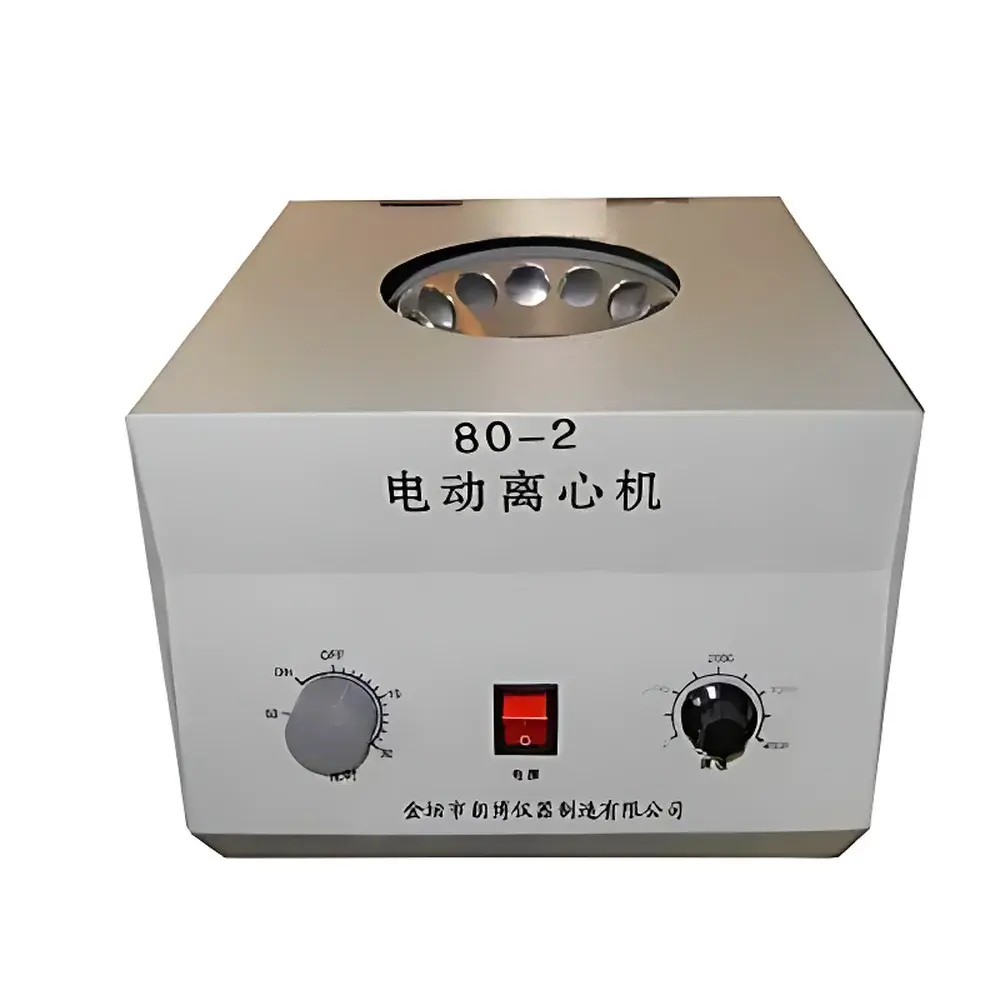
Brookfield 80-2 Benchtop Centrifuge
| Origin | Jiangsu, China |
|---|---|
| Manufacturer Type | Authorized Distributor |
| Origin Classification | Domestic (PRC) |
| Model | 80-2 |
| Price | USD 115 |
| Capacity | 12 × 20 mL |
| Max Speed | 4000 rpm |
| Max RCF | 1795 × g |
| Speed Control | Continuously Variable (Analog Knob) |
| Power Supply | 220 V AC, 50 Hz |
Overview
The Brookfield 80-2 benchtop centrifuge is a mechanically robust, analog-controlled laboratory centrifuge engineered for routine sample separation in clinical, educational, and quality control laboratories. It operates on the principle of sedimentation under radial acceleration—utilizing rotational force to separate components of heterogeneous mixtures based on differences in density, particle size, and molecular weight. With a maximum rotational speed of 4000 rpm and a corresponding relative centrifugal force (RCF) of 1795 × g, the 80-2 delivers consistent performance for low-to-medium speed applications including cell pelleting, serum/plasma separation, precipitate recovery, and basic nucleic acid or protein isolation workflows. Its compact footprint and fixed-angle rotor configuration support rapid turnaround without requiring refrigeration or vacuum sealing—making it ideal for ambient-temperature protocols where thermal stability is not critical.
Key Features
- Fixed-angle rotor accommodating twelve 20 mL conical or round-bottom tubes (compatible with standard polypropylene and glass centrifuge tubes)
- Continuously variable analog speed control via calibrated front-panel knob—enabling precise manual adjustment across the full 0–4000 rpm range
- Stainless steel rotor chamber and reinforced polymer housing for long-term mechanical durability and resistance to chemical splashes
- Automatic safety cut-off triggered by lid interlock; motor deactivates immediately upon lid opening during operation
- Low-noise brushless DC motor design with thermal overload protection to ensure stable performance during extended runs
- No refrigeration system—optimized for room-temperature separations where sample integrity is unaffected by ambient thermal conditions
Sample Compatibility & Compliance
The 80-2 supports standard 20 mL centrifuge tubes meeting ISO 8573-1 Class 4 purity requirements for plasticware. Tube compatibility includes common materials such as polypropylene (PP), polycarbonate (PC), and borosilicate glass—provided wall thickness and dimensional tolerances fall within ANSI/CLSI GP31-A6 specifications for centrifuge tube safety. While the unit does not carry IEC 61010-1 certification for hazardous environments, it complies with general-purpose electrical safety standards applicable to non-explosive, non-medical-grade laboratory equipment per GB 4793.1–2007 (equivalent to IEC 61010-1:2010 Ed.3). It is routinely deployed in GLP-aligned workflows where documentation of operational parameters (speed, duration) is maintained manually in lab notebooks.
Software & Data Management
The 80-2 is a stand-alone analog instrument with no embedded microprocessor, digital display, or data logging capability. All operational parameters—including run time—are set manually using mechanical timers (optional external timer recommended for reproducibility). No firmware, USB interface, or PC connectivity is provided. For regulated environments requiring audit trails, users integrate the device into existing SOPs by recording speed setting (via calibrated dial position), duration, and rotor load distribution in bound logbooks. This architecture aligns with minimal-compliance instrumentation strategies used in teaching labs and QC departments operating under simplified quality systems (e.g., ISO/IEC 17025 Clause 6.4.3 for equipment suitability).
Applications
- Routine blood fractionation: separation of whole blood into packed red cells, buffy coat, and platelet-poor plasma
- Microbial culture harvesting: pelleting E. coli, yeast, or Bacillus spp. from LB or TSB media prior to lysis or storage
- Environmental sample processing: clarification of soil leachates or wastewater filtrates prior to spectrophotometric or ion chromatographic analysis
- Educational demonstrations: illustrating sedimentation kinetics, Stoke’s law validation, and RCF vs. RPM relationships in undergraduate physics and biochemistry labs
- Preparative chemistry: recovery of crystalline precipitates from reaction mixtures following solvent quenching or pH adjustment
FAQ
Is the 80-2 suitable for use with infectious or biohazardous samples?
No. The unit lacks sealed rotor containment, aerosol-tight lid gasketing, or biosafety certification (e.g., NSF/ANSI 49). It must be operated only with non-pathogenic, non-toxic, and non-volatile samples.
Can I use 15 mL tubes in the 20 mL rotor buckets?
Yes—provided tubes are placed upright with balanced mass distribution and do not exceed the 20 mL fill line. Always verify tube compatibility with rotor geometry before initiating rotation.
Does the 80-2 meet FDA 21 CFR Part 11 requirements?
No. As an analog-only device with no electronic data capture, it falls outside the scope of Part 11 compliance. Electronic records must be generated externally and linked via procedural controls.
What maintenance schedule is recommended?
Rotor inspection every 6 months for corrosion or deformation; lubrication-free operation eliminates bearing servicing. Clean chamber weekly with 70% ethanol; avoid chlorine-based disinfectants on stainless surfaces.
Is calibration traceable to national standards?
Speed calibration may be verified using a NIST-traceable handheld tachometer. Factory calibration certificates are not supplied; users must establish internal verification protocols per ISO/IEC 17025 Section 6.5.



