
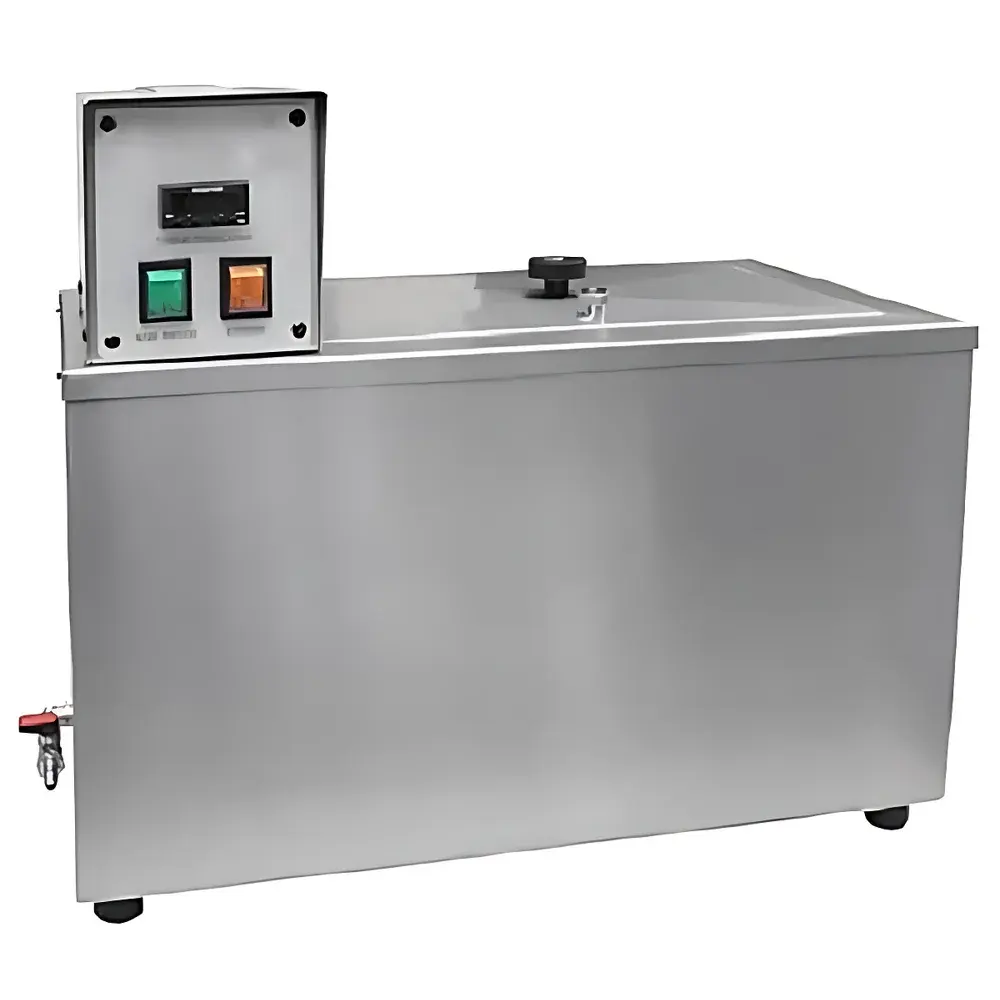
Brookfield D130 Petroleum Copper Strip Corrosion Tester
| Origin | Switzerland |
|---|---|
| Manufacturer Type | Authorized Distributor |
| Origin Category | Imported |
| Model | D130 |
| Pricing | Upon Request |
Overview
The Brookfield D130 Petroleum Copper Strip Corrosion Tester is a precision-engineered laboratory instrument designed to evaluate the corrosivity of petroleum products toward copper and silver metals in accordance with internationally recognized standard test methods. It operates on the principle of controlled thermal exposure: a polished copper (or silver) strip is immersed in the test sample and held at a specified temperature for a defined duration under reflux conditions. Following exposure, the strip’s surface is visually compared against standardized ASTM corrosion rating scales to determine the degree of tarnish, discoloration, or pitting—quantitative indicators of active sulfur compounds, mercaptans, hydrogen sulfide, or other corrosive species present in the hydrocarbon matrix. This gravimetric–visual assessment method forms the basis of ASTM D130, IP 154, IP 227, DIN 51759, and ISO 2160, and is routinely applied in refinery QC labs, fuel certification facilities, and aviation fuel quality assurance programs where material compatibility with copper-bearing components (e.g., fuel lines, injectors, heat exchangers) must be verified prior to distribution.
Key Features
- Fully stainless-steel construction (AISI 316 grade), ensuring long-term resistance to aggressive hydrocarbon vapors and acidic condensates during extended reflux cycles.
- 26 L capacity thermostatically controlled bath, enabling simultaneous testing of multiple sample vessels while maintaining uniform thermal stability across the working volume.
- Digital PID temperature controller with ±0.3 °C accuracy over the full operating range (ambient to 100 °C), integrated with PT100A Class A platinum resistance thermometer for traceable calibration.
- Overtemperature protection circuit with audible/visual alarm and automatic heater cutoff, compliant with IEC 61000-6-2 electromagnetic immunity requirements.
- Tapered condenser lid with precision-machined reflux geometry to minimize vapor loss and ensure consistent condensate return during prolonged tests (up to 3 h per ASTM D130).
- Motor-driven magnetic stirrer (0–300 rpm, adjustable) providing uniform heat transfer and preventing localized hot spots around immersed metal strips.
- Integrated cooling loop interface compatible with external chiller units (e.g., 10–25 °C supply) for rapid post-test bath cooldown and improved lab throughput.
Sample Compatibility & Compliance
The D130 tester accommodates a broad spectrum of volatile and non-volatile petroleum derivatives, including aviation gasoline (AVGAS), jet turbine fuels (Jet A, Jet A-1), motor gasoline (including ethanol-blended variants), natural gasoline, kerosene, diesel fuel (EN 590, ASTM D975), distillate heating oils, lubricating base stocks, and low-RVP (<124 kPa / 18 psi) hydrocarbon solvents used in dry-cleaning or parts washing. Silver strip testing per ASTM D130 Annex A is supported using optional silver-grade test strips and dedicated holder fixtures. All operational protocols adhere strictly to ASTM D130 Section 7 (Apparatus Requirements), ISO 2160 Clause 5 (Test Apparatus), and IP 154 Appendix B (Bath Temperature Uniformity Validation). Instrument documentation includes a factory-issued calibration certificate traceable to NIST standards and a conformity statement aligned with EU Machinery Directive 2006/42/EC.
Software & Data Management
While the D130 operates as a standalone analog-digital hybrid system without embedded PC software, its temperature controller supports RS-485 Modbus RTU output for integration into centralized lab data acquisition networks (e.g., LabVantage, Empower, or custom SCADA platforms). Logged temperature profiles—including setpoint, actual bath temperature, and alarm event timestamps—are exportable via USB or serial interface in CSV format. Audit trail functionality complies with FDA 21 CFR Part 11 requirements when paired with validated third-party electronic lab notebook (ELN) systems. Calibration records, preventive maintenance logs, and operator training documentation are structured to support GLP and ISO/IEC 17025 accreditation audits.
Applications
- Refinery final product release testing for copper corrosion compliance prior to pipeline shipment or aviation fuel dispatch.
- Monitoring sulfur scavenger efficiency in hydrotreated naphthas and middle distillates.
- Quality control of additive packages containing copper deactivators (e.g., benzotriazoles) in lubricant formulations.
- Investigation of storage-induced degradation in biodiesel blends (B5–B20) exposed to copper catalytic surfaces.
- Supporting ASTM D3241 (Jet Fuel Thermal Oxidation Stability) by pre-screening feedstock corrosivity.
- Contract laboratory testing for ISO 8217 marine fuel certification (residual and distillate grades).
FAQ
What standards does the D130 fully comply with?
ASTM D130, IP 154, IP 227, DIN 51759, and ISO 2160 — all verified via third-party metrological validation report included with shipment.
Can the instrument perform silver strip corrosion testing?
Yes, with optional silver strip holders and certified silver test strips; procedure follows ASTM D130 Annex A and IP 154 Appendix C.
Is the temperature uniformity across the 26 L bath validated?
Yes — uniformity mapping per ASTM D130 Section 7.2 confirms ≤±0.5 °C deviation at 50 °C and 100 °C across nine spatial points.
What maintenance intervals are recommended?
PT100A probe recalibration annually; condenser cleaning after every 50 test cycles; stirrer motor inspection every 6 months per manufacturer’s service manual.
Does the unit meet electrical safety standards for use in Zone 2 hazardous areas?
No — it is rated for general laboratory use only (IEC 61010-1 CAT II); explosion-proof modifications require OEM engineering review and cannot be field retrofitted.



